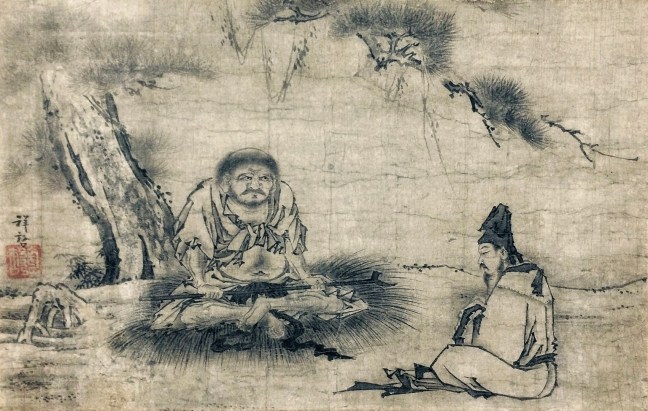
Huang Po

’Zen Encounter (Niaoke Daolin and Bai Juyi)’ – Kenko Shokei, 16th AD – Wikimedia

.

This Dharma is Mind, beyond which there is no Dharma;
and this Mind is the Dharma, beyond which there is no mind.”
~ Huang Po (Ch.7)

.

Every religion has its mystical counterpart, where beliefs, rituals, and book studies are replaced by self-investigation, direct experience, and understanding. Buddhism is no exception. Out of the nimbus of Buddha’s awakening came a single practice called by the simple word ‘chán’, which means ‘meditation’ (‘dhyāna’ in Sanskrit). Bound by the rigorous practice of watching their mind and recognising its true nature — which is called Buddha-Nature in Buddhism — a whole dynasty of influential Patriarchs and Masters have transmitted this tradition known as Zen in the West. Huang Po was one such eminent Chinese Master. His concise work called ‘On the Transmission of Mind’ is one of the world’s major expositions of truth. Recorded by the scholar of the time P’ei Hsiu, this collection of Huang Po’s sayings and sermons opens with this simple, illuminating phrase:

.
All the Buddhas and all sentient beings
are nothing but the One Mind,
beside which nothing exists.”
~ Huang Po (Ch.1)

.
In this book, Huang Po wants to make very clear and very simple, that all understanding, all mystery, all the content of Zen practice, is to be found here, in ourself, as ourself, as our Mind, and that this Mind of ours, of all of us, is the Buddha. In other words, what we take to be our everyday little, separate, private self is, when investigated, nothing but the one supreme being that we share with all other beings. This understanding is what Huang Po calls the Way. This is the only recognition that we need:

.
To awaken suddenly to the fact
that your own Mind is the Buddha,
that there is nothing to be attained
or a single action to be performed –
this is the Supreme Way.”
~ Huang Po (Ch.13)

[…]

Read more about the teaching of Chinese Zen master Huang Po… (READ MORE…)

.

Defining Enlightenment

‘Saint Augustine’ (detail) – Philippe de Champaigne, 1645 – Wikimedia

.

A thunderclap under the clear blue sky
All beings on earth open their eyes;
Everything under heaven bows together;
Mount Sumeru leaps up and dances
.”
~ Wumen Huikai (enlightenment poem)

.

The words for the discovery of our true nature — like enlightenment, realisation, awakening, liberation, etc — are all very significant. They all point to truth and have numerous things to say. Take ‘enlightenment’ for instance. Its original signification is ‘to shine’ or ‘to make luminous’. So to enlighten means to put the light on. It means to cease being distracted by all that is objective in our experience and doesn’t define us truly, and make what is already and absolutely ours here and now apparent. It doesn’t mean to achieve, to reach, to attain, to get something new. Where did we get this idea from? But let’s be very cautious here: to make luminous — does this even require a doing? Why should we have anything to do when the light is already fully on? So to be enlightened is really more a matter of noticing what is already here, and that we have missed due to a pathological phenomenon of blindness. We are too occupied with a thousand things, worried, concerned, busy with this and that, distracted, ambitious, desiring, grasping, expecting, and god only knows what else we have in mind to so successfully avoid seeing the patently obvious. Our true reality and identity as consciousness is already present, luminous and shining in every corner of our experience and we are blind to it. That’s where the word ‘realisation’ comes in.

[…]

An essay exploring the signification of enlightenment… (READ MORE…)

.

Blown Out

We continue our series of texts or essays on different subjects of spiritual interest. The question here is about ‘having a spiritual experience’, and delving into the nature of what is called ‘awakening’…


There is a safe place in view of all, but difficult of approach,
where there is no old age nor death, no pain nor disease.
It is what is called nirvāṇa, or freedom from pain, or perfection;
it is the safe, happy, and quiet place which the great sages reach.
That is the eternal place, in view of all, but difficult of approach.

~ Uttaradhyana Sutra, 81-4 (Buddhism)


Nothing much, really. Something just like peeking out of the window. But let’s not be overly disdainful, for this can bend the course of a life and change it in a profound way. To have a spiritual experience is a blessing, a call, maybe a rehearsal for the final dissolution. It leaves you puzzled, wanting to understand, and above all, searching to have it again in the future. It can be just a flavour suddenly lingering at the back of your mind, or a spectacular awakening, or anything in between. In all cases, you meet something new, that is outside any known experience, and yet has a familiar flame, like an old forgotten memory. Above all, peace, love, and happiness are attached to it. It is the DNA of any genuine experience, its vital core, and what makes it so desirable. After all, do we want anything in life but a lasting happiness? It can last for seconds, minutes, or days. It comes as a grace, unexpected, uninvited. One important characteristic is that it fades away, finally disappears. Otherwise we wouldn’t call it an ‘experience’. A spiritual experience is an awakening that failed.

An essay to delve into the nature of Awakening (READ MORE…)