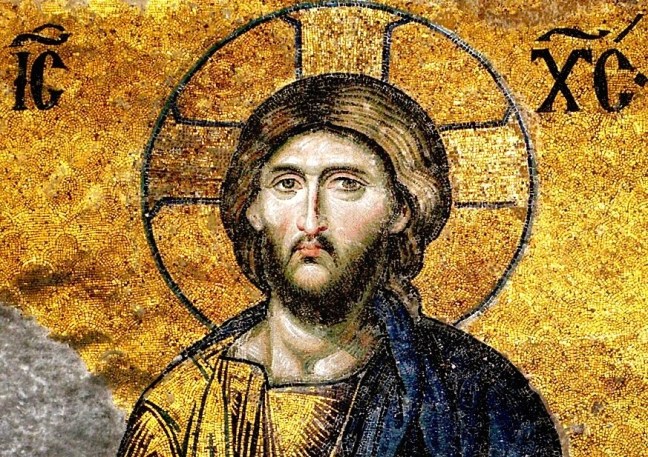
‘Christ Pantocrator mosaic in Hagia Sophia, Istanbul’ – Unknown, 13th AD – Wikimedia
.
Sometimes, the simplest questions are the ones never asked. Like, for example: ‘What is ‘Christ’?’ Were we ever curious about it? To know why this word was chosen to represent what it represents. Don’t we want to know? A word that has lent itself to a whole religion, that has been used to name a person —Jesus — who was worshipped for millennias, who is nothing less but the son of God, and who claims to be the solution to the relief of our suffering, to our being cleansed of our faults, and to our being reborn, resurrected, and blessed eternally. Don’t we want to know, to approach it with an inquisitive mind? Just once?
But it’s like we are being afraid. A sort of strange ‘fear of god’ that we have deep down, both as lovers of god or as atheists. Especially in religious matters, where it feels that we are often satisfied with a hazy understanding, a shaky belief, or a quick judgement, and are never prone to go deeper than that. ‘This is too big for us! Too remote! Where too much is at stake! So we’re not going to shake that boat! Not now!’ And so… This is how we keep a simple misunderstanding safe, how we keep an old stale belief alive, and how we keep at bay the truth of who we are… but we’re not going to do that now. Now is for truth. Now we have come to know at last! And one way to start an inquiry, in our highly conceptualised world, is to humbly dig for the etymology of the word that defines the thing we want to know about. That usually reveals some deeply buried secrets. So…
‘Christ’ comes from the Greek word ‘
chrīstós’ meaning the ‘anointed one’. A meaning that is shared with the Hebrew word ‘
mašíaḥ’, translated as Messiah. To be anointed is to be smeared or rubbed with oil, typically in a ceremonial way. It is a form of consecration, of elevation. It was used throughout history in multiple ways, for example as a form of medicine, or for the blessing of a king, or to attract the influence of the divine. But behind all the pompousness of it, is simply an act of redemption: We want to be happy, to be brought back to a state of health and harmony. It is the desire to elevate ourself from our conditioned ways of thinking and believing, and find the peace that we all think to deserve. It is the longing to be relieved from our suffering, and to rest at last in our own glorious being.
[…]
An exploration of the meanings hidden in the word ‘Christ’… (READ MORE…)
.

 The Dawn Within