
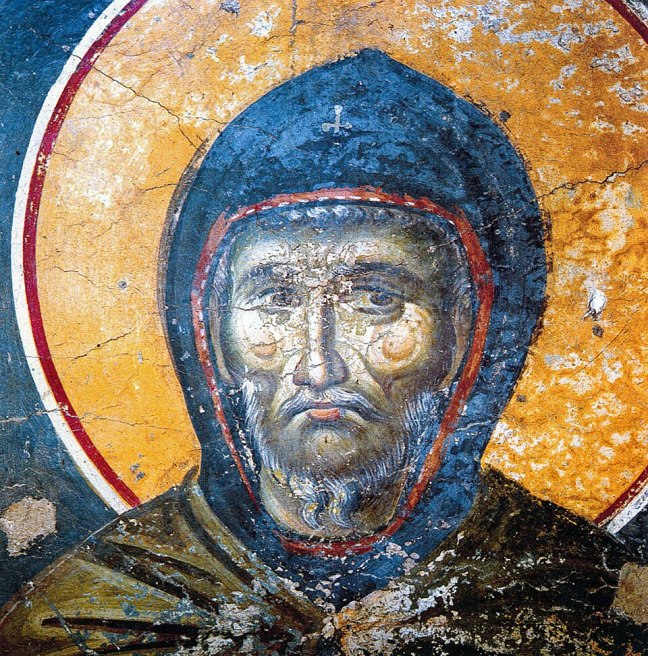
Fresco of Ephrem the Syrian, 14th AD (part) – Protaton Church, Mt Athos – Wikimedia
.
If you go for its gems, you will find the Christian tradition to be unbelievably rich of the highest wisdom. The work of Ephrem the Syrian is one such gem. He was a prominent Christian theologian and hymnographer born in 303 AD, expressing himself in the Classical Syriac language of early Christianity, in the eastern part of modern-day Turkey. But he was also known for his outstanding poetry, which he used as a vehicle for theologian purposes. Over four hundred of his hymns have come down to us, and many more got lost along the way, that have earned him the title of ‘Harp of the Holy Spirit’. It is said that his poetic descriptions of the Last Judgment influenced Dante Alighieri in some sections of the Divine Comedy. There is no doubt that he had a passion to put his long years of studying and reading into the fire of experience, as can be felt in this eloquent verse:
.
“On a certain day a pearl did I take up, my brethren;
I saw in it mysteries pertaining to the Kingdom;
Semblances and types of the Majesty;
It became a fountain, and I drank out of it mysteries of the Son.”
~ The Pearl, Seven Hymns on the Faith (1:1)
.
Ephrem the Syrian is said to have been baptised as a young man, and to have been a deacon, with a more limited liturgical role than a priest, and a duty centred on service. He had a great knowledge of the Scriptures and was devoted to his mission as a teacher. He made theology accessible through his poetry, and is recognised as one of the first to introduce songs into the Church’s public worship. He was eager to transmit his passion and devotion in whatever way was possible to him.
.
“In its brightness I beheld the Bright One Who cannot be clouded,
And in its pureness a great mystery,
Even the Body of Our Lord which is well-refined:
In its undivideness I saw the Truth
Which is undivided.”
~ The Pearl, Seven Hymns on the Faith (1:1)
.
There is no doubt that he was an influential man, being honoured with titles like the ‘Sun of the Syrians’, or the ‘Column of the Church’. He lived a simple, ascetic life, embracing the ideals of poverty and celibacy. During the last decade of his life, he moved to Edessa, and stayed there in a small cave overlooking the city, devoting his time to his writings. In Hymns on Faith (VIII.9), he stressed that “the intellect was not intended to pry into hidden things”, emphasising the fact that our deepest identity as being cannot be understood conceptually, through the mind, but is a living, subjective reality. In his Hymns on Paradise, he described this with these exquisite words:
.
“Your nature is far too weak
to be able
to attain to its greatness,
and its beauties are much diminished
by being depicted in the pale colors
with which you are familiar.”
~ Hymn on Paradise, XI:7
[…]
Discover the hymns of ancient theologian Ephrem the Syrian… (READ MORE…)
.
 The Dawn Within