The Ultimate

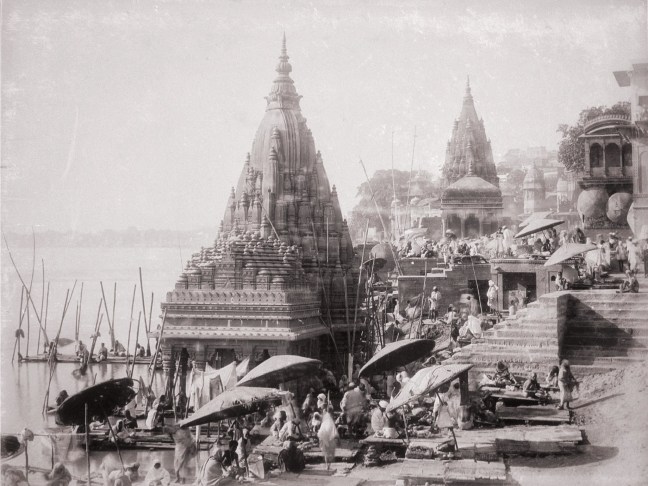
‘Benares, Temple of Tarhishwara or Well of Manikarankia – Samuel Bourne, 1860 – Wikimedia

The thing in ourself that has the capacity to know anything is itself not a thing. We can only exist in relation to things, but only the state of no-thing can we ever truly be. The illusion that we are something separate, a self — whatever we are — is due to the knowing of an object. When no such objective knowing is being activated, then there is no necessity to be anything. There is no purpose in being a self. The being that we appear to be is realised as void. And without a self to know them, things have no support for their reality. Within that perspective, all things dis-appear, are swallowed back into no-thingness, into where they have never ceased to be. This ultimate realisation is in fact not a realisation. It is the ultimate truth contained in simply being, when all duality has been nipped in the bud, unable to show any reality as such, lost in a being so subjective that nothing can be there which could be formed and recognised as ‘other’. This is the end of form. It is the state of no-thing that cannot be spoken of. It can only be approached, envisaged, but never lived as an objective experience, or from the position of an experiencer. It is the timeless, objectless point where the moth dis-appears into the flame of being. Its identity as ‘moth’ has been dis-qualified from itself to never be formed again. Now engulfed into the very no-thing that we are when all objectivity has dis-appeared, we are left with being, our pure essence, where no form could ever be formed. This is in fact, paradoxically, how a world, a thought, anything, can seem to appear — through the intercession of formlessness. This place is where we can never go. This thing is what we can never be. World, thought, self, death, bondage, liberation, are only the gaming of god, or infinite being, with no reality of their own. Only at the point of un-being, of coming to an end, can we ever be true, ultimate being. This is what ‘ultimate’ in fact means: ‘to come to an end’. To cease being anything is the ultimate truth of life. What is left is pure, essential, unqualified, infinite being, where no self or world could ever come to be. This, truly, is the ultimate. That ultimate, because of its purity, can bear in itself the illusion of being coloured or stained; because of its essentiality, can be divided in an endless chain of cause and effect; because of its unqualified nature, can adopt any form or quality; in reason of its unknowability, can be known through a multiplicity of names; and because of its infinite nature, can be seemingly separated as a multitude. And it does this without ever ceasing to be the ultimate. Now, know in all occasions that you are not a suffering self lost in the multitude, with a name, a form, and qualities — an entity living in a world, endlessly caught in multiple, arbitrary causes and effects. Know only being as your ultimate, uncreated self. There only is the abode of peace.

.

~~~

Text by Alain Joly

Photograph by Samuel Bourne (1834-1912)

~~~

.

Website:
Samuel Bourne (Wikipedia)

Suggestion:
Other ‘Ways of Being’ from the blog…

.
The Heart Sutra

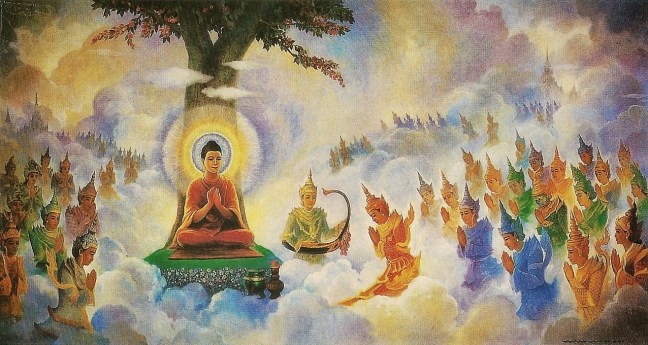
‘Buddha preaching Abhidhamma in Tavatimsa’ – Wikimedia Commons

.

प्रज्ञापारमिताहृदय

心經

བཅོམ་ལྡན་འདས་མ་ཤེས་རབ་ཀྱི་ཕ་རོལ་ཏུ་ཕྱིན་པའི་སྙིང་པོ

.

There is a text that came from the dawn of ages, whose author is unknown, but which has been widely accepted, practised, and chanted in Mahāyāna Buddhism as a condensed exposé of the teaching of Buddha. Although known and praised as the ‘Heart Sutra’, its original Sanskrit name translates as ‘The Heart of the Perfection of Wisdom’. If the Sutra’s main teaching asserts that all phenomena is ‘Śūnyatā’, a term widely translated as emptiness, its wide implications extend to many other aspects in the understanding of our true nature. Originally translated in Chinese by a 9th century Buddhist monk called Prajñā, the text exists in a shorter and longer version. I am sharing here the standard long version that provides an elegant and story-like context to the main teaching. I have also chosen to give to the many Sanskrit terms their original meaning or context. Following the Sutra is a short text that I wrote, some words that the text has evoked in me. I hope that this presentation will give justice to the profundity of this text, and that you will enjoy the reading.

~

Form is emptiness, emptiness is form.”
~ The Heart Sutra

[…]

Discover this milestone of Buddhist literature: the ‘Heart Sutra’… (READ MORE…)

.

Ten Bulls

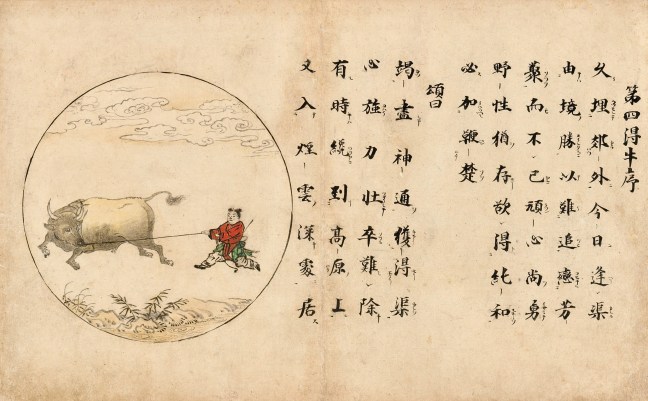
‘Ten Verses on Oxherding’, 1278 – Metropolitan Museum of ArtWikimedia

.

十牛图

.

Back in the 12th century, in China’s Zen tradition, appeared a series of ten drawings and their accompanying poems. They were meant to describe the ten stages on the path to enlightenment, or to the recognition of our true nature. This series is traditionally named the ‘Ten Ox Herding Pictures’ or more simply ‘Ten Bulls’, and its best known version was created by the Chinese Zen master Kuoan Shiyuan in the 12th century. The present drawings are copies of the originals by the the 15th century Japanese Zen monk and artist Tenshō Shūbun.

The bull and the herder is an old theme in the Buddhist literature of the first centuries AD, and was borrowed and developed in the tradition of Zen. Although other versions have a different number of drawings, this series with ten pictures was adopted in Japan and made famous in the West through the 1957 book ‘Zen Flesh, Zen Bones: A Collection of Zen and Pre-Zen Writings’, by Paul Reps and Nyogen Senzaki. The poems have been translated and commented numerous times, as is often the case with Old Chinese, a language which lends itself to many interpretations.

The main contribution of this version is that the series doesn’t end with the awakened state, shown by a mere circle representing emptiness, but with two more drawings where the realisation of truth is taken further into the realm of form, or everyday life. As the Zen master Jitoku Ki said: “Every worldly affair is a Buddhist work, And wherever he goes he finds his home air; Like a gem he stands out even in the mud, Like pure gold he shines even in the furnace.”

.

Form is not different from emptiness, 
and emptiness is not different from form.
Form itself is emptiness, 
and emptiness itself is form
.”
~ Heart Sutra

.

Taste the poetry and evocative power of these old poems and drawings… (READ MORE…)

.