The Impeded Buddhas

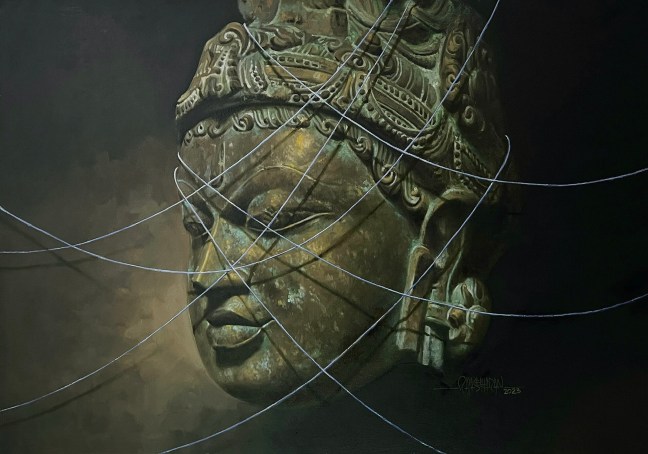
Holy Thread’ – by Rajasekharan Parameswaran – Wikimedia

This is what we want against all odds. No matter what. All of us. We want that love, that piece of eternity, although we may not voice it that way. Yet everything tells us that we will never get it. We can’t have it. It is not something to be had, and we know it. We have experienced its elusiveness a thousand times. But that knowledge doesn’t appease our seeking. This indefatigable quest is ingrained in our system. Something deep inside us is missing, is not quite completed. There is an insufficiency, a suffering that sets us on this path of longing. And this seeking has become such an intimate part of our lives, and has taken so many banal, inconspicuous forms, that it is not often noticed or recognised as such. But the fact is: all that we are truly looking for in our life is this deep, abiding peace, which ultimately comes from love. This is our path. Our journey. To get to that point where we don’t have to suffer and strive.

The problem comes with defining our search precisely. We are being too vague about it. Most of the time, it is not taken seriously. So we stroll about, taking divergent, contradictory roads. We are only interested in bits and pieces. A little happiness here and there will do. Our quest remains a fearful one, and mostly consists in avoiding difficulties, in being attached to what we have, and in acquiring little pleasures. But all we do through this, is to battle with happiness. In fact, the whole of our life is made of that, of this frustrated happiness, this thwarted love. Everything we do — including our most unkind, insensitive, foolish, ignorant actions — we do out of our deep, inner desire for happiness. In a way, we are all spiritual seekers. We are all engaged in the same frantic battle to be happy, at peace, rested, unafraid. We are all brothers and sisters in arms. We may do it in the most clumsy, mindless way, and be punished for it. Or we may be gifted with a thirsty, pointed mind, and all the tools necessary to meditate and recognise our true nature. So this seeking is not for a few elected, but extends to humanity’s tireless striving for betterment.

In fact, we are all — without our realising — accomplished Buddhas, beings of light. But we have chosen to identify with our shortcomings, our failures, our reactive patterns, our sorrows, all the inner waste that life produces along the way. Their objective nature makes them easier to associate with. Unfortunately, by doing so, we have troubled our innate clarity, have limited our infinite nature, and have soiled our innocence. We have become ignorant of who we are. We have confused our luminous, peaceful being with a few passing, trifling occurrences. We have all made the same mistake. Our self is the story of a disillusionment, of a shrouded delight to just be. We are all impeded Buddhas. Paradoxically, our nature as peace and happiness, because of its being veiled by our prejudiced sense of self, is the reason for our feeling incomplete, inadequate, and is in consequence the cause of our suffering. So most of our seeking is a direct product of our natural predisposition towards peace and happiness. Our disentangling from this false, unfortunate association may take us on various roads of varying difficulty and intensity. But the truth behind it all is that everyone — everyone — we meet on our journey is our equal partner in this most sacred quest. This recognition would go a long way in establishing some measure of love in our wounded world.

.

~~~

Text by Alain Joly

Painting by Rajasekharan Parameswaran (born 1964)

~~~

.

Website:
Rajasekharan Parameswaran (Wikipedia)

Suggestion:
– Other ‘Reveries’ from the blog…

.
The Heart Sutra

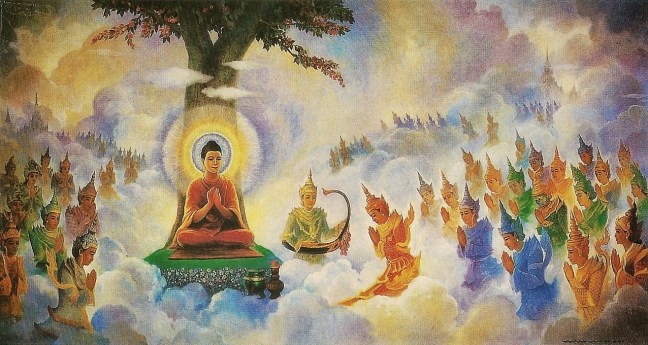
‘Buddha preaching Abhidhamma in Tavatimsa’ – Wikimedia Commons

.

प्रज्ञापारमिताहृदय

心經

བཅོམ་ལྡན་འདས་མ་ཤེས་རབ་ཀྱི་ཕ་རོལ་ཏུ་ཕྱིན་པའི་སྙིང་པོ

.

There is a text that came from the dawn of ages, whose author is unknown, but which has been widely accepted, practised, and chanted in Mahāyāna Buddhism as a condensed exposé of the teaching of Buddha. Although known and praised as the ‘Heart Sutra’, its original Sanskrit name translates as ‘The Heart of the Perfection of Wisdom’. If the Sutra’s main teaching asserts that all phenomena is ‘Śūnyatā’, a term widely translated as emptiness, its wide implications extend to many other aspects in the understanding of our true nature. Originally translated in Chinese by a 9th century Buddhist monk called Prajñā, the text exists in a shorter and longer version. I am sharing here the standard long version that provides an elegant and story-like context to the main teaching. I have also chosen to give to the many Sanskrit terms their original meaning or context. Following the Sutra is a short text that I wrote, some words that the text has evoked in me. I hope that this presentation will give justice to the profundity of this text, and that you will enjoy the reading.

~

Form is emptiness, emptiness is form.”
~ The Heart Sutra

[…]

Discover this milestone of Buddhist literature: the ‘Heart Sutra’… (READ MORE…)

.

The Buddha Nature

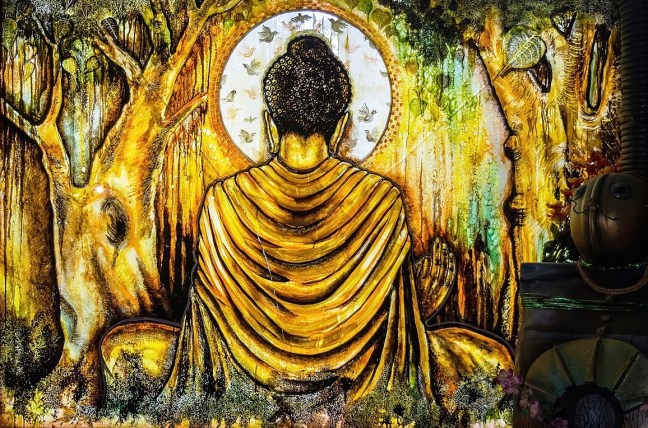
‘Buddha Painting at Amazing Banyan Tree’ – Utsav Rock Garden – Wikimedia

When you see the representation of a Buddha in meditation — or a Shiva or a goddess —, it is not about a person or a god, not about an entity, no matter how mythical or divine he or she might be. It is yourself represented. It is the description of your own aware being. Present. Self-sufficient. Undisturbable. Undivided. Not dispersed. It is a representation of consciousness — that thing or essence of which we are made, and with which we are all having our many experiences. It is the very form of being. It is an attempt to make seen what cannot be seen, to make graspable that which cannot be grasped. It is the form of the formless. It is teaching itself. It is truth in a condensed and visible form.

To see it that way will never make you laugh again at the expressions of devotion in front of statues. It is not to say that the immense majority of believers do not see in these statues the representation of a person or a god, but rather to emphasise the truer significance behind these objects of devotion. They are reminders of truth, wake up calls from the bottomless being contained in your own being. They are beseeching you to direct your attention inwards. You are being asked to devote your attention to your self, to worship your own being, to not disperse yourself in the ten thousand things and the endless dance of thoughts and feelings, but to focus on that which is before them, that which is seeing them all. That is your true self, and that true self is Buddha-nature.

A Buddha in meditation is not a Buddha in meditation. It doesn’t tell you that you should meditate. It is rather the expression of the very being that sits as your very self or awareness. In other words, it is you. You are this close to a Buddha sitting in meditation. A breath away. Less than a breath, you are it to a point that you can never even envisage. That’s what keeps you so far remote from it. This is the real belief: to think of yourself as being a common person and not a Buddha. Imagination is taking you far away from your true self. Don’t let it do that to yourself. Don’t be so malleable as to follow the injunctions of a voice in your head. Sit down in yourself and look within. Surrender to the presence of your innermost being. Stay with it. Admire it. Your true nature is nothing but Buddha-nature. It is the only thing that you must not be asked to believe. It’s just for the realising.

.

~~~

Text by Alain Joly

Painting by Utsav Rock Garden

~~~

.

Website:
Utsav Rock Garden

.

Other ‘Ways of Being’ from the blog…

.