Verses on the Perfect Mind

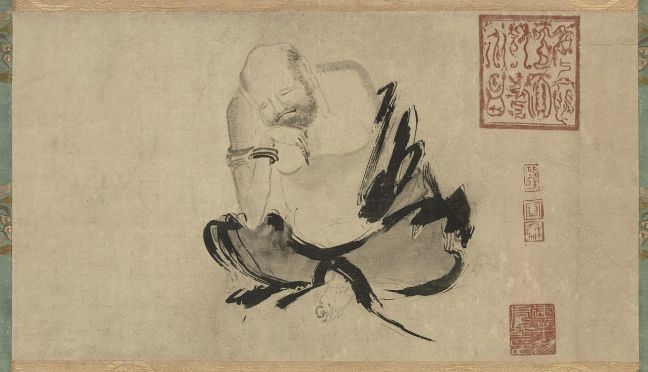
‘Huike thinking’ – Shi Ke, 10th Century – Wikimedia Commons

信心銘
鑑智僧璨


It is only recently that I have heard the first two lines of this Zen poem called ‘Hsin-hsin Ming’, which can be translated as ‘Verses on the Perfect Mind’. It is an ancient poem, one of the earliest and most influential Zen writings. It was allegedly composed by Chien-chih Seng-ts’an, who is referred as the Third Zen Patriarch. Very little is known about him, except that he was initiated into the Dharma by Dazu Huike (487–593) and died in 606. It has been multi-translated, and given various names. The title literally means ‘Inscription (or record) on the Believing Heart (or the Faith Mind)’. Verses on the Perfect Mind seems to be a good translation, considering the deeper meaning of the word ‘perfect’ which is ‘completed, accomplished’. The perfect Mind here is an ‘is-ness’, the natural mind, the Buddha mind. As the Nirvana Sutra says, “Great faith is no other than Buddha nature.”

What makes the translation of the poem difficult is the tension between conveying the right meaning and rendering the brevity of the poem. There is a passage in the present translation that goes: “When things can no longer be faulty, it is as if there are no things. When the mind can no longer be disturbed, it is as if there is no mind.” This was translated by Prof. Dusan Pajin: “No blame, no things; no arising, no mind.” The poem consists of 146 unrhymed four-character verses, which is shorter than the usual lines in Chinese poetry which have five or seven characters. So the form is concise, scarce, and that is in line with the Zen meditative form. 

It should not be read as a succession of individual quatrain, but more as a vision, something whole, indivisible. I think it was written in this spirit, for the original work is really just a succession of undivided characters. Maybe it was recited fast, concentrating on the meaning behind the words, the felt-understanding. It starts with these famous lines, so often quoted: “The Great Way is not difficult, for those who have no preferences.” It develops as variations on these lines before ending and finding completion — we could say vanishing — with this strong reminder: “Words! Words! The Way is beyond language, Words never could, can not now, and never will describe the Way.” The present interpretation is by Eric Putkonen. Eric is a Modern-day house-holder yogi and lover of what-is who lives in St. Petersburg, Florida where he hosts nonduality satsangs. I hope you will enjoy…


至道無難 
唯嫌揀擇 
但莫憎愛 
洞然明白 


The Great Way is not difficult, 
for those who have no preferences. 
Let go of longing and aversion, 
and it reveals itself.

Make the smallest distinction, however, 
and you are as far from it as heaven is from earth. 
If you want to realize the truth, 
then hold no opinions for or against anything.

Like and dislike 
is the disease of the mind.
When the deep meaning (of the Way) is not understood, 
the intrinsic peace of mind is disturbed.

As vast as infinite space, 
it is perfect and lacks nothing.
Indeed, it is due to your grasping and repelling 
that you do not see things as they are.

[…]

Continue reading this old poem by the Third Zen Patriarch… (READ MORE…)
 

The Chariot and the Charioteer

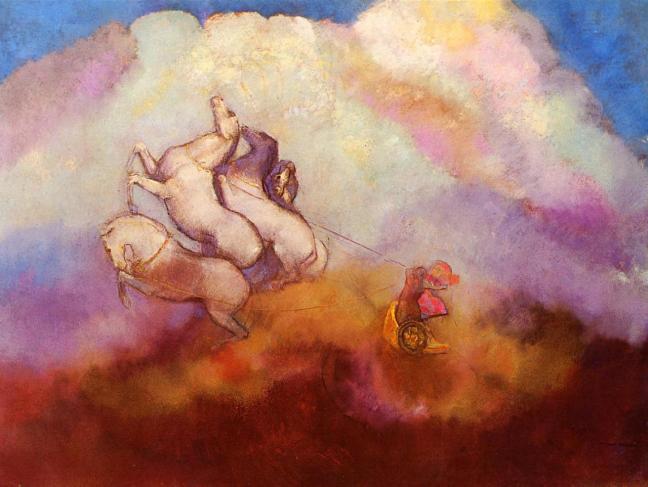
‘Pantheon’ – Odilon Redon, 1910 – WikiArt


The mental and the material are really here, 
But here there is no human being to be found. 
For it is void and merely fashioned like a doll, 
Just suffering piled up like grass and sticks
.”
~ Visuddhimagga (The Path of Purification)


Free will is a tentacular issue. It permeates our life in a very intimate way, like very few things do. Any action that we might engage in, any decision we take, any thought we think, bear at their core the question of their ownership. If we believe in free will and don’t exercise it for all sorts of psychological reason, then the road is open to guilt, shame, regret, self-loathing. Could things have been any different? What if I had not made that choice? What if I had taken a different decision, if I had been more courageous, if I had followed my heart? Well, it is not any different if I feel I have exercised my free will; I could be left with the same regrets. Is it even possible to not exercise our free will, if we leave aside the unchangeable circumstances we are in? Is not free will our nature no matter what? Or conversely, can we ever, at all, exercise our free will? Maybe there is no such thing. Who is here, deep down, to exercise free will? Is there not only a flow of life on which we superimpose a continuous stream of hectic, frantic thinking? What is it?

I was watching a mountain torrent the other day during one of my walks. How miraculous to see the water flow down unquestionably, directed left or right, split up by a stone. If you had been a water drop placed here, it is left, but more there and it is right. Who could imagine such a droplet having any kind of choice? The river would sometimes divide itself in three little currents, forming islands. Sometimes you could be dragged sideways in a stagnant little pool, or rushed about in a forceful cascade. What struck me was the absence of resistance, and the fact that no matter the direction, no matter where you were dragged into, how slow or fast, smooth or jumpy, water was water and you would find yourself downstream at exactly the same place than any other drop of water that you might have judged as having a more harmonious or lucky course. Are we not such a drop carried, or literally swept along, in the stream of life? […]

An exploration into the nature and reality of free will… (READ MORE…)


Self Recognition

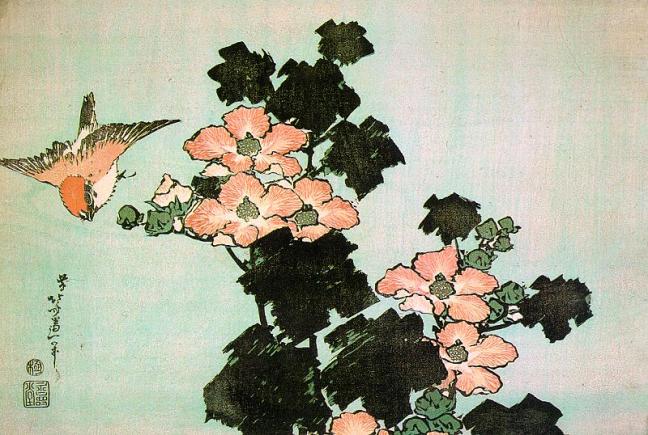
‘Hibiscus and Sparrow’ – Katsushika Hokusai, 1830 – WikiArt


Nasreddin Hodja is what could be called a sublime idiot. He is a liar, irreverent, a disturber of peace. But he is also ingenious, free, full of wit, a timeless figure whose stories have spread and been adapted the world over. In the Sufi tradition, they were used for study purposes.

~

One day Nasrudin walked into a shop. 
The owner came forward to serve him. 
‘First things first,’ said Nasrudin. ‘Did you see me walk into your shop?’ 
‘Of course.’ 
‘Have you seen me before?’ 
‘Never in my life.’ 
‘Then how do you know it is me?’

~

Nasrudin’s Pointers:
I happen to be me, apparently located in, and certainly connected with this body, amongst billions, trillions of other possibilities. I am me, I can be addressed, recognised, challenged, by other beings or things without them ever having the experience of being this particular ‘me-form’ that I am. I am uniquely built. And yet how silly it would be that the consciousness that I am was just but one version of trillions of other consciousnesses. If it was, what would be the chances for these different consciousnesses — including animals’ — to be so closely related to each other, let alone meet in any deep way? Separation does’t seem to make sense. Like Nasrudin is implying, how would we even recognise each other? How would we know, when we address another person, that we could relate at all, that she is a ‘me’ in the same way that I too am a ‘me’? This simple recognition of the ‘I am’ in me, or her, or him, is the very experience of our own true nature, the oneness that reverbates in each and every human ‘I am ness’. It is said in one Upanishad, “When a man directly realises this effulgent Self, the Lord of all that has been and will be, he no longer wishes to hide himself from it.” So even though we think we are, nobody is in fact hidden, private, with his essential being. We are being in full light. We think we are hidden because of a few petty thoughts, images, or memories. But the essential and fundamental part of our being is shared. Stephen Jourdain once wrote: “Somewhere behind you, someone calls for you. Hey, John! Or Peter, or Paul, or Annie. You turn around. I give the name ‘me’ to the gentle and saintly reason of this movement. It’s as simple and luminous as that. No reason to search further. (…) To aim for another encounter other than this one is furious folly.” I had this thought one day that if a young man, a westerner, rich, educated, were to suddenly experience the being of an old, poor, uneducated Indian woman, it would take him a long time to notice that a change had occurred. Such is the power of ‘I am’, of the sense of ‘me’ in every being, of the pervasiveness of our shared being in — or more accurately said, beyond — our apparently different forms. Maybe that’s why, as Nasrudin once asserted, “everything is true”…

~

One day a fool asked Nasrudin ‘is God true?’
‘Everything is true’ replied Nasrudin.
‘Even false things?’
‘Even false things are true’, said Nasrudin.
‘But how can that be?’
‘I don’t know. I didn’t do it’, shrugged Nasrudin.


~~~


The Nasreddin stories are borrowed from ‘The Exploits of the Incomparable Mulla Nasrudin’ by Idries Shah, and ‘Sufism/Nasrudin’ Wikibooks.

‘Nasreddin’s pointers’ is by Alain Joly

Bibliography:
– ‘The Exploits of the Incomparable Mulla Nasrudin’ – by Idries Shah – (ISF Publishing)
– ‘Nasreddin Hodja: 100 tales in verse’ – by Raj Arumugam – (CreateSpace Independent Publishing Platform)
– ‘Radical Awakening: Cutting Through the Conditioned Mind’ – by Stephen Jourdain – (Inner Directions Publishing)

Websites:
Nasreddin Hodja (Wikipedia)
The Idries Shah Foundation
Katsushika Hokusai (Wikipedia)
Stephen Jourdain


The Inconceivable Actuality Here-Now

Photo by Corinne Galois – Galerie photographique

Joan Tollifson is my newly invited guest on ‘The Dawn Within’. Joan writes and talks about being awake to the aliveness and inconceivability of Here-Now — being just this moment, exactly as it is. She has explored Buddhism, Advaita and radical nonduality. Joan’s main teacher was Toni Packer, a former Zen teacher who left that tradition behind to work in a simpler and more open way. Joan does not identify with or represent any particular tradition. You will find ample information on her website: Joan Tollifson, the simplicity of what is. She currently resides in southern Oregon. 

I like Joan’s down to earth, bare-bones approach to reality, which is refreshing and does not need complex practices. I like too her frank and direct relationship to the ’what is’ of life, including the most human, most confused expressions of ourselves. I have chosen to share here one of her texts called ‘The Inconceivable Actuality Here-Now’. It is an extensive, and rather complete description of the descent into the ‘here and now’ of present experience, beyond all maps and conceptualisations. There is immediate and incredible potency in just being present to what is taking place right now — what is taking its place within the awareness that we are. “The rain pattering on the roof—is it inside me or outside me? Is it separate from me? Is there a boundary between these sounds and the listening presence that is hearing them? What happens when full and open attention is given to something?” Joan keeps inviting you to see and understand for yourself the nature of reality. I hope you enjoy…

~

Nature is not imaginary: it is actual; 
and what is happening to you now is actual. 
From the actual you must begin—
with what is happening now—
and the now is timeless
.”
~ J. Krishnamurti

~~~


The Inconceivable Actuality Here-Now

I had a high school film teacher back in the 1960s who, in the first class, had us look at our thumbs. After about 10 minutes, he asked how many of us were bored. He told us that if we were really seeing, we wouldn’t get bored. He gave us homework assignments that involved sitting in front of trees and looking at small sections of bark for an hour, or watching grass blow in the wind. One night I was lying on the floor in our dining room in the dark, watching shadows move on the wall. My mother came in, a bit upset, and asked me if I had finished my homework. I told her I was doing it. And I was! What a blessing to have a teacher like this in school.

As I told someone recently in a FB comment, the ‘ordinary’ is actually extraordinary, and what we think is ‘the same old thing’ is never actually the same from one instant to the next. The more closely we attend to anything that shows up (whether it is a visual appearance, a sound, a somatic sensation, a taste, a smell, a tactile sensation), the more it unfolds into ever more subtle dimensions with no end to that unfolding.

By simply looking and listening openly, we can notice and enjoy the fluidity and playful nature of reality — the clouds moving through a puddle of rainwater on the sidewalk, the gorgeous hills and valleys in a crumpled Kleenex, the way light dances on the wall, a tingling in our feet. We can notice it is all one seamless, infinitely varied but undivided happening, and that all our words for it and explanations of it can never capture or nail it down. We also begin to notice the common factor in every different experience: the presence of it, the immediacy of it, how everything is the immovable, infinite and eternal, ever-present Here-Now that never departs from itself. […]

Continue Reading Joan Tollifson’s text on Here-Now… (READ MORE…)