Of Dimitry’s Prayer

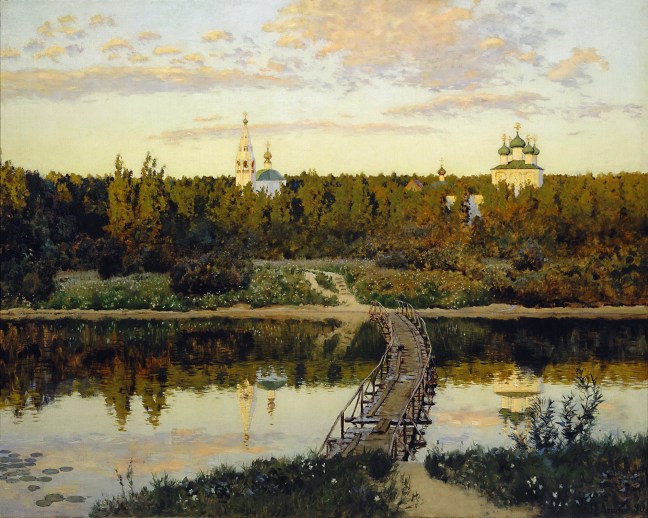
‘A Quiet Monastery’ – Isaac Levitan, 1890 – Wikimedia

.

Open, O doors and bolts of my heart,
that Christ the King of Glory may enter!
~ Dimitry of Rostov

.

Prayer is an invitation for what is already here to show itself up. It is not that you already know who you are, and that you-the person are begging for a supreme entity, or for an other, to come and soothe you, for an external, benevolent providence to shower you with its benefits. Remember that there is no other entity than the entity of your self, no other providence than the providence of recognising who you are. Nothing, in matters of peace and happiness, could ever enter into you that is not already there. So don’t make that mistake over and over again: to wait for someone knocking at your door, to hope for something to fulfil you, to expect a new element to enter your life. The benefit of life is not with something you receive, but in what you recognise yourself to be. So prayer is prior. It is not in reaching but in realising, not in expecting but in recognising, not in receiving but in noticing, and not in having or possessing, but in being.

So always pray as if you were utterly alone. Pray as if you couldn’t ask anything, anyone, any favour or event, to give you something that is not already there in you, as you, expressed as your very own being. Notice that nothing of worth could ever enter your house that is not already present, already eating at your table, already thinking the thoughts you think, already dreaming the dreams you dream. This is how Dimitry’s prayer ought to be uttered.

[…]

More reflections on a prayer by Dimitry of Rostov… (READ MORE…)

.
Fear and Trembling

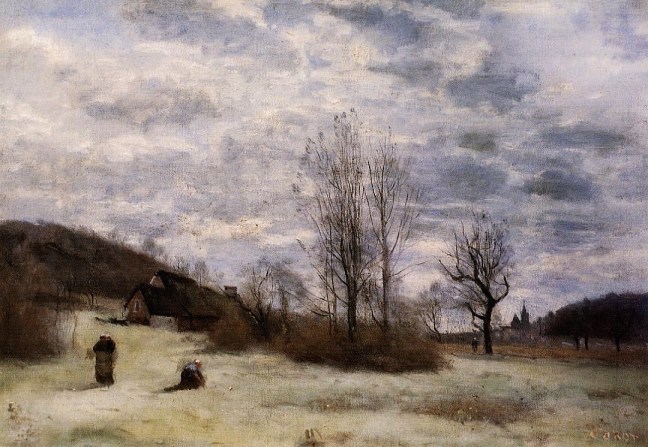
‘Plains near Beauvais’ – Camille Corot, 1860-70 – WikiArt

.

The fear of the Lord is a fountain of life,
to depart from the snares of death.”
~ Proverbs, 14:27

.

There is an expression that we may find puzzling, maybe slightly paternalist, condescending and outdated, but is well worth looking at. We find this expression mostly in Christianity and Islam, where the mentions ‘fear of God’, ‘fear of the Lord’, or the injunction ‘fear God’ are found far more than a hundred times in the Bible, or in the Quran. This fear is said to be one of the seven gifts of the Holy Spirit, along with wisdom, understanding, guidance, mightiness, knowledge, and devoutness. But why would we be afraid of what we longed for the most in our lives? We should be embracing it with ardour and ease. So what is this “fear of the Lord” that, in Proverbs 9:10, is said to be “the beginning of wisdom”? Why is it given such primary importance?

Maybe we fear god for the same reason that we fear death. We think that we are something, someone, a self that we appreciate and have a fondness for, that we love and want to cling to as something precious. We want it to continue. So we have elaborated strategies to keep our self padded with multiple pleasurable sensations through our various habits as thoughts, daydreams, pleasure oriented activities, routines, manipulations, avoidances, all these addictions that have come to form the main part of what we call our self. But these are vain distractions, for awareness as god seems to have in itself a momentum, a power to draw every thing and being to itself. So this pull can be felt as a threatening force from the limited point of view of a self that feels vulnerable, and finds temporary security in being something, even if this something is in final analysis the cause of its suffering. In Hebrews 10:31, it is said: “It is a fearful thing to fall into the hands of the living God.”

[…]

An essay that inquires into the notion of the fear of god… (READ MORE…)

.