I Am Nobody

Nasreddin Hodja is what could be called a sublime idiot. He is a liar, irreverent, a disturber of peace. But he is also ingenious, free, full of wit, a timeless figure whose stories have spread and been adapted the world over. In the Sufi tradition, they were used for study purposes. “There is the joke, the moral — and the little extra which brings the consciousness of the potential mystic a little further on the way to realisation.” writes Idries Shah. These stories are like ‘eternity with a smile’…

~

One day, the dervish Nasreddin entered a formal reception area 
and seated himself at the foremost elegant chair. 

The Chief of the Guard approached and said: 

“Sir, those places are reserved for guests of honor.”

“Oh, I am more than a mere guest,” replied Nasreddin confidently.

“Oh, so are you a diplomat?”

“Far more than that!”

“Really? So you are a minister, perhaps?”

“No, bigger than that too.”

“Oho! So you must be the King himself, sir,” said the Chief sarcastically.

“Higher than that!”

“What?! Are you higher than the King?! 
Nobody is higher than the King in this village!”

“Now you have it. I am nobody!” said Nasreddin.

~

Nasreddin’s pointers:

Nasreddin is a genius. In just a few attitudes, and a few chosen words, he has just conveyed that nothing, and nobody is greater than god.

There is a presence inside each and every human being, a consciousness, pure, indivisible, that is one without a second, that is all encompassing and infinite, therefore doesn’t bear, or conceive, or even renders possible the existence of another reality by its side. 

Therefore by being nobody, Nasreddin can be all and claim the most prominent seat in the world. That’s why one should show regard for those of humble means. This is the second lesson from Nasreddin, the mollah. Nobody is left aside, nobody is unworthy of the highest, most sublime throne of life, pure presence. For this is each and every being’s birthright and resplendent reality, despite being an unnoticed one for most.

The dignitaries, nobles and ministers of the assembly who believed in appearances and ranks, could not be humbled by a nobody, and catch thereby the high lesson that was delivered in that moment, which is: even a person of no consequence can be Hodja. Hodja is one with the ultimate skill and power to be, who by his or her very knowing of his or her highest identity, can be the vehicle and teacher of a truth that is the greatest and purest one on earth.

This elevation is attainable by everyone through the abandonment of the ego. This is Nasreddin’s ultimate teaching. The ego here is the illusion of being a ‘somebody’. When we abandon our very small identity, our believed being, our own limitations, we can access the highest rank of all. By his genius, in just a few attitudes, and a few chosen words, the mollah has just conveyed the ultimate truth.

This, my friend, is the extent of Nasreddin’s power, the deed of the simple, idiot, absurd, naive, fool, comic, irreverent, sometime witty, sometime wise, Nasir ud-din Mahmood al-Khoyi, known simply as the Hodja, or the mollah.


~

“Some people say that, whilst uttering what seemed madness, he was, in reality, 
divinely inspired, and that it was not madness but wisdom that he uttered.”
~ The Turkish Jester or The Pleasantries of Cogia Nasr Eddin Effendi

~


The Nasreddin story is taken from Sufism/Nasrudin, Wikibooks.

‘Nasreddin’s pointers’ is by Alain Joly

The photo is by Ben_Kerckx / Pixabay

Bibliography:
– ‘The Sufis’ – by Idries Shah – (ISF Publishing)
– ‘The Exploits of the Incomparable Mulla Nasrudin’ – by Idries Shah – (ISF Publishing)
– ‘Nasreddin Hodja: 100 tales in verse’ – by Raj Arumugam – (CreateSpace Independent Publishing Platform)

Website:
– Nasreddin Hodja (Wikipedia)


Jñāna, the Song of the Self

“Without me here, to know experience, 
how could this experience be?
”
~ Aitareya Upanishad, I,3,11


It happened long ago, during a morning stroll behind my house. I was contemplating my deep sadness and my desire to change, when a simple intuition came uninvited. I felt that it was possible to change and I had the power to initiate it. I felt that this change, this cure for my unhappiness was to be found in myself. I felt that it was all happening here, in this me-presence, and that the necessary tools were all provided in me. No reliance on any external authority. It was the intuition, not that I-the little me with its conditioning could do it, but that there is an inward process for accessing this change, this seeming transformation, in other words, happiness. And this process could be implemented, carried out through the tools of thinking, logic, understanding, which are my natural inclination. I had just discovered the very nature of the path of knowledge.

So I’d like today to make an attempt at better understanding this path of knowledge which has been named ‘Jñāna’ in the tradition of India. It is an interesting word which shows the family ties with many of our European languages. In Sanskrit, the word means ‘knowledge’, the root ‘Jñā’ being close to our English word ‘know’, or the Greek ‘gnosis’, the French ‘connaître’, all words that convey the idea of ‘knowledge’. Jñāna is one of the three main pathways towards realising our true nature, namely the path of knowledge, which involves the process of thinking, the path of love, ‘Bhakti’ in India, which involves feeling, and the tantric path, which involves the senses and thereby the so-called external world. It seems to me that there is some value in understanding the nature of each pathways and seeing how they can blend in our daily living and Sadhana.

An exploration into Jñāna, the path of knowledge (READ MORE…)


The Heart of Tagore

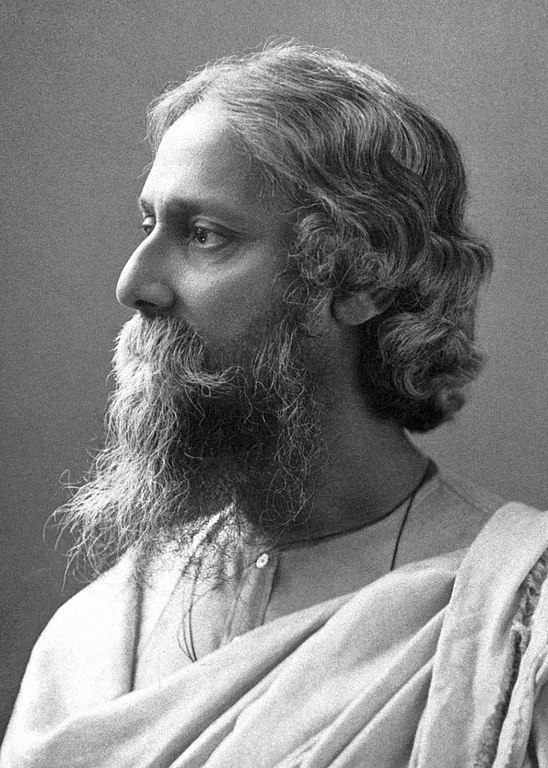
Rabindranath Tagore is certainly one of the fathers of modern Indian literature. His work is immense and fascinating. He is the author of more than a thousand poems, two thousand songs of which he also wrote the music, novels, short stories, plays. He has also written essays on all subjects that were dear to him, from philosophy to politics, from education to the arts, and left many sketches, drawings and paintings. But Tagore was first and foremost a poet, ‘The Poet’, as he is affectionately known in India, and it was through his poetry that he became known throughout the world.

He was born the last child of a Brahmin family from Calcutta, in 1861, and grew up in the shadow of a learned father and religious reformer. He took part in the intense intellectual and social emulation that Bengal experienced in the 19th century, when it struggled with modern Western influences. Educated in the three languages ​​- Sanskrit, Bengali and English, he wrote poems very early, and translated some of his collections into English himself. The publication of ‘Gitanjali’ in Europe and North America made Tagore famous, and he received the Nobel Prize for Literature in 1913. His sudden renown allowed him to make numerous trips to various continents for conferences or visits of friendship, in which he tirelessly preached peace, non-violence and unity among men. A friend of Gandhi, Tagore participated in his own way to the emergence of India as a nation. He is the author of many poems and patriotic songs, two of which have become the national anthems of India and Bangladesh.


“Thou hast made me endless, such is thy pleasure. 
This frail vessel thou emptiest again and again, 
and fillest it ever with fresh life
.”
~ Gitanjali


‘Gitanjali’ (1912) is a succession of dialogues, praises to God, filled with some accents of the most profound spirituality. Face to face with the Master, with the Friend, with the Lord, the poet is alternately filled with aspirations, confusions, caught in lamentations, or in luminous resolutions. These poems combine the finesse of language with philosophical reflection or contemplation, and they do so so harmoniously that we are invited to a double and indissociable meditation.


“And it shall be my endeavour to reveal thee in my actions, 
knowing it is thy power gives me strength to act
.”
~ Gitanjali

Let’s delve into the spiritual heart of Tagore’s poetry and essays (READ MORE…)


A Day at Brockwood Park

Homage to J. Krishnamurti


“Surely,
freedom
from the self
…is the true function 
of man
.”
~ J. Krishnamurti


Seated on the back seat of the car, I was scrutinising the landscape. Although we were driving through one of these English narrow roads, squeezed between two tall hedges, the place was nevertheless growing in familiarity. Twenty-two years! Twenty-two years that I hadn’t been here! Now the landscape and the roads were known by me, my heart was throbbing and I was seized by an unavoidable emotion. We passed in front of the school’s gate, another hundred meters, and there it was, on the right. It said on a sign: “Krishnamurti Centre”. We parked and came out of the car. No building was yet in view, I was standing and felt overwhelmed by something warm and familiar, as if all the trees, and the pebbles under my feet, and the trembling leaves, and the few sounds around, and the presence – Oh yes, the presence! – were all presented to me like one big sensation, one big knowing and remembering of something I have dearly loved. I was shaken with tears. I lived and worked here for more than four years. A big part of my personal identity still belongs to this place, even decades later, and my apprehension of the spiritual journey comes from these years spent in the aura of Krishnamurti’s teaching. …

Join me for a day spent in the aura of Krishnamurti’s Teaching (READ MORE…)


No Others…

Q: How should we treat others?

A: There are no others.

~ Ramana Maharshi

.

– Photo by Alain Joly

Bibliography:
– ‘The Collected Works of Ramana Maharshi’ – (Sophia Perennis et Universalis)
– ‘Be As You Are’ – by Ramana Maharshi (Edited by David Godman) – (Penguin Books)

Website:
– Ramana Maharshi (Wikipedia)

Suggestion:
– Rendezvous with Ramana, Part II (Homage to Ramana Maharshi)

.

The Fruitless Search

“I have been an [explorer] and still am.
But I stopped asking the books and the stars.
I started listening to the teachings of my own soul
.”
~ Rumi


It is not because I have read a few books, bathed in the presence of some beautiful beings, and participated to many retreats that I know where I am, what I am at, and can now follow the upward course of a promised, enlightened destination. I’m not like an arrow steadily cutting through the air. It’s not like that I’m afraid. I confess: I’m a lost bird. One that’s flapping its wings on the winds of uncertainty, not knowing how, where and what to proceed. I spend all my time in the forest, flying around like a mad bird, thinking that I have one thousand things to do to secure a more decent life for myself. And this is an endless, confusing activity. …

A tale that speaks of a lost being and its fruitless search (READ MORE…)


A Path, What Path?

The question of the ‘spiritual path’ is a difficult one, that seems to draw different points of view and approaches, both from students and teachers. I have gathered here many quotes and pointers on and around this subject, from various spiritual teachers and poets of the eternal and the infinite. I hope that this will bring some clarity, or at least give a better overview of this ‘thing’ we call the Path… Yes, what path?


“How shall I cross the ocean of the world?
Where is the path? 
What way must I follow?
I know not, Master.
Save me from the wound of the world’s pain.” 
~ Adi Shankara

~

This is an excerpt of the famous discourse Krishnamurti gave in 1929 the day when he announced the dissolution of the Order of the Star, the organisation built around his person:
“I maintain that Truth is a pathless land, and you cannot approach it by any path whatsoever, by any religion, by any sect. That is my point of view, and I adhere to that absolutely and unconditionally. Truth, being limitless, unconditioned, unapproachable by any path whatsoever, cannot be organized; nor should any organization be formed to lead or to coerce people along any particular path. If you first understand that, then you will see how impossible it is to organize a belief. A belief is purely an individual matter, and you cannot and must not organize it. If you do, it becomes dead, crystallized; it becomes a creed, a sect, a religion, to be imposed on others. This is what everyone throughout the world is attempting to do. Truth is narrowed down and made a plaything for those who are weak, for those who are only momentarily discontented. Truth cannot be brought down, rather the individual must make the effort to ascend to it. You cannot bring the mountain-top to the valley. If you would attain to the mountain-top you must pass through the valley, climb the steeps, unafraid of the dangerous precipices.”
~ J. Krishnamurti 

~

“In the direct approach the premise is that you are the truth, there is nothing to achieve. Every step to achieve something is going away from it. The “path,” which strictly speaking is not a path from somewhere to somewhere, is only to welcome, to be open to the truth, the I am. When you have once glimpsed your real nature it solicits you. There is therefore nothing to do, only be attuned to it as often as invited. There is not a single element of volition in this attuning. It is not the mind which attunes to the I am but the I am which absorbs the mind.”
~ Jean Klein

~

“The mind that seeks happiness is like a current in the ocean that longs for water. The mind that resists suffering is like a current in the ocean trying to escape from the water. See what happens to your longing and your suffering when this becomes clear. This understanding is the true alchemy, not the transformation of one experience into another, but rather the revelation of the true nature of all experience.”
~ Rupert Spira

~

More quotes and pointers on the subject of the spiritual path (READ MORE…)