
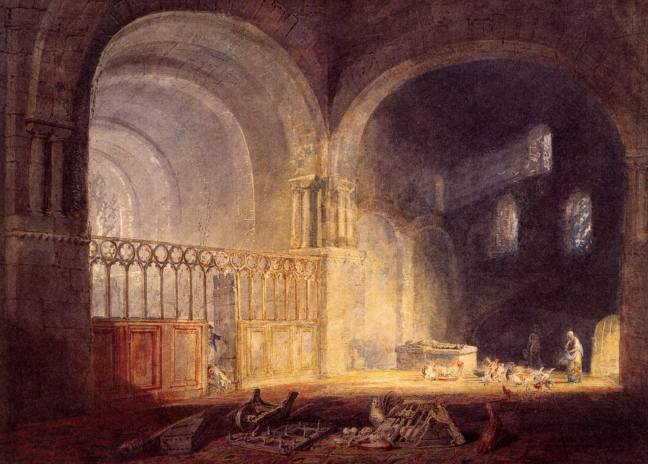
‘Transept of Ewenny Priory, Glamorganshire’ – J.M.W. Turner, 1797 – WikiArt
Most of our thinking is so much unnecessary work. Consider all the worries we had, that have been fuelled by thought, and have now evaporated into thin air. Think of all our expectations and dreams that were never fulfilled, replaced by just being what we are now. There’s been so much energy wasted in these internal fights with reality. So much presence that we have missed or hidden for being tied up with these endless rounds of endless thoughts. Thinking can be a damaging factor in our being aware of our utmost reality. And we most often don’t need to have thoughts to actually be caught in their net. Thoughts are good at delegating. They will sooner than we think be replaced by chronic tensions, nasty feelings, diffuse depression, and the uneasiness of being a self. All the troubles contained in being a person — the endless suffering that goes with it, and the seeking that never seems to stop. In fact, we have been sculpted by our thoughts. We owe thoughts all that we have seemingly become. It really gives me shivers to think about it.
Our thoughts are both the cause and result of the idea of ourself they have imposed on us over time. We have been a follower of thoughts. We have been conditioned by them. They have us in their spell, and we could spend a lifetime without confronting them, without going right to the bottom of their essence. Have you ever met a thought face to face? Do it now. Ask your next unnecessary thought that simple question: ‘Why are you here?’, and see its reaction. See how it will shy away and retreat. Thoughts are not courageous beings. They thrive out of our carelessness. They love our being inattentive. It goes the same way with the self they have made us into. If it is left to act alone, that self will never leave you out of its own will. It will keep hiding your most truthful identity. It will continue feeding you with its thoughtfully rehearsed beliefs and illusions. You will keep being an entity. You won’t see the infinite that your being is made of. Silence and eternity will keep evading you. They too are shy — they don’t like when that boastful self is around.
Thoughts are silent workers, and pernicious ones. We think we have them when they in fact have us. The problem is not so much in their being there, but in what they have left in their trail for us to believe in. That’s why we call them ‘thought’ — a past participle. Thoughts are known when they have already been thought. They are agents from the past, that are here for a mission. They have created an entity that is in turn thinking them with the view of keeping itself strong and alive. So we are caught and doomed, aren’t we? Well… maybe not. Maybe thoughts too have their weaknesses, and I’ll tell you one. Pierce your thoughts through to get to their ground of being. Your freedom from thoughts is in your looking beyond them. And your freedom from being a self is in giving attention to what beholds that self, to what gives it the light necessary for its appearance, and for the knowing of your thoughts. Everything that you can know is lit by a knowing faculty. Be engrossed by that light, be only that one, for there is no thinker behind any of your thoughts, and no knower behind any of your ‘knowns’. Espouse the being in you that is responsible for being aware of everything — thoughts, objects, experiences, the feeling of being a self separate from the world. Just stay present in, as, and to this deepest, most intimate presence — the one which you cannot know, or even be as an object, and which will deliver you from being a self. In that deliverance is contained the severing of all the thoughts that are like the bricks and walls of your illusory self. You will hear the sound of the rubbles crashing at your feet. This sound is the sound that freedom makes. Silence comes afterwards — and this silence is you, who you are before the coming of any thought, truthful or not. But really, nothing is new here — after all, Paul the Apostle said it all long ago in far more succinct terms:
“Whenever anyone turns to the Lord, the veil is taken away.
Now the Lord is the Spirit, and where the Spirit of the Lord is, there is freedom.
And we all, who with unveiled faces contemplate the Lord’s glory,
are being transformed into his image with ever-increasing glory.”
~ 2 Corinthians, 3:16-18
.
~~~
Text by Alain Joly
Quote by Paul the Apostle (5-64/65 AD)
Painting by J.M.W. Turner (1775-1851)
~~~
.
Websites:
– Paul the Apostle (Wikipedia)
– J.M.W. Turner (Wikipedia)
Suggestion:
– Other ‘Reveries’ from the blog…
.
 The Dawn Within