
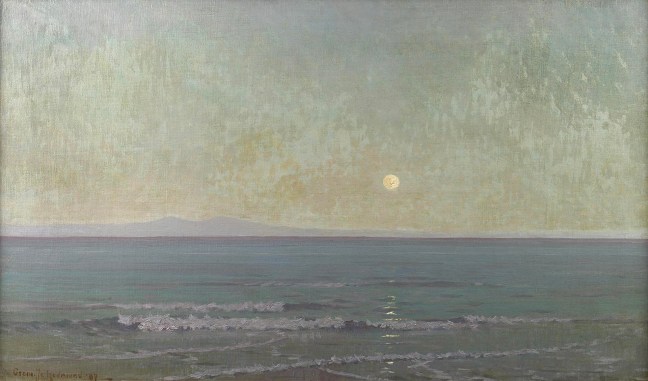
‘Quiet Moonlight (beyond Catalina Island)’ – Granville Redmond, 1907 – WikiArt
Be effortless. That’s the clue you need if you want to meet yourself. Because yourself is for ever here, a natural presence, a stillness in the background, that is your silent being. If you look, you will see it, feel it — who you are, the nature of yourself. So don’t assume too quickly that you know who you are. That who you are is in your body, in your thoughts, in being someone, an entity. Don’t believe that what you are is tied to and dependent on your body-mind, and that you find your true expression in being a person, preferably a successful one, that can be improved, and is subject to death. These are beliefs, concepts that you have learned but never took the time to verify. Don’t accept the subtle tension that is implied in being someone. Go for that part of yourself that is here without effort, that never moves or changes, that is beyond the apparent boundaries of birth and death.
Don’t even try to be spiritual, for the effort you will apply to bring that identity in, will ruin everything. Be exactly as you are, when you are not anything that can be pointed at. Learn to go beyond everything that you are not, so that you can land on the true ground of your effortless being. That may require just a little bit of effort, a redirecting, a gentle looking, the release contained in a moment of relaxation. That is enough. Don’t go for a strain, an ambition, a glory of any kind. These go too far, will take you to a self, a fake identity that will stand in the way of your innate nature. You are already yourself. Nothing new or other than what you already are is needed. Spirituality is a gentle reminder. It is for you to remember that you are almost as nothing, a breath within a breath, a spirit that you will never in a thousand years be able to own. Spirituality is only about being — being effortlessly. This is your natural, unavoidable skill — what you could never not be.
To make an effort is to pull yourself out of your natural being. It is also the veiling of yourself, for any movement that takes you away from your true nature, will own an identity that is acquired, not innate, and that will close the door in the face of your awareness of being. This little bit of effort is you trying to be a person — what you are not — and refusing to be who you are. Through the absence of effort, you will be introduced to yourself, to your true nature. There is a vast expanse there — in fact infinite — that is the very ground of your being. There is a life there, in yourself, as yourself, that some have called bliss or paradise. Not because it is giving you a new place to be, but in reason of the lack of effort or tension there is in being yourself. In effort is contained suffering, fear, lack, hope, conflict, separation, everything that makes your life a burden. To be yourself without effort is the meaning behind the word ‘bliss’. It is the sweetest fall you will ever experience — to be yourself in this free, unconstrained, unforced way. To be without strain, even of the most subtle kind. The blissful is in the absence of effort. In being carefree. Not that you don’t care. But you have your care — which is love — lodged in naturally being, and don’t need any kind of effort for it.
.
~~~
Text by Alain Joly
Painting by Granville Redmond (1871-1935)
~~~
.
Website:
– Granville Redmond (Wikipedia)
Suggestion:
Other ‘Ways of Being’ from the blog…
.
 The Dawn Within