Arise, O Krishna!

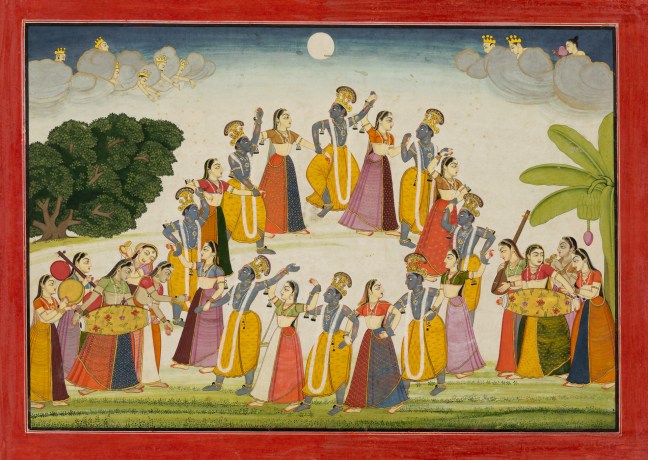
‘The Rasa Mandala Dance of Krishna and the Gopis’ – Anonymous, 1760 – Wikimedia

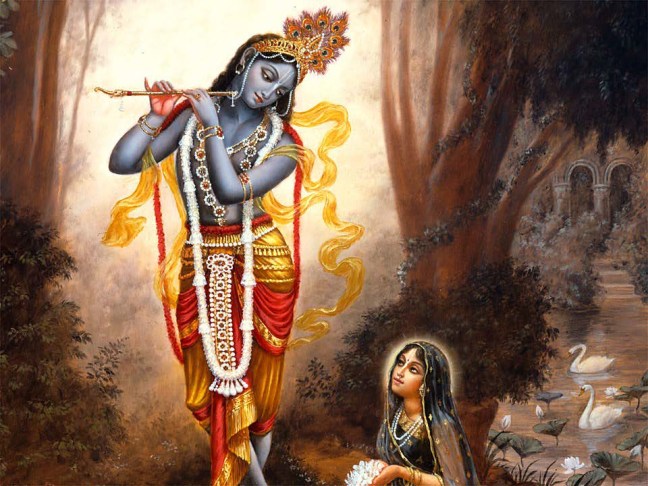
Arise, O Krishna! This is not a time for discretion. There is enchantment around the lake of experience. Ladies have come with fine clothes and jewellery to be adorned by you. You have to be their cup-bearer, the one presence giving to every forms of experience their gorgeous light. For what is a thought without the cup in which it grows, stands for a second, and disappears? Krishna, you alone are the meaning and beauty attached to every object that inhabit our daily living. So this is not a time to hide, but to reveal, to shed light, to glorify. The Gopis — the milkmaids of the Krishnaite folklore — have come to you in the effervescence of their longing. You are the reason for their looking so beautiful. They come to you to be revealed and embellished by your presence, by the one being that is their most precious jewel. So enter the round, O Krishna, and dance with every one of them.

Give to the thoughts that come and wander for a time in our minds their chamber of peace. Clothe them with clarity and intelligence. Appease the suffering of which they are the vehicle, and offer them the rest they deserve. Don’t let anyone unattended. Not a feeling should be left alone, frightened or sad, without benefiting from your warm embrace. No sensations should come along without your building for them a temple of awareness. Be the one present for all, infallible, unswerving. Should a Gopi be lost in the contemplation of nature, and you are here showering her vision with beauty. You are the noble harmony of every experience, and what confers to the dance of life the sweetest of melodies. And have you noticed, O Krishna, how your absence can throw a shadow of sorrow on every experience that passes unseen by you? And have you witnessed how acute is our longing for you, when you withdraw your loving gaze from the many happenings of our lives?

So now, with flowers in their hair, and boundlessness in their hearts, do the Gopis join in your endless round, O Krishna. You hold everyone, every experience, every object that stands lost and alone, in your loving arms. You create around them an armour of beauty, and clothe them in truth’s brightest apparel. That’s how we find the peace at the heart of experience: by marrying every appearance to the gentle presence that holds them. And that presence is ourself — who we are — now giving shape to every perception, every occurrence, sheltering them in the being that gives them protection and form. That’s how the Gopis are experienced as an emanation of Krishna, and how Krishna is seen to be their primordial cause. So now arise, O Krishna! Truly arise! We have come here in celebration of truth, to contemplate you and be contemplated by you. The set for the dance has been arranged. We have come to you enamoured as humble milkmaids, as the fervent Gopis of your heart.

.

~~~

Text by Alain Joly

Painting by Anonymous (1760-65)

~~~

.

Website:
Raslila (Wikipedia)

Suggestion:
Other ‘Ways of Being’ from the blog…

.
The Song of God

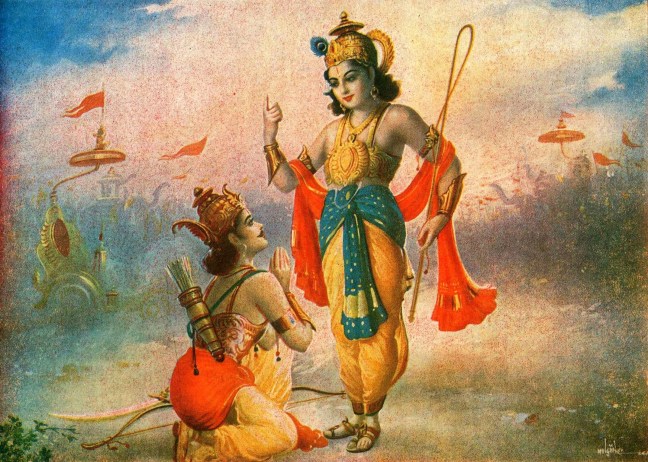
‘Lord Krishna preaching Gita to Arjuna’ – Mahavir Prasad Mishra – Wikimedia

.

भगवद् गीता

.

अहं सर्वस्य प्रभवो 
मत्तः सर्वं प्रवर्तते ।
इति मत्वा भजन्ते मां 
बुधा भावसमन्विताः 

ahaṁ sarvasya prabhavo
mattaḥ sarvaṁ pravartate
iti matvā bhajante māṁ
budhā bhāva-samanvitāḥ

.

I am the self, O Gudākesa! 
seated in the hearts of all beings.
I am the beginning and the middle
and the end also of all beings
.”
~ Lord Krishna (Bhagavad Gita)

.

There is an old and long Sanskrit story that arose in India around the fourth century BC. So long that it has been described as “the longest poem ever written“. So encompassing that the poem mentions about itself: “That which occurs here occurs elsewhere. That which does not occur here occurs nowhere else.”(XVIII.5.38). A story that is as big and epic as life and which took centuries to write, up until the fourth century AD. This masterpiece of universal literature, which influenced the thought, customs, and festivals of a whole civilisation and beyond, is called the Mahābhārata. It is composed of fables, myths, and tales of every kind, that are recipients for multiple religious, philosophical and political considerations. The eminent British film and theatre director Peter Brook wrote: “I sincerely believe that, of all the subjects that exist — including the totality of Shakespeare’s work — the richest, densest and most complete myth is the Mahabharata.”

Among the infinite number of episodes in the poem is concealed a jewel. A short 700-verse scripture — out of the 100 000 contained in the Mahabharata — composed of 18 chapters, that stands as a monument of Hinduism and one of the most highly praised spiritual text in the world. Written around the second century BC by the legendary sage Vyasa — also the main author of the Mahabharata — it has been named nothing less than the ‘Song of God’. This text, called the ‘Bhagavad Gītā’, is a magistral teaching given to the Pandava prince Arjuna by Lord Krishna, who happened to be his charioteer. It is set in the middle of the worst battle between two branches of the same family, the Pandavas and the Kauravas, for the control of the kingdom — a war whose story is the subject of the Mahabharata. So here we are, at the dawn of a horrific battle: 

And then all at once, conchs,
and kettledrums, and tabors,
and trumpets were played upon; 
and there was a tumultuous din.” (I.13)

[…]

A summary of the Bhagavad Gita, a monument of spiritual literature… (READ MORE…)

.

O Mystic Nuns!

Photo by Abee5 on Foter.com / CC BY-SA

Thy love was not of earth; no woman’s soul 
For mortal love craved with such a yearning. 
So thou didst wed great God Himself! O Goal 
Beyond our ken, beyond our dim discerning! 
And soul to soul, like sunbeam unto Sun, 
Thou didst vanish away, O mystic Nun!

~ Sri Devendranath Sen


At all times, India has embraced the love and longing for God as a privileged access to our ultimate reality. This path of love or devotion, called bhakti, was trodden by countless seekers and poets who have offered their verses to posterity. Amongst them many women. Women who, alone, have walked the steep path to God, going against the society of men, marriage and conventions, with only one goal: to reach divine love. I present here three such women — Andal, Akka Mahadevi, and Mirabai — these mystic nuns, whose personality and poetry are an unforgettable milestone to this day in India and elsewhere.

Through devoting or directing their love to a god, be it Krishna or Shiva, these devotees were searching to experience the bliss of their own being, the happiness that is the very nature of their self. But by conditioning their love to an object, they also experienced suffering, longing, sadness, anger, which all came to feed their poetry, their songs, all these exquisite expressions. These were the very vector that supported their spiritual search. But don’t think that this is a path that is limited or lacking depth. For though directed towards an object, the love they feel is always their own. The forms of Krishna or Shiva were a vehicle to lead them to their very self, to realise that their longing is and has always been for their own unborn nature, for love itself, the oneness of their own being.

This tension between the love for God as a form, and for being or oneness as a principle, between saguna and nirguna bhakti, as it is expressed in the Indian tradition, is at the core of the bhakti endeavour, of the journey to divine love. In ‘The Embodiment of Bhakti’, Karen Pechilis Prentiss wrote: “The lord is characterized by both ‘paratva’ (otherness) and ‘soulabhaya’ (ease of access). He is both here and beyond, both tangible as a person and intangible as a principle.” These nuns were expressing this tension with various degrees in their many songs and poems. Listen to their voice. Listen to how Krishna’s forms and attributes, ramblings and happenings are only expressions of a deeper reality, of the understanding and tensions at play in the seeker’s very being. They are their paths whose completion will lead to the recognition of their own true self. […]

Listen to the poetry of Andal, Akka Mahadevi, and Mirabai… (READ MORE…)