‘I Am with You Always’

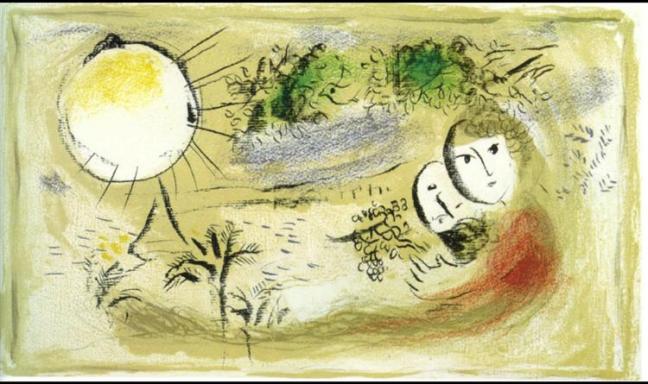
‘The rest’ – Marc Chagall, 1968 – WikiArt

There is no ambiguity with God. This has been said in a thousand different ways, in every corner of every page of the Bible for example, that God is with us, that there is in us, as us, a presence hidden in plain sight, that won’t let go of us ever. That it is the very making of ourself, our sublime identity — what we live our life with and could never depart from. We couldn’t doubt it in the least, for with just the right kind of looking, and with no effort whatsoever, we could see it, feel it, sense it, that we are that, and not truly our body or mind, let alone our thoughts, our story, our problems, our suffering. “I am with you always, to the end of the age”, that’s from ‘Matthew 28:20’. So there is no worry to be had. We are not alone. That’s just an impression, an invention, that we are separate, insecure, fragile. In fact, we couldn’t be without it. In ‘Zephaniah 3:17’, they say “The Lord your God is in your midst”. That’s what they mean, that our mind finds its ground in this very presence, in this being of ours that is in fact borrowed from God’s being. In ‘1 Corinthians 3:16’, they are even more specific, clearer on that subject, “God’s Spirit dwells in you”. It couldn’t be plainer and clearer. Why don’t we listen?

And we profit from an inbuilt, intrinsic protection in our life. After all, haven’t we gone through illnesses and floods, through a thousand aches, and is not death itself called eternal rest? Haven’t we lived in the constant grip of desire and worry, hassled by a quiet, ever going despair? And yet, are we not beautiful now as we are, after having gone through all this? Are we not pristine beings, untouched by it all, made of this unsurpassable, never changing awareness of being? In ‘Isaiah 41:10’, God is reported to have said: “I will strengthen you, I will help you, I will uphold you with my righteous right hand.” And in ‘Zephaniah 3:17’, it is written that God is the “mighty one who will save”. They wouldn’t say that if they don’t mean it. But we won’t be saved in an hypothetical future, at the time of death. We are being saved now, kept virgin of every objective experience, if we are willing to look. Furthermore, there is an inner peace that has landed in and as our very being since time immemorial. This inner peace expresses itself as joy or love, which we have experienced even amongst our ignorance. Isn’t life worth living for these fleeting moments of joy? And isn’t love our most precious, cherished, sought after experience, that seems to be a miracle beyond understanding? In ‘Zephaniah 3:17’, they say, clothed in the most exquisite poetry: “He will rejoice over you with gladness; he will quiet you by his love; he will exult over you with loud singing.”

So, as is advised in ‘1 Chronicles 16:11’, “Seek the Lord and his strength; seek his presence continually!” Which means we ought to stay with that part of ourself that lies peacefully below the hustle and bustle of existence, before everything that can be pointed at and named, and that is therefore not truly ourself. But God is not happy with only being our being, with filling us with its own infinite being. This presence is also made of the gorgeous fabric of love. This is where love finds its reality, in the innocence of our being, in awareness. So if we love, this love is not our own. We have not manufactured it, let alone directed it. “We love because he first loved us”, it is said in ‘1 John 4:19’. This is what our being feels like, when it is kept pure, unsoiled by our attachment to experience. Love is what we feel when we have relinquished everything in ourself that is mistakingly taken to be us, but is not. In ‘1 John 4:19’, we are being reminded of this eternal truth, that “God is love, and whoever abides in love abides in God, and God abides in him.” And this love, this being of God, is not something that can be had. It lives and breathes only through our being it. The world of things, of objectivity, cannot apprehend it, “cannot receive, because it neither sees him nor knows him”, as is said in ‘John 14:17’. So we are it, not have it, not know it. As long as we believe to be an entity, a something, a someone, we have separated ourself from our reality as God or consciousness. Yet everything, everyone, is eternally made of this being, which is God’s being, and finds its identity and essence as that. After all, didn’t God make that very clear, when saying in ‘Jeremiah 23:24’, “Do I not fill heaven and earth?” To which God could have added: I am all beings and all things, their secret identity, their essence which is only spirit. As I have said and proved a zillion times: ‘I am with you always’.

.

~~~

Quotes taken from the Bible

Text by Alain Joly

Painting by Marc Chagall (1887-1985)

~~~

.

Website:
Marc Chagall (Wikipedia)

Suggestion:
– Other ‘Shreds of Infinity’ from the blog…

.
I have Called You by My Name

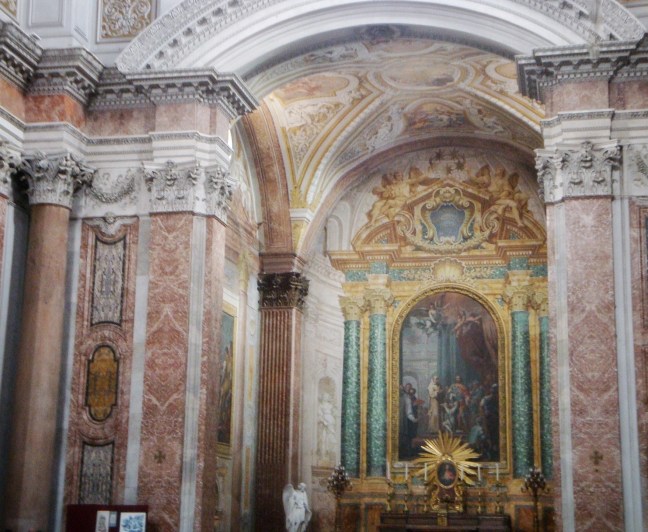
‘Basilica of St. Mary of the Angels and the Martyrs’ in Roma

.

I – luminous, open, empty Awareness – 
am the truth of your Being and am 
eternally with you, in you, as you, 
shining quietly at the heart of all experience. 
Just turn towards Me, and acknowledge Me, 
and I will take you into Myself
.”
~ Rupert Spira

.

In some of the religious texts of the world, the subtlest expressions of truth are so deeply buried in the text that they have become unintelligible. The limitations of translation, the analogies and metaphors borrowed, the time in which these texts appeared, the audience for which they were written, the veneer of poetry or story-telling, all these concur to add multiple layers of confusing elements to the original idea. And these texts have also served such inappropriate religious purposes in the course of history that they are, for all these many reasons, rejected or misunderstood by many. The Christian Bible is one such text. 

I have here attempted to find exquisite passages from the Bible, where the veneer is cracking and the hidden meanings shine more brightly. For a clearer understanding, I have selected two excerpts by Rupert Spira that will help focusing on one possible expression of truth and how it comes to be hidden behind the most innocent line in the Old Testament. They make for a necessary and beautiful introduction. They are borrowed from a video called ‘The Memory of Eternity’ in Buckland Hall, Dec. 2018. I hope you enjoy, for when we come to these texts with the right perspective or understanding, they come shining with a new glow of truth…

~

Our mind is just a temporary limitation or localisation of the only mind there is, infinite consciousness or god’s infinite being. So our mind is permeated with the memory of eternity, permeated by the memory of its origin. Why? Because it is made of it, although it is a limited version of it. So in everybody’s mind, there lies this memory of its own eternity. And that memory is felt by a person as the longing for happiness, or the longing for love. When we long for happiness, or we long for love, we are desiring to be divested of everything that limits us. We are designed to go back to our wholeness, our fullness, our sense of fulfilment, or completion. That’s why everybody longs for happiness or love. What people do to find happiness or love varies. But the actual longing itself is because there lives in everybody’s heart a memory of our eternity, the knowledge of our origin, or in religious language, a trace of God’s mind.

There is this beautiful line in the Old Testament, in the Book of Isaiah, where Isaiah says (Isaiah speaking on behalf of God): “I have called you by my name. You are mine.” I have called you by my name. I have planted my name in your mind. The name your mind gives to itself — that is the name ‘I’ — is the name of ‘me’. So the ‘me’ (God is saying) the ‘me’ in ‘you’ is in fact the ‘me’ in ‘me’. I have called you by ‘my’ name. That makes the ‘you’ of ’you’, ‘mine’ — or ‘me’. […] Everybody’s experience is permeated by what they call ‘I’. Experience is limited and individual, but the ‘I’, the self that permeates all experience doesn’t share the limits of experience. So Isaiah is saying that ‘I’ is God’s mind in our mind. It’s not even God’s mind in our mind. All there is to our mind is God’s mind, with a limit attached to it. That’s what seems to make it ‘me-the person’. But the ‘me’ of ‘me-the person’ is infinite consciousness.”
– Rupert Spira (‘The Memory of Eternity’ – Buckland Hall, Dec. 2018)

[…]

Read some beautiful expressions of truth from the Bible… (READ MORE…)

.

Search me, O God

I am presenting here a text excerpted from the Christian Old Testament, in the Bible. It is commonly known as Psalm 139, and belongs to the Book of Psalms. ’Psalm’ in Greek means ‘instrumental music’ and is by extension, a hymn. These hymns are mostly praises to God. This particular Psalm was brought to my knowledge by Rupert Spira. This is certainly one of the richest for it expresses the all knowing and pervasiveness of God, of that deep presence that is the nature and heart of our utmost self. It also stresses that this presence shines in all circumstances, including in our darkest hours. The psalm seems to hold in itself the soft power of a prayer, which is the ability to make us aware of our true self. For this is the function of a prayer, to throw us back into our self, into the deep silence that is the core of our being. As Stephen Mitchell wrote in ‘A Book of Psalms’, “Pure prayer begins at the threshold of silence. It says nothing, asks for nothing. It is a kind of listening. The deeper the listening, the less we listen for, until silence itself becomes the voice of God.” Listen to the depth of this poem. As its promise reads, you may be led “in the way everlasting”.

~

.

O lord, thou hast searched me, 
     and known me.
Thou knowest my downsitting and mine uprising, 
     thou understandest my thought afar off.
Thou compassest my path and my lying down, 
     and art acquainted with all my ways.
For there is not a word in my tongue, 
     but, lo, O Lord, thou knowest it altogether.
Thou hast beset me behind and before, 
     and laid thine hand upon me.
Such knowledge is too wonderful for me; 
      it is high, I cannot attain unto it.

Whither shall I go from thy spirit? 
     or whither shall I flee from thy presence?
If I ascend up into heaven, thou art there: 
     if I make my bed in hell, behold, thou art there.
If I take the wings of the morning, 
     and dwell in the uttermost parts of the sea;
Even there shall thy hand lead me, 
     and thy right hand shall hold me.
If I say, Surely the darkness shall cover me; 
     even the night shall be light about me.
Yea, the darkness hideth not from thee; 
     but the night shineth as the day: 
     the darkness and the light are both alike to thee.

For thou hast possessed my reins: 
     thou hast covered me in my mother’s womb.
I will praise thee; for I am fearfully and wonderfully made: 
     marvellous are thy works; 
     and that my soul knoweth right well.
My substance was not hid from thee, 
     when I was made in secret, and curiously wrought 
     in the lowest parts of the earth.
Thine eyes did see my substance, yet being unperfect; and in thy book 
     all my members were written, which in continuance were fashioned, 
     when as yet there was none of them.
How precious also are thy thoughts unto me, O God! 
     how great is the sum of them!
If I should count them, 
     they are more in number than the sand: 
     when I awake, I am still with thee.

[…]

Search me, O God, and know my heart: 
     try me, and know my thoughts:
And see if there be any wicked way in me, 
     and lead me in the way everlasting.

~ Psalm 139 (King James Version)

.

~~~

Psalm from the Holy Bible (King James Version)

Photo by Alain Joly

~~~

.

Bibliography:
– ‘The Book of Psalms: King James Version’ – (CreateSpace Independent Publishing Platform)
– ‘A Book of Psalms: Selected and Adapted from the Hebrew’ – by Stephen Mitchell – (Harper Perennial)

Websites:
The Bible (Wikipedia)
King James Version (Wikipedia)
Psalms (Wikipedia)
Psalm 139 (Wikipedia)

Suggestion:
Other prayers from the blog at Fragrance of Love

.