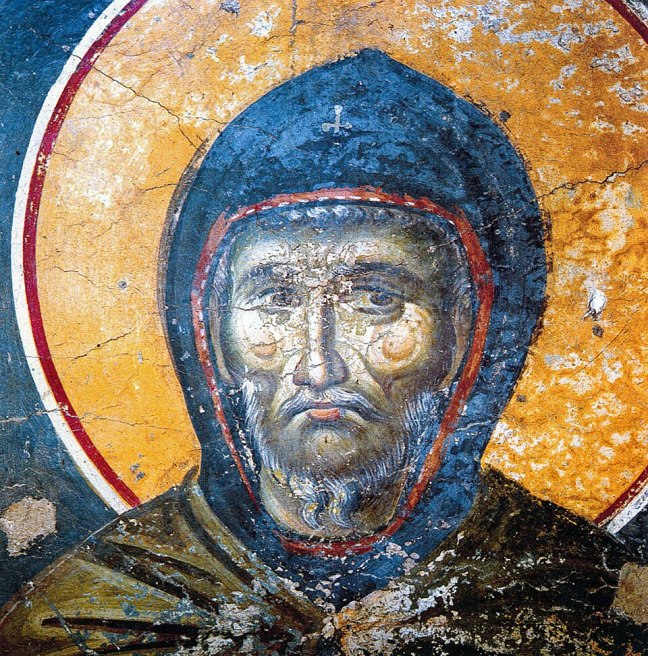
Huang Po

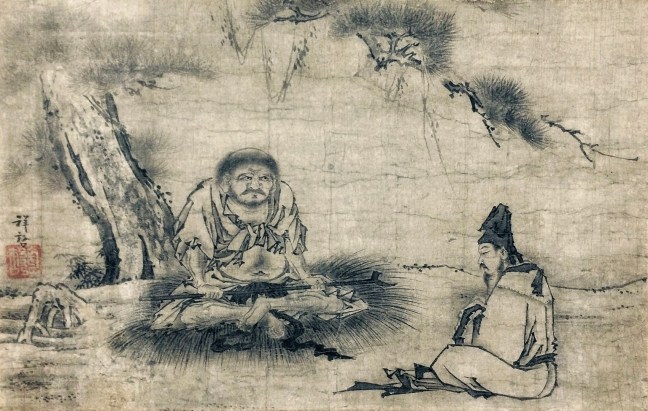
’Zen Encounter (Niaoke Daolin and Bai Juyi)’ – Kenko Shokei, 16th AD – Wikimedia

.

This Dharma is Mind, beyond which there is no Dharma;
and this Mind is the Dharma, beyond which there is no mind.”
~ Huang Po (Ch.7)

.

Every religion has its mystical counterpart, where beliefs, rituals, and book studies are replaced by self-investigation, direct experience, and understanding. Buddhism is no exception. Out of the nimbus of Buddha’s awakening came a single practice called by the simple word ‘chán’, which means ‘meditation’ (‘dhyāna’ in Sanskrit). Bound by the rigorous practice of watching their mind and recognising its true nature — which is called Buddha-Nature in Buddhism — a whole dynasty of influential Patriarchs and Masters have transmitted this tradition known as Zen in the West. Huang Po was one such eminent Chinese Master. His concise work called ‘On the Transmission of Mind’ is one of the world’s major expositions of truth. Recorded by the scholar of the time P’ei Hsiu, this collection of Huang Po’s sayings and sermons opens with this simple, illuminating phrase:

.
All the Buddhas and all sentient beings
are nothing but the One Mind,
beside which nothing exists.”
~ Huang Po (Ch.1)

.
In this book, Huang Po wants to make very clear and very simple, that all understanding, all mystery, all the content of Zen practice, is to be found here, in ourself, as ourself, as our Mind, and that this Mind of ours, of all of us, is the Buddha. In other words, what we take to be our everyday little, separate, private self is, when investigated, nothing but the one supreme being that we share with all other beings. This understanding is what Huang Po calls the Way. This is the only recognition that we need:

.
To awaken suddenly to the fact
that your own Mind is the Buddha,
that there is nothing to be attained
or a single action to be performed –
this is the Supreme Way.”
~ Huang Po (Ch.13)

[…]

Read more about the teaching of Chinese Zen master Huang Po… (READ MORE…)

.

The Carder of Innermost Souls

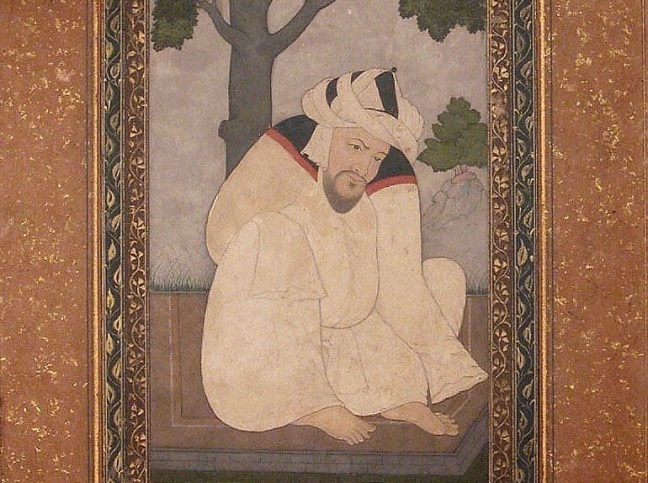
‘Portrait of a Sufi’ (part), 17th AD –Metropolitan Museum of Art – Public Domain

.

أنا الحق
Anā l-Ḥaqq
“I am the Truth.”
~ Mansur al-Hallaj

.

We all enjoy a good story. Here is one coming from far ago, in ancient Persia, where lived a man who became one of the most celebrated mystic, poet, and teacher of Sufism. Mansur al-Hallaj was born in 858 AD near Shiraz, in the Pars province of today’s Iran. He was considered an ‘al-Insān al-Kāmil’, which in the Islamic tradition is a honorific title meaning literally ‘the complete person’, a human being whose identity is merged with pure consciousness. Al-Hallaj is also known as the ‘Jesus of Islam’. He was tortured and publicly crucified for having pronounced the highly blasphemous statement: “I am the Truth”, which equals in Islam to saying ‘I am God’. The French scholar of Islam Louis Massignon wrote that al-Hallaj was “the most beautiful case of human passion that I had yet encountered, a life striving entirely towards a higher certainty.” The mystic’s last words were said to be:

.

Help me, O You only One,
to whom there is no second!
~ Al-Hallaj (‘I Am the Truth’)

.

From an early age, Mansur al-Hallaj was a devoted practitioner of truth. He grew up in a Sunni Muslim family and read the Quran at an early age, but he was irresistibly drawn towards the mystics. As a young man, he received the Sufi habit and moved to Basra in today’s Irak. After marrying, he began travelling extensively and made his first pilgrimage to Mecca, staying there for a year, facing the mosque in fasting and total silence. Although also the father of three children, he kept pursuing a life of devotion and started preaching to a growing number of followers. He became known as ‘ḥallāj al-asrār’, ‘the carder of innermost souls’, for his name ‘hallaj’ means ‘cotton-carder’. From that time on, he began writing exclusively in Arabic. His reverence for truth and the simplicity of his writing are here perceptible:

.

I have abandoned to the people
their religion and their customs
to dedicate myself to Thy love,
Thou my religion and my use.”
~ Al-Hallaj

.

”For your sake, I hurry over land and water;
For your sake, I cross the desert and split the mountain in two,
And turn my face from all things,
Until the time I reach the place
Where I am alone with You.”
~ Al-Hallaj (‘Perfume of the Desert’)

.

Know that Judaism, Christianity and Islam, like other religions,
are only denomination and appellation,
the goal sought through them never varies or changes.”
~ Al-Hallaj

.

[…]

.

The life and teaching of the ancient Sufi master Mansur al-Hallaj… (READ MORE…)

.

The Poetic Genius

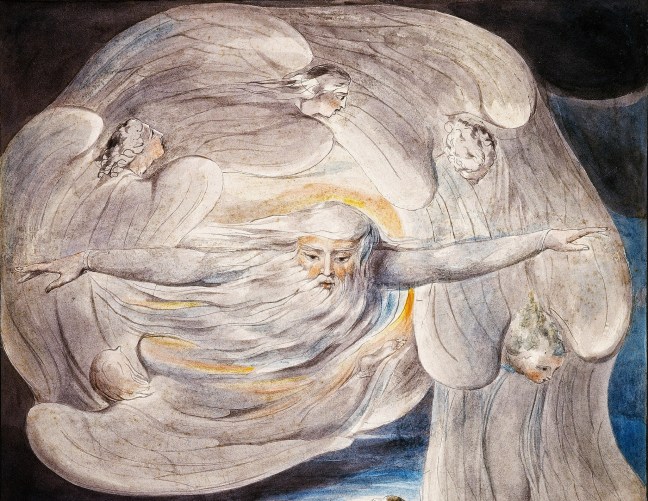
Job Confessing His Presumption to God’ (detail) – William Blake, 1803 – Wikimedia

.

I must Create a System, or be enslav’d by another Man’s;
I will not Reason and Compare: my business is to Create
.”
~ William Blake (‘Jerusalem’)

.

Artists, through their sensitivity to perception, their pointed quest towards beauty and harmony, are natural candidates for delving into the depth of reality and understanding their true nature. Many poets, painters, musicians, have been able to explore their being in ways that are traditionally the privilege of mystics. Indeed, they wrestle with eternity, and strive to find a way to convey it. William Blake was one such wrestler. He was a poet, painter and printer born in London in 1757. Although not recognised during his life, his art is bursting with creativity, intelligence, and vision. His profuse work, soaked with spiritual explorations, symbolic and personal mythologies, is not to be easily classified. Of William Blake, the 19th-century scholar William Michael Rossetti wrote that he was “a man not forestalled by predecessors, nor to be classed with contemporaries, nor to be replaced by known or readily surmisable successors“. Besides, his poetry is infused with pearls of the most profound non-dual understanding, which I invite you to explore here.

In his childhood, William Blake was fascinated by the work of great masters such as Raphael, Michelangelo, and Albrecht Dürer. He was educated at home, was given drawing lessons, and began writing poetry at an early age. Profoundly influenced by the Bible and Christianity, he was all his life gifted with visions and insights, from which he drew guidance and inspiration for his poetry and paintings. He was nevertheless not a follower, and developed his own vision and understanding. He was very critical of narrow-minded religiosity, or what he named the “general truth” or “general beauty“, writing uncompromisingly that: “To generalize is to be an idiot; To particularize is the alone distinction of merit“. William Blake wrote these enlightening verses about his religious endeavour and passion:

.
Trembling I sit day and night, my friends are astonish’d at me.
Yet they forgive my wanderings, I rest not from my great task!
To open the Eternal Worlds, to open the immortal Eyes
Of Man inwards into the Worlds of Thought: into Eternity
Ever expanding in the Bosom of God. the Human Imagination.”
~ ‘Jerusalem’ (Ch. 1, plate 5)

.
When will the Resurrection come, to deliver the sleeping body
From corruptibility? O when, Lord Jesus, wilt thou come?
Tarry no longer; for my soul lies at the gates of death:
I will arise and look forth for the morning of the grave:
I will go down to the sepulchre and see if morning breaks.
I will go down to self-annihilation and eternal death
Lest the Last Judgment come and find me unannihilate
And I be seized and given into the hands of my own selfhood.”
~ ‘Milton’ (Book the First)

[…]

An exploration of William Blake’s non-dual pearls and poetry… (READ MORE…)

.

The Golden Speaker

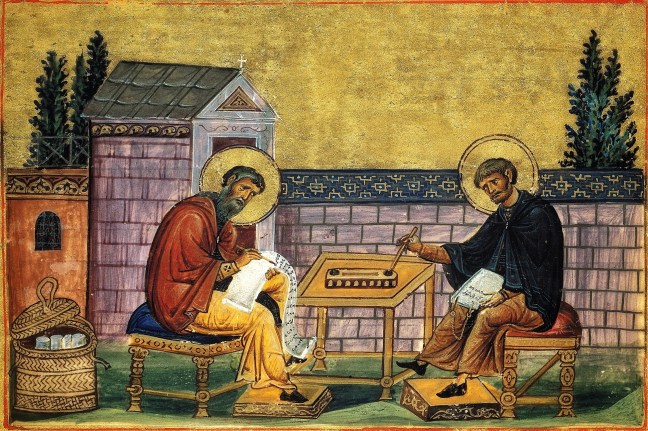
‘Saints John of Damascus and Cosmas’ – Menologion of Basil II, 11th AD – Wikimedia

.

The knowledge of the existence of God is implanted in us by nature.”
~ John of Damascus

.

In spiritual matters, it is always a pleasure and a thrill to find a new gem, to mingle with a different formulation, to venture for a while with an old, unexpected description of the perennial understanding; in more simple terms, to stumble on a new exponent of the eternal truth. John of Damascus is one such talented teller, to the point of having been named, in his own remote time, the ‘golden speaker’, or literally — and even more poetically — ‘streaming with gold’ (from the Greek ‘Chrysorroas’). John of Damascus was born in 675-676 AD to a prominent and wealthy Arab-Christian Damascene family. He is known to have composed many hymns and canons that are still sung today, and has written treatises, teachings, and other works, amongst which a highly influential synthesis of Christian philosophy called ‘The Fountain of Wisdom’.

Although raised in a rich and influential family, John became so dissatisfied that he relinquished all his possessions at around the age of 40, becoming a priest and a monk in a monastery near Jerusalem, where he spent the rest of his life studying, writing, and composing. The excerpts presented here are borrowed from the last volume of John’s work ‘The Fountain of Wisdom’, translated by S. D. F. Salmond, called ‘An Exact Exposition of the Orthodox Faith’. In Book I, Chapter 1, John shows in a few eloquent quotes, that God is not to be apprehended in objects. It is empty and unreachable by thought or the mind. However, God is not knowable outside of, or away from ourself, but only in and as our very own self. In consequence, the nature of God as awareness is self-sufficient, and doesn’t need to find peace and happiness outside itself, in the objects of experience, which would rob God — and ourself — of Its/our divine nature…

No one hath seen God at any time. […]
The Deity, therefore, is ineffable and incomprehensible
.”

God, however, did not leave us in absolute ignorance.
For the knowledge of God’s existence has been implanted by Him in all by nature
.”

No one knoweth the Father, save the Son, nor the Son, save the Father. […]
[no one] has ever known God, save he to whom He revealed Himself
.”

The Divine nature […] is both passionless and only good.”

[…]

Discover the life and insightful writings of John of Damascus… (READ MORE…)

.

On Parmenides

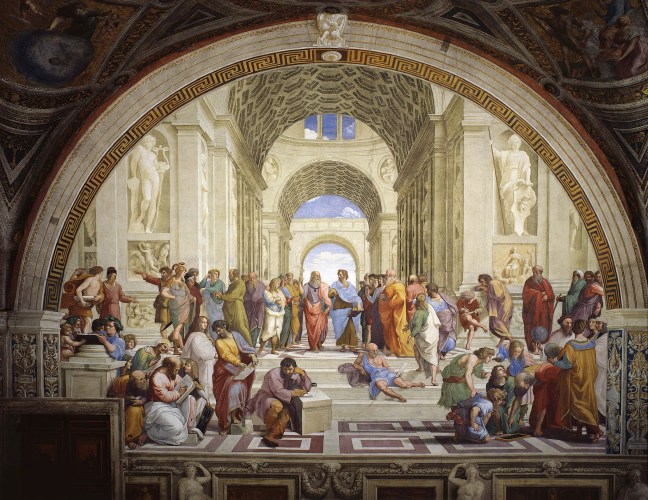
‘The School of Athens’ – by Raphael, 1509 (fresco at the Vatican City) – Wikimedia

.

There is nothing,
and there will never be anything,
outside of being
.”
~ Parmenides (trans. Francis Lucille)

.

The Oxford Dictionary wrote this very concise description of Parmenides: “Greek philosopher. Born in Elea in south-western Italy, he founded the Eleatic school of philosophers. In his work ‘On Nature’, written in hexameter verse, he maintained that the apparent motion and changing forms of the universe are in fact manifestations of an unchanging and indivisible reality.” This statement is a quintessential definition of non-duality, and a summary of Parmenides’ work expressed as far as the early fifth century BC, in the cradle of western civilisation. The depth of understanding and vision required to make such statement has puzzled and influenced many a philosopher since, and has aroused the interest of countless spiritual seekers. This spiritual message is worth a good attention here.

Parmenides is the author of one single work, a poem of which only fragments have remained over the years. It survived because the around 800-verse original poem was abundantly quoted by his pairs, and could be re-formed in a shorter version, as known today, of 160 verses. His poem, today translated as ‘On Nature’, ‘On Reality’, or simply ‘Fragments’, is comprised of three parts of which the second and most important has survived in its almost entirety.

[…]

A study of Parmenides’ statement of truth in his poem ‘On Nature’… (READ MORE…)

.

The Mystical Doctor

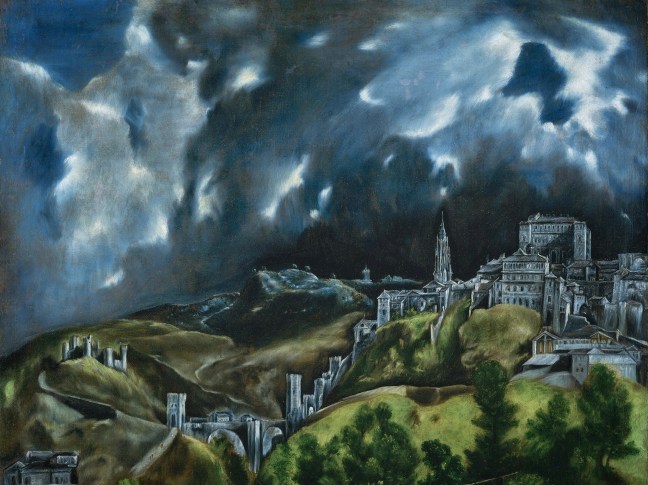
‘View of Toledo’ – El Greco, 1596 (Metropolitan Museum of Art) – Wikimedia

.During the night of 2 December 1577, in the city of Toledo in central Spain, a priest was imprisoned by a group of Carmelites who were refusing Teresa of Ávila’s reformation projects for their Order. He was jailed for 9 months in a monastery under brutal conditions. He was publicly beaten at least weekly, confined in a cell of barely 10 by 6 feet, with only a little light passing through a hole during the day, with bread and scraps of salt fish for a meal, and no change of clothes. But his burning love of god, along with his unfailing devotion and clarity of mind, allowed the 35 years old friar to compose, along with other shorter poems, the greater part of a sumptuous poem — ‘The Spiritual Canticle’ — about a bride’s search for her beloved. The poem, symbolising the soul seeking union with god, and inspired by the ‘Songs of Songs’ of the Bible, starts with these eloquent lines:.

Where have You hidden Yourself,
And abandoned me in my groaning, O my Beloved?
You have fled like the hart,
Having wounded me.
I ran after You, crying; but You were gone
.”
~ ‘The Spiritual Canticle’

The name of this priest and poet was John of the Cross, a Spanish Catholic mystic born in 1542 near Ávila, to whom we owe some of the brightest exposition of truth in the Christian world. Thomas Merton, who held him in very high esteem, presented him as “one of the greatest as well as the safest mystical theologians God has given to His Church.” John of the Cross was born in a poor family of Jewish converts to Catholicism, and received a simple education. He entered the Carmelite Order, made his First Profession when 21, and met Teresa of Ávila a few years later, of whom he remained a faithful associate all his life. Although not a scholar, his studies in theology and philosophy allowed him to quote abundantly from the Bible, and be acquainted with the work of St. Thomas Aquinas.

Although I have chosen to quote here only from the poem ‘The Spiritual Canticle’, John of the Cross is the author of many other poems, among which the renowned ‘The Dark Night’ — better known as ‘The Dark Night of the Soul’ — and ‘The Ascent of Mount Carmel’. His poems have a rich and powerful imagery and are considered to be masterpieces of Spanish poetry. Although they transpire with beauty and meaning, they are not to be readily understood. This is why John of the Cross wrote precise and extensive commentaries on them, some soaring pieces of teaching whose beauty and profundity is sometimes breathtaking. The most exquisite poetry is here going hand in hand with both a great depth of understanding, and the sweetest accents of devotion. The commentaries were written in prose but are here occasionally presented in a free verse form when they lent themselves to it. I am sharing the 1909 translation made by David Lewis, with corrections by Benedict Zimmerman. Listen with what tender accents of poetry and longing the bride is here conversing with her bridegroom, and how a suffering soul who has tasted of the divine is longing for “the secret chamber of God”, which is nothing but the pure consciousness that is hiding in our innermost being:

.
O you soul, then, most beautiful of creatures,
who so long to know the place where your Beloved is,
that you may seek Him, and be united to Him,
you know now that you are yourself
that very tabernacle where He dwells,
the secret chamber of His retreat where He is hidden.
Rejoice, therefore, and exult, because all your good
and all your hope is so near you as to be within you;
or, to speak more accurately, that you can not be without it.”
~ ‘The Spiritual Canticle’, 1.8 (Commentaries)

[…]

Discover the rich poetry and commentaries of John of the Cross… (READ MORE…)

.

Wei Wu Wei

‘Hotei in a Boat’ – Hakuin Ekaku (1686-1769) – Yale University Art Gallery – Wikimedia

.

When could I have been born,
I who am the conceiver of time itself?
Where could I live,
I who conceive the space wherein all things extend?
How could I die,
I who conceive the birth, life, and death of all things,
I who, conceiving, cannot be conceived?

~ Wei Wu Wei (Posthumous Pieces)

.

You may have sometime come across the name ‘Wei Wu Wei’ while reading or researching, and you have thought that it referred to an exotic and remote Zen master of ancient China. Well, you couldn’t have been more wrong. For this is the pen name of a British aristocrat and writer of the last century. His name: Terence James Stannus Gray, who was born in 1895 and died in 1986, the very same years as J. Krishnamurti. ‘Wu Wei’ is nevertheless a Taoist term which literally means ‘effortless action’ or ‘action that is non-action’, and was chosen by the author for the meaning it carries. Regarding his name, the writer explains in the preface of his book ‘Fingers Pointing Towards The Moon’: “What is a name? […] Is not a name essentially — the name of an ego? But the Self, the Principal, the I-Reality has no name. […] If the nameless builders of the Taj Mahal, of Chartres, of Rheims, of a hundred cathedral symphonies, knew that — and avoided the solecism of attributing to their own egos the works that were created through their instrumentality — may not even a jotter-down of passing metaphysical notions know it also?” He continued: “But in case you should still wonder who is responsible for this book I do not know how to do better than to inscribe the words

WEI WU WEI

為無為

~

Why are you unhappy?
Because 99.9 per cent
Of everything you think,
And of everything you do,
Is for yourself —
And there isn’t one
.”
~ (‘Ask The Awakened’)

[…]

Discover the rich and insightful nondual writing of Wei Wu Wei… (READ MORE…)

.