
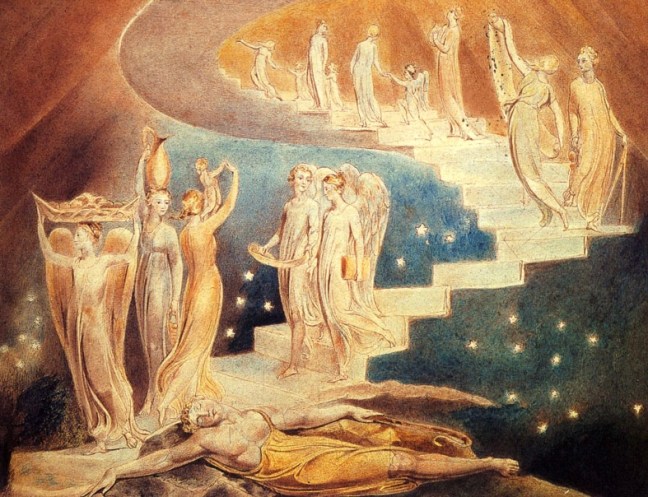
‘Jacob’s Ladder’ – William Blake, c.1799-1806 (part) – WikiArt
You shouldn’t waste even the smallest portion of beauty. You know, the landscape that happens to be before your eyes, or the colours of autumn, the glistening leaves after the rain. There is beauty everywhere, in a sky, a movement, the drifting of clouds, the smile that you catch in a street. There is nothing small in the noticing of it, for it extends far beyond what you have been encouraged to believe. Beauty doesn’t come randomly, or by accident. It is in the nature of things. It takes its source in the infinite, which is everywhere your eyes land on, every time your mind is willing to notice its own boundless nature.
The same goes for love. A tiny love is to be treated with honour and awe. For every love is the birth of a love that pervades the totality of experience and nourishes your very soul and being. So don’t despise a smaller love for want of a better, grander, desired Love. Every experience carries within itself everything that you have longed for. Every desire for peace, love, or beauty is already fulfilled within your very own being, which you carry with you in every imperfect situation, in every random, fleeting moment of beauty, in every broken, shaky surging of a shy expression of love. Experience is constantly nourishing you with everything you need to converse and blend with your own divine, eternal nature.
So be interested in beauty itself, not in what is beautiful, not in the form. Go for the quality itself, to what will lead you to yourself. Be fascinated by love, not by the object of love. It will lead you to discover that love is your very nature, and has no true object except itself. Rest in every tiny moment of peace, between two thoughts, between two fascinations for an object. You will come to see that peace in fact pervades your very nature, and that this peace is another name for beauty, or love, or understanding. Make your whole life a prayer for one form only, which is the very form of your own nature, which you will recognise not in the many, but in the one nature that gives rise to the many. That one nature is yourself too.
There is nothing new here. This teaching is mentioned in Plato’s Symposium, through the words of an ancient priestess called Diotima. She referred to it as the ‘Ladder of Love’, for you are led to see that it is beauty which you have to pursue now — not the form — and that pursuing beauty, you will come to its essence. Of one such seeker, it is said in ‘The Ascent, 210a-e’ and ‘The Vision, 210e-211b’, through the voice of Diotima:
“Soon he will of himself perceive that the beauty of one form is truly related to the beauty of another; and then if beauty of form in general is his pursuit, how foolish would he be not to recognize that the beauty in every form is one and the same!”
“In the next stage he will consider that the beauty of the mind is more honourable than the beauty of the outward form.”
“[He will] understand that all is of one kindred, and that personal beauty is only a trifle.”
“[He will be] not like a servant in love with the beauty of one youth or man or institution, himself a slave mean and narrow-minded, but drawing towards and contemplating the vast sea of beauty.”
“Until on that shore he grows and waxes strong, and at last the vision is revealed to him of a single science, which is the science of beauty everywhere.”
“[He] will suddenly perceive a nature of wondrous beauty, a nature which in the first place is everlasting, not growing and decaying, or waxing and waning.”
“And the true order of going, or being led by another, to the things of love, is to begin from the beauties of earth and mount upwards for the sake of that other beauty, using these as steps only, and from one going on to two, and from two to all fair forms, and from fair forms to fair practices, and from fair practices to fair notions, until from fair notions he arrives at the notion of absolute beauty, and at last knows what the essence of beauty is.”
.
~~~
Text by Alain Joly
Quotes by Plato in ‘Symposium’ (c.428–347 BC)
Painting by William Blake (1757-1827)
~~~
.
Bibliography:
– ‘The Symposium’ – by Plato (trans. Benjamin Jowett) – CreateSpace Independent Publishing Platform
Websites:
– Diotima of Mantinea (Wikipedia)
– Symposium (Wikipedia)
– William Blake (Wikipedia)
Suggestion:
– Other ‘Shreds of Infinity’ from the blog…
.

