A Perfect Bull’s-eye

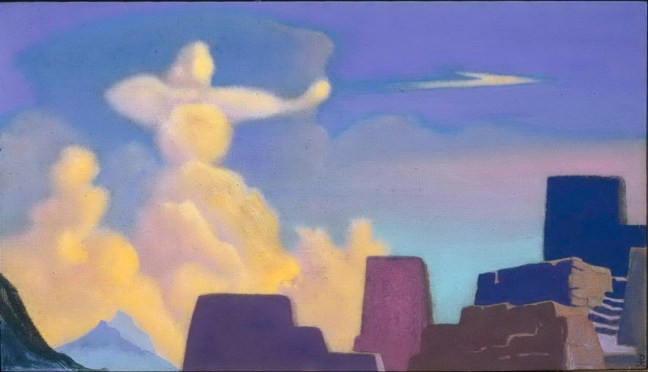
‘Defender. Cloud-archer.’ – Nicholas Roerich, 1937 – WikiArt

The Mullah Nasruddin is what could be called a sublime idiot. He is a liar, irreverent, a disturber of peace. But he is also ingenious, free, full of wit, a timeless figure whose stories have spread and been adapted the world over. In the Sufi tradition, they were used for study purposes. “There is the joke, the moral — and the little extra which brings the consciousness of the potential mystic a little further on the way to realisation.” writes Idries Shah.

~

The Mullah Nasruddin brought his students to the fair so that they could watch him compete in the archery contest. Before his first shot, the Mullah fixed his cap military style and, assuming a soldier’s posture, drew the bow and fired. The arrow missed the target completely, and the crowd roared with derisive laughter.

Then he picked up the bow again, this time with little strength, and shot the second arrow. It flew straight, but landed far short of the mark. Again, the onlookers guffawed. For the last of his three allotted shots, Nasruddin nonchalantly turned to face the target, aimed, and let fly. It was a perfect bull’s-eye.

The crowd went wild, then fell into a stunned silence. Nasruddin chose the moment to take his prize and indifferently started to walk on. 

But his students and the astonished throng demanded an explanation. 

Nasruddin complied and told them, “For the first shot, I was identified with a soldier, face-to-face with the enemy. Fear made the arrow miss. With the second shot, I became like the man who, having failed miserably with the first shot, was so anxious and eager he could not concentrate. He simply had no power.”

“And the third shot?” inquired a brave soul. “Who fired that one?” 

“That? Oh, that was me.”

~

Nasruddin’s pointers:
Nasruddin makes the point perfectly clear. Why is it that to be ‘me’, I think that I have to do something? I have to pretend, imitate, add, subtract, hide, and god knows what else. I make such efforts, such desperate attempts, at being myself, and yet it’s not really working. I fail again and again at being just myself. I am only myself plus. But simply being my plain, simple self, I’m not. I miss the mark. And then I find ways to reconcile my various fabricated selves into an acceptable one. One that would make a little sense, that would have some kind of logic, that would  be presentable to the world. Well, it seems that there is too much thinking that goes into it, isn’t there? So how can I be ‘me’? Nasruddin is almost discarding this ‘being me’, brushing it aside very matter-of-factly. He seems to imply that ‘being me’ is the simplest thing to achieve. It’s not even worth considering. I am ‘me’ by only ‘being’. There is no ‘more’ in simply being. And don’t think that this is too easy, too universal, not enough the fancy ‘me’ that you’ve been trying to be for so long — and all along failing it so miserably. Listen carefully: This ‘being’ is the ‘me’ that has been perfectly designed for the ‘you’ that you truly are. No ‘me’ could ever be more ‘you’ than this me-being, this ‘I am’. This ‘being’ will make your life easier, happier. You will never miss the mark with ‘I am’. For the mark is yourself. And see for yourself: by being my most precious, simple self, I already am that, that I am. See? This is a perfect bull’s-eye! Nasruddin knew it all along. What clever man he is! Always hitting the target — as far as his true Self is concerned!

.

~~~

.

The Nasruddin’s story is borrowed from ‘365 Spirit: A Daily Journey for Your Soul’ – by Aaron Zerah – (A to Z Spirit Publishing).

‘Nasruddin’s pointers’ is by Alain Joly

Bibliography:
– ‘365 Spirit: A Daily Journey for Your Soul’ – by Aaron Zerah – (A to Z Spirit Publishing)
– ‘Every Day is a Blessing: 365 Illuminations to Lift the Spirit’ – by Aaron Zerah – (Grand Central Publishing)
– ‘As You Grieve: Consoling Words from Around the World’ – by Aaron Zerah – (Sorin Book, U.S.)
– ‘The Exploits of the Incomparable Mulla Nasrudin’ – by Idries Shah – (ISF Publishing)
– ‘Nasreddin Hodja: 100 tales in verse’ – by Raj Arumugam – (CreateSpace Independent Publishing Platform)

Websites:
A to Z Spirit (Aaron Zerah’s website)
Nasreddin Hodja (Wikipedia)
The Idries Shah Foundation
Nicholas Roerich (Wikipedia)

Suggestions:
Self Recognition (An interrogation by Nasreddin Hodja…)
I Am Nobody (The newly discovered identity of Nasreddin Hodja…)
Hodja Tells the Truth (A story where Nasreddin Hodja tells the truth…)

.

The Song of Ashtavakra

Photo by Nick Kenrick.. on Foter.com / CC BY-NC-SA

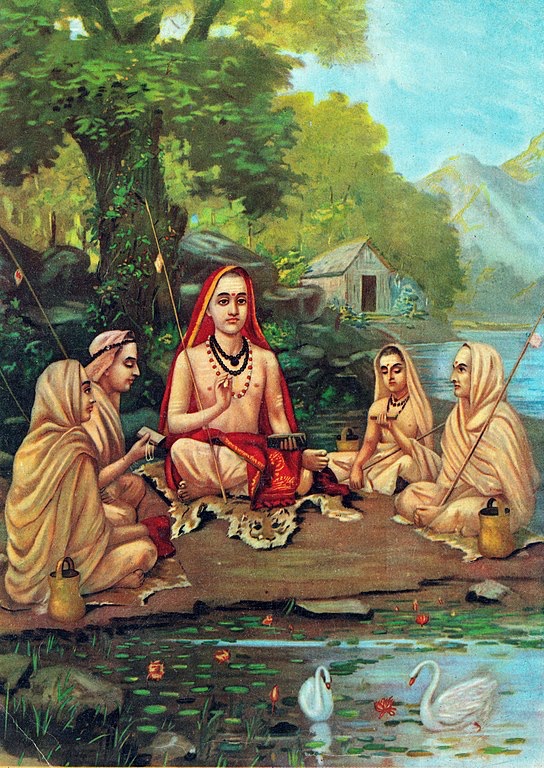
I’m sharing here the Ashtavakra Gita, in the translation of John Richards. This is a famous song and landmark of non-duality in India. It has been composed in Sanskrit as a dialogue between the eminent sage Ashtavakra and his brilliant disciple Janaka, also king of Mithila. It was allegedly written around the third Century BC although some scholars dated it in the eighth Century AD, at the period of Shankara. The author is unknown and the characters are borrowed from the ancient epics of India. ‘Ashtavakra’ means ‘eight bends’, for he has a deformed body. This is a short work of 300 verses, and was one of the favourites of Ramakrishna and Ramana Maharshi. In this dialogue, the process of enlightenment is easily dealt with, for Janaka is, in Ramesh Balsekar’s words, “a superbly ‘ripe’ disciple, one who is just waiting for that one quick spark of initiation into Truth that brings about sudden enlightenment.” The dialogue quickly moves to be an exposition of truth by two equally enlightened beings. Yet, a process is here at work, between the guru and his disciple, between truth and the slow movement towards full understanding, between the one reality and the many roads and aspects that lead to a total and definitive grasp of it…

.

अष्टावक्रगीता

.

Chapter I

Instruction on Self-Realisation

King Janaka asks the question that provoked Ashtavakra’s plain and direct exposition of truth…

Your real nature is as the one perfect, free, 
and actionless consciousness, the all-pervading witness 
– unattached to anything, desireless and at peace. 
It is from illusion that you seem to be involved in samsara
.”

.

Janaka asked:

How is knowledge to be acquired? How is liberation to be attained? And how is dispassion to be reached? Tell me this, sir.

Ashtavakra replied:

If you are seeking liberation, my son, shun the objects of the senses like poison. Practise tolerance, sincerity, compassion, contentment and truthfulness like nectar.

You are neither earth, water, fire, air or even ether. For liberation know yourself as consisting of consciousness, the witness of these.

If only you will remain resting in consciousness, seeing yourself as distinct from the body, then even now you will become happy, peaceful and free from bonds.

You do not belong to the brahmin or any other caste, you are not at any stage, nor are you anything that the eye can see. You are unattached and formless, the witness of everything – so be happy.

Righteousness and unrighteousness, pleasure and pain are purely of the mind and are no concern of yours. You are neither the doer nor the reaper of the consequences, so you are always free.

You are the one witness of everything, and are always totally free. The cause of your bondage is that you see the witness as something other than this.

[…]

Continue reading the beautiful teaching of Ashtavakra… (READ MORE…)

.

This is Meister Eckhart

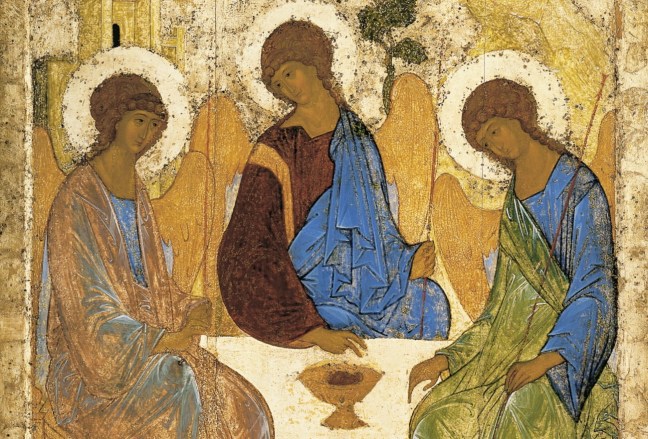
‘Trinity’ – Andrei Rublev, 1410-1420 – WikiArt

.

The eye wherein I see God 
is the same eye wherein God sees me; 
my eye and God’s eye are one eye, 
one vision, one knowing, one love
.”
~ Meister Eckhart

.

In the Middle Ages, in the heart of Europe and of the Christian faith, rose a voice of such richness and profusion, of such dumbfounding wisdom and precision of thought, that it is a duty for all serious seekers to be reminded of it. The name shines with a polish of spiritual mastery and authority: Meister Eckhart. Eckhart von Hochheim OP was born in 1260 near Gotha in central Germany. OP stands in Latin for Order of Preachers, which is a mendicant order of the Catholic Church — better known as the Dominican Order — of which Meister Eckhart was a monk and a leader. His teaching and sermons left a deep impression but he was so ahead of his time and of the general understanding of his pairs, that his work went into oblivion only to reappear in the 19th century. His voice and light could not possibly be left unnoticed. He is now accepted as one of the most profound and eminent theologians, philosophers, and mystics of all times.

Little is known about his family and early life. From 1295 onwards, he held many posts of responsibility in various states of central Germany, and as far as Cologne or Strasbourg. Among others, he was a Prior of the Dominicans, managing tens of convents, and was later made Provincial of Saxony. He also travelled around Europe and more specifically to Paris where he studied Aristotle and the Platonists. With the degree of Master of Arts, he later on became a professor of theology at the school of Dominicans in the French capital and was invited as a magister — equal to the doctorate — for two consecutive years. At this time in Europe, during the Avignon Papacy, Christianity was prey to many tensions and confusion, the Inquisition was blowing a wind of suspicion and terror, as a result of which many new groups and movements were forming in search of new avenues of practice and understanding. It goes without saying that Meister Eckhart was a coveted source of wise counsel in these times of darkness. 

Let’s say it plainly: Meister Eckhart was a scholar, but it is as a preacher that he is most remembered. His sermons in the vernacular German were highly unusual for the time and took many a liberties with the conventional church rituals and dogmas. He stated: “When I preach, I usually speak of detachment and say that a man should be empty of self and all things.” […]

.

Blessed, supremely blessed, are they who are installed in the eternal now, 
transcending time and place and form and matter, 
unmoved by weal or woe or wealth or want, 
for in so far as things are motionless they are like eternity
.”
~ Sermon 16 

.

An exploration into the teachings of Meister Eckhart… (READ MORE…)

.

The Paradox

“You run into this amazingly beautiful paradox 
that there is no ‘I’ at all and ‘I’ is everywhere, 
and both of those are true simultaneously. 
It’s about as much fun as you could possibly have. 
There isn’t an ‘I’, and 
the only thing that exists is one big ‘I’
shining out of everything.”

~ Adyashanti 


~~~

Photograph by Jerry Katz

Quote by Adyashanti

~~~


Read ‘Jerry Katz: Let the Scene See You’ on Paula Marvelly’s blog ‘The Culturium’.

F73D470C-C4EC-42C3-A2BB-BBAC3CBF363CJERRY KATZ has been interested in human consciousness since childhood, and has investigated many spiritual teachings. He is also a landscape photographer. For him, “photography is a journey toward honesty, beauty and self-discovery.” Jerry is the creator of the website ‘Nonduality: The Varieties of Expression’. He also founded ‘Nonduality Salon’, a forum that recognizes and welcomes both the ‘impossible’ and the ‘worthwhile’ expressions of nonduality. Since 1998, Jerry has published a free daily email letter, ‘The Nondual Highlights’. He lives in Halifax, Nova Scotia.

Bibliography:
– ‘One: Essential Writings on Nonduality’ – by Jerry Katz – (1st Sentient Publications Ed)
– ‘Emptiness Dancing’ – by Adyashanti – (Sounds True Inc.)

Websites:
Nonduality: The Varieties of Expression (Jerry Katz’s website)
Nonduality Salon (Jerry’s group on Facebook)
Adyashanti


Be Still and Know

This was our last retreat there. In the old mansion that we so dearly loved. Amongst the rolling hills of Wales. Here we have listened and felt. Here we have known what needs to be known. We have felt our heart sing and thrive beyond measure. 

Here we sang together for the last time. A small improvised choir. A last song that is like a hymn for future days. Its lovely tune I cannot convey to you. But the words. Oh the words… Only listen and feel the heart of it. It goes:

Be still and know that I am God
And there is none besides me

The first injonction is ‘be still’. It’s a call. There is a wild world out there. Don’t run after every seducing thought. Don’t follow every glitter of experience. Be disinterested for once. Turn your head away. Say: I don’t want you! Try it.

Don’t let the world eat you. If anything, swallow it yourself! But do it softly. Let it go and disappear of its own accord. Be gentle. We don’t want to upset it. It needs to tell you more. Wait a little longer. You will be surprised.

Put yourself together. Find the place of togetherness in you. Stay there. See how good it feels. Be reunited with your own self. Make it happy. Make yours its sweet presence. Hear its heartfelt cry resonating. You’re here. At last! […]

Continue unraveling these verses from a song… (READ MORE…)


The Unattainable One

Parvathy Baul – Wikimedia

If you want to attain 
the unattainable One,
Free yourself from all that is
Fragile and temporary.
Know yourself
.”
~ Rasika Dasa


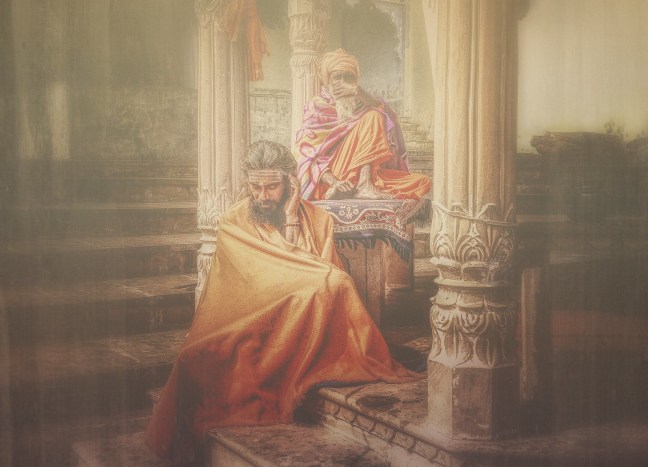
In the deepest villages of Bengal, there remains today a community of vagrant singers, both mystical bards and wandering minstrels, the Bauls. For centuries they have been treading the dust of the roads, with a firm and aerial step, at the rhythm of their daily needs and highest aspirations. The term ‘baul’, derived from the Sanskrit ‘vatulā’, means ’he who is affected, or carried away by the wind’. It might also refer to the term ‘vyakula’, meaning ‘impatient eagerness for god’, or ’auliyā’, a word of Arabic origin meaning ‘holy’, ‘ascetic’. But the asceticism of the Bauls is not lost in penances and meditations, is not only about achieving the set goal. It is rather a kind of refinement in the expression of the moment, a healthy ‘madness’ expressing through dance, music, and songs, the love of the divine and the spontaneity of living. Coming from both Hindu and Muslim religions, the Bauls retain nevertheless a fierce freedom of spirit and are rebellious to any ideology, following no ritual, referring to no scriptures. They are ’outside’, offbeat, refreshing and unique. […]

Continue reading about the Bauls of Bengal… (READ MORE…)


Benares my Love

One day long ago, I was stopped on my way, redirected as it were. It was one morning, the time of a glorious encounter with the subtle ethers of a city. Nothing would ever be the same. But what did I know at the time?

In Benares I met the Ganges. But it wasn’t a river. It was something calm, placid, yet charged with a force and power that I had never met before. At night, the river was still not a river. It was an absence, an emptiness. It was dark. And the boats that were aligned on it were like suspended, resting, immobile, placed here by something I could never comprehend. And the waters met here secretly with silence, in the crystalline air where a bell breathed an occasional, happy tone.

In Benares I saw the sun rising. But it wasn’t a sun. It was a bath of golden light spread above the waters. It was giving and fresh like all illumination must be. It was a pointer reminding us tirelessly to turn our attention on ourselves. It was not taken for granted but received. You were being exposed, as all beliefs and limitations ought to be. And in the evening, its setting amongst the heartfelt notes of a devotional song would send shivers down your spine. Then you knew. You would come again tomorrow to be clothed by its golden light. And you couldn’t wait.

A secret meeting with the city of Varanasi or Benares… (READ MORE…)