
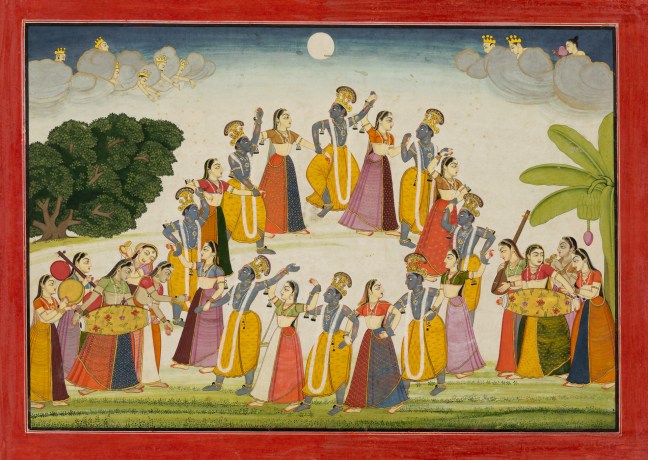
‘The Rasa Mandala Dance of Krishna and the Gopis’ – Anonymous, 1760 – Wikimedia
Arise, O Krishna! This is not a time for discretion. There is enchantment around the lake of experience. Ladies have come with fine clothes and jewellery to be adorned by you. You have to be their cup-bearer, the one presence giving to every forms of experience their gorgeous light. For what is a thought without the cup in which it grows, stands for a second, and disappears? Krishna, you alone are the meaning and beauty attached to every object that inhabit our daily living. So this is not a time to hide, but to reveal, to shed light, to glorify. The Gopis — the milkmaids of the Krishnaite folklore — have come to you in the effervescence of their longing. You are the reason for their looking so beautiful. They come to you to be revealed and embellished by your presence, by the one being that is their most precious jewel. So enter the round, O Krishna, and dance with every one of them.
Give to the thoughts that come and wander for a time in our minds their chamber of peace. Clothe them with clarity and intelligence. Appease the suffering of which they are the vehicle, and offer them the rest they deserve. Don’t let anyone unattended. Not a feeling should be left alone, frightened or sad, without benefiting from your warm embrace. No sensations should come along without your building for them a temple of awareness. Be the one present for all, infallible, unswerving. Should a Gopi be lost in the contemplation of nature, and you are here showering her vision with beauty. You are the noble harmony of every experience, and what confers to the dance of life the sweetest of melodies. And have you noticed, O Krishna, how your absence can throw a shadow of sorrow on every experience that passes unseen by you? And have you witnessed how acute is our longing for you, when you withdraw your loving gaze from the many happenings of our lives?
So now, with flowers in their hair, and boundlessness in their hearts, do the Gopis join in your endless round, O Krishna. You hold everyone, every experience, every object that stands lost and alone, in your loving arms. You create around them an armour of beauty, and clothe them in truth’s brightest apparel. That’s how we find the peace at the heart of experience: by marrying every appearance to the gentle presence that holds them. And that presence is ourself — who we are — now giving shape to every perception, every occurrence, sheltering them in the being that gives them protection and form. That’s how the Gopis are experienced as an emanation of Krishna, and how Krishna is seen to be their primordial cause. So now arise, O Krishna! Truly arise! We have come here in celebration of truth, to contemplate you and be contemplated by you. The set for the dance has been arranged. We have come to you enamoured as humble milkmaids, as the fervent Gopis of your heart.
.
~~~
Text by Alain Joly
Painting by Anonymous (1760-65)
~~~
.
Website:
– Raslila (Wikipedia)
Suggestion:
Other ‘Ways of Being’ from the blog…
.
 The Dawn Within