Sayings of the Church Fathers

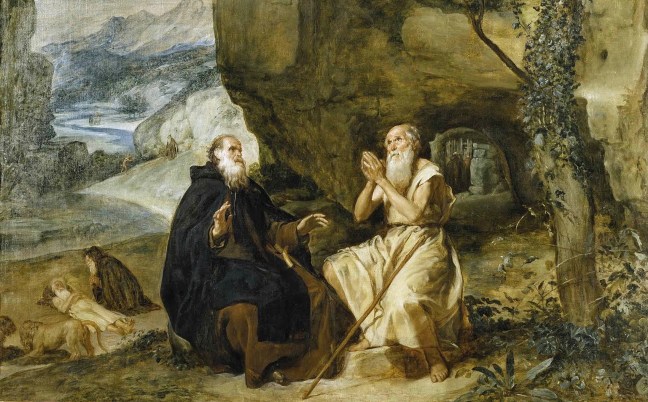
‘St. Anthony the Abbot and St. Paul the First Hermit’ – Diego Velazquez, 1635 – WikiArt

.

The whole earth is a living icon of the face of God.”
~ John of Damascus

.

The birth of a religion is always a time of effervescence. This was the case with Christianity, when appeared many monks, hermits, writers and theologians who contributed to build what would become the foundations of this religion. They were later called the Church Fathers, for they were the first Christians, who cleared the grounds. They took the teaching of Jesus and put it to the test, to the fire of experimentation. They explored it in Greek, in Latin, in Syriac, in silence, in poverty, in the desert, in knowledge. They were the first commentators, the first bishops, popes, exegetes, monks, martyrs of a religion that was still under construction. They came to it with fresh minds. They popped up from Syria, Egypt, Arabia, Turkey, Algeria, Italy, Spain, France, some of them still hungry to find out in their body and mind the traces of truth. They bore the evocative names of a distant time: Anthony the great, Moses the Black, Augustine of hippo, Papias of Hierapolis, Polycarp of Smyrna, Isaac of Nineveh, Maximus the confessor, and many more. Some of the oldest ones had been the direct students of the apostles. Others went to the desert where they lived in reclusion, as was the case with Anthony the Great.

Anthony the Great was born in 251 in Egypt. He was one of these Desert Fathers, and amongst the very first ones to live the hardships of a solitary life in the wilderness. For decades, he remained a strict ascetic. His purpose for doing so was clear enough: “The person who abides in solitude and quiet is delivered from fighting three battles: hearing, speech, and sight. Then there remains one battle to fight — the battle of the heart.” Towards the end of his life, he organised the many people who had finally gathered around him into the first body of monks in history, which is why he was later known as the ‘Father of All Monks’. He died in 356, leaving to his companions this very touching message: “Be earnest to keep your strong purpose, as though you were but now beginning. You know the demons who plot against you, you know how savage they are and how powerless; therefore, fear them not. Let Christ be as the breath you breathe; in Him put your trust. Live as dying daily, heeding yourselves and remembering the counsels you have heard from me. […] And now God save you, children, for Anthony departs and is with you no more.”

~

To one whose mind is sound, letters are needless.”

~

To say that God turns away from the sinful
is like saying that the sun hides from the blind
.”

[…]

Discover many more excerpts of the first Christians’ writings… (READ MORE…)

.
The Sadness of Life

The sadness of life is this –
the emptiness that we try to fill
with every conceivable trick of the mind
.”

~ J. Krishnamurti

.

~~~

Quote by J. Krishnamurti (1895-1986)

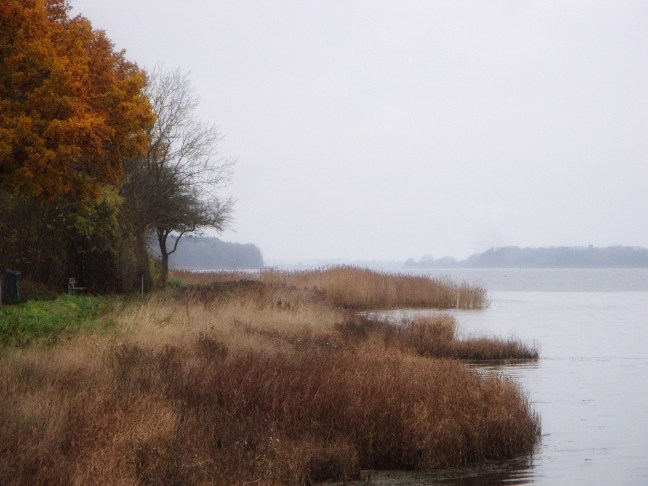
Photo by Alain Joly

~~~

.

Bibliography :
– ‘Krishnamurti’s Notebook’ – by J. Krishnamurti – (Krishnamurti Publications of America, US)

Website:
J. Krishnamurti

Suggestions:
Beauty in Essence (other pointers from the blog)
A Day at Brockwood Park (Homage to J. Krishnamurti)

.

A Mountain Walking

Arthur Rubinstein mural, Lodz – Eduardo Kobra, 2014 – Wikimedia

.

People are always setting conditions for happiness…
I love life without condition
.”
~ Arthur Rubinstein

.
Thank you, Master Arthur Rubinstein. For you did it all for me tonight. No need for convoluted meditation postures. That effortless demeanour of yours in front of the piano was enough. All your thousand nuances of lows and heights, of patience and haste, of a suspended note, or a subtle release, all were concurring to deepen me. For it is all about profundity, isn’t it? About keeping a pointed inner eye on a vast array of forms dancing in and out of ourself, while staying like an unmovable rock. The play was prodigious in its complexity and nuances, but the maestro behind it all was at rest. Voraciously still. A fullness was produced at every empty second, as his fingers were slowly racing on the keyboard towards that never moving, never ending melodious symphony of presence. He was boiling life, and the fumes of it were like curls after curls of beauty. And yet all was kept in its pristine simplicity and humility. No effect and no affect. ‘A mountain walking’, to use that koan like image by Zen master Dōgen. That’s what art can truly do. It can take your breath away to never return it back in the way you have known it.

And the maestro is not busy in a cage of his own. He doesn’t perform. He has space, leisure. And he listens. Shhhh… Rubinstein’s listening, walking at his own pace, slowly mountaineering. Loving it all. You see it in his imperceptible smile. Or the minute rise of a couple of muscles above his eyelids. And in the glance exchanged with the conductor. Oh that glance! Rubinstein is not alone. He is conversing with Chopin; co-composing this Piano Concerto No 2. He is conversing with an oboe, or with a clarinet. Meditating with a line of supporting violins. And the maestro is teaching. He’s teaching you how to listen — not to the notes — but to yourself. This is where the notes acquire their meaning and purpose. This is where listening truly takes place. This is how you become a mountain walking. This is where is revealed the essential of life, of a piece of music, of anything. And this is where you find joy. Enjoying is all that the maestro is doing, and he gives it to you. That’s how an audience breaks in rapture, in screams and applauds of thankfulness. You are grateful because the maestro broke your heart, again and again, until you can be served one thing only: yourself. Your own gentle, pliable, undefeatable self. Hurrah!

.
~~~

.
Mountains do not lack the qualities of mountains.
Therefore they always abide in ease and always walk.
You should examine in detail
this quality of the mountains walking.
[…]
If you doubt mountains’ walking,
you do not know your own walking
.”
~ Zen Master Dōgen (Mountains and Waters Discourse, Trans. by Kazuaki Tanahashi)

.

~

I have found that if you love life, life will love you back…”
~ Arthur Rubinstein

~

At every concert I leave a lot to the moment. I must have the unexpected, the unforeseen. I want to risk, to dare. I want to be surprised by what comes out. I want to enjoy it more than the audience. That way the music can bloom anew. It’s like making love. The act is always the same, but each time it’s different.”
~ Arthur Rubinstein

~

Yes, I am very lucky, but I have a little theory about this. I have noticed through experience and observation that providence, nature, God, or what I would call the power of creation seems to favor human beings who accept and love life unconditionally, and I am certainly one who does with all my heart.”
~ Arthur Rubinstein

~

It is simply my life, music. I live it, breathe it, talk with it. I am almost unconscious of it. No, I do not mean I take it for granted — one should never take for granted any of the gifts of God.”
~ Arthur Rubinstein

.

~~~

Quotes by Arthur Rubinstein (1887-1982)

and Dōgen Zenji (1200-1253)

Text by Alain Joly

~~~

.

Listen to Arthur Rubinstein playing Chopin’s ‘Piano Concerto No 2 in F minor, Op 21’ (with conductor Andre Previn & London Symphony Orchestra), which he recorded one last time, for posterity, when he was 88 years old in an empty Fairfield Hall, only months before becoming blind…

Read the ‘Mountains and Waters Discourse’ by Zen Master Dōgen…

Bibliography:
– ‘My Many Years’ – by Arthur Rubinstein – (Renaissance Literary & Talent)

Websites:
Arthur Rubinstein (Wikipedia) 
Frederic Chopin (Wikipedia) 
Dōgen (Wikipedia) 

.