
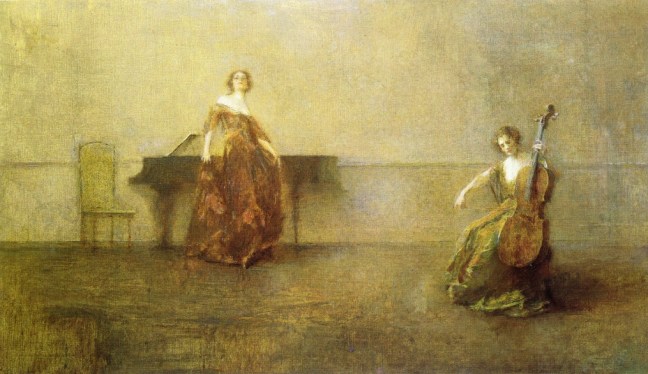
‘The Song and the Cello’ – Thomas Dewing, 1910 – WikiArt
There is a prayer that was once addressed to our deepest self. This is a song of mourning for the life that we cannot get hold of, for the self that we cannot truly be. This mourning is the story of our wrestling with life, of our puny self, a self that is elusive, fragile, fearful, and has been plagued with suffering. So this prayer is a plea addressed to the one that can save us from our intolerable pain. But it is not intended to God. It is intended to ourself, to that part of ourself that appears to be soft, uncertain, constantly seeking affirmation, but is in fact holding the key to the peace we are so desperately looking for.
This self is called, in the Christian tradition, the ‘lamb of God’, and refers to Jesus as ‘Christ’. It is the one for whom John the Baptist had this exclamation: “A man who comes after me has surpassed me because he was before me”. (John 1:30) This self is called a ‘lamb’ because it is destined to die in the embrace of being. Being is its only reality, its rock-like ground and certainty, the one that ‘surpassed me’ because it was ‘before me’. The self that we believe ourself to be is a fragile construction, and a vulnerable entity. It is afraid of dying, of having no solid ground, and is pleading for one.
“Lamb of God, who takes away the sins of the world, have mercy on us.” This plea is a liturgical prayer used in every Catholic Mass, borrowed from a passage in the New Testament (John 1:29). This prayer, called in Latin ‘Agnus Dei’, was used by many of the greatest composers for a number of choir pieces. In 1967, an American composer named Samuel Barber, at the time battling with depression, decided to adapt his 1938 ‘Adagio for Strings’ into a choral work. His ‘Agnus Dei’ is a gorgeous expression of a longing for God, a longing that is the one longing of all humanity, the desire for peace, the unceasing quest for a happy living.
[…]
Exploring the meaning behind a choir song by Samuel Barber… (READ MORE…)
.
 The Dawn Within