A Vehicle for God

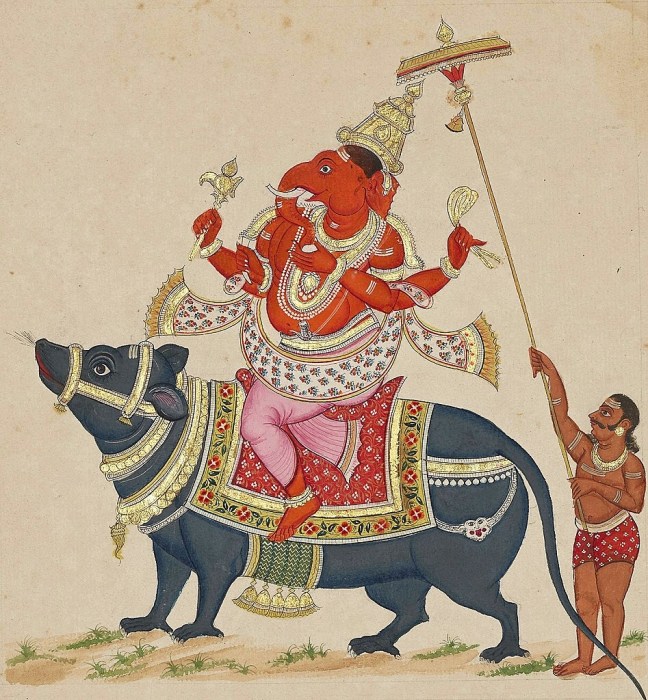
‘Thanjavur Ganesha’ – Unknown author, 1820 – Wikimedia

.

Regarding all things spiritual, I have always trusted the vision of India’s perennial understanding. And there is one thought that bothered me recently, which is simply: why do Hindu gods need a vehicle, a mount? Why do they all have an animal by their side, or to ride on? For god is God. All powerful and reaching far and wide. Self-sufficient and contained in Itself. So why would Shiva need a bull as his vehicle, why would Saraswati have a swan by her side, or Kartikeya a peacock, Lakshmi an owl, Indra an elephant, or Durga a tiger? Why such partnership? And for what purpose?

So I pushed further my enquiry. I discovered that these vehicles, these animals, symbolise some of the qualities inherent to the god they are attached to. For example, the swan represents the beauty, wisdom and grace in Saraswati. Or the peacock the splendour and majesty contained in the Hindu god of war. Many qualities like strength, swiftness, sharpness, fierceness, speed, effortlessness, and so many others, are attributes of god which are reflected in, or represented by, their own vehicles. So I looked at myself, as I am too, deep down, this radiating presence of consciousness, of god’s being. Could it be that, in the same way the dreamer becomes conscious of a dreamt world through the agency of a subject of experience in the dream, consciousness is experiencing a world through its being refracted by a mind? So the mind is the vehicle that consciousness needs to experience a world. Doesn’t that make me, in some way, the vehicle of the Self? And do I radiate the qualities of this presence as should a vehicle of god?

[…]

A playful text asking why god needs a vehicle… (READ MORE…)

.
A Furnace of Love

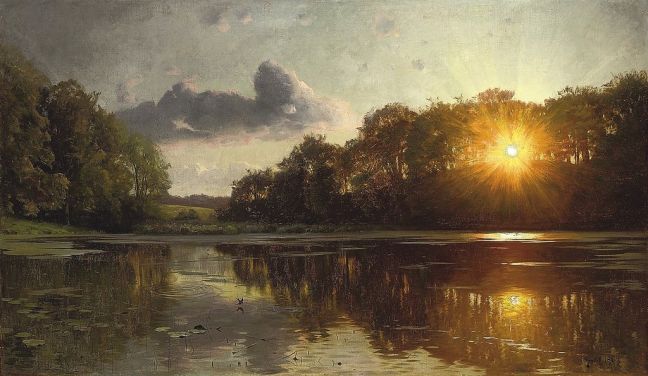
‘Sunset over a forest lake’ – Peder Mønsted, 1895 – Wikimedia

.

Birgitta was sitting by the window, considering once again the recent chain of events that led to her present day situation. Twenty years ago, she came on this small Danish island for the first time, to never leave again. Lolland! What a beautifully telling name! She loved the place immediately. It is called by some the ‘pancake island’, for it is the flattest place here in the kingdom of Denmark. Its highest point: twenty five meters! But the skies were tall and wide with majestic clouds and the land imbued with a quiet remoteness that she loved on first sight. She had often smiled and still smiles on at the incongruous nature of her new home. For she was born in the heart of the French Alps, the daughter of a mountainous landscape where peaks are soaring high above deep valleys. 

Birgitta was a Catholic nun here, in a small monastery on the outskirts of the charming town of Maribo. Her actual name was Brigitte, but the sisters around her had quickly, and laughingly at first, re-baptised her Birgitta, which was the name of the fourteenth century Swedish saint and founder of their religious Order. She liked her new name for its Nordic and melodic quality. She had fit well here, in this quiet building amongst the trees, close to a little lake that she could see from her bedroom window. She came from a very religious family, and had always felt an attraction for all things spiritual. The trigger to espouse a religious life came rather abruptly, after her first dashed expectations in life. So she embarked on the preparatory journey, a few years of education in France and trips to the mother house in Rome.

[…]

A short story that narrates Birgitta’s journey of love… (READ MORE…)

.

The Song of the Little Road

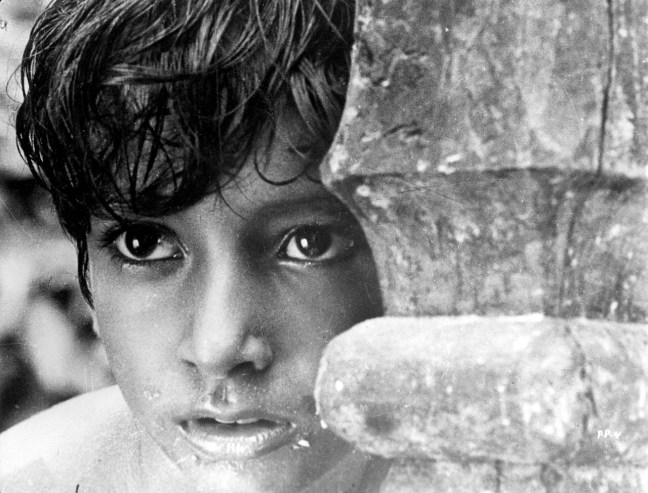
Subir Banerjee (Apu) in ‘Pather Panchali’ – Wikimedia

..

.

You never know how and when a piece of art, a film here, is going to touch the soft grounds of delight and beauty. And how it will come to be loved by people for opening that hidden, special place in their heart. ‘Pather Panchali’, or ‘The Song of the Little Road’ is one such heart opener. It was the first film made by the Indian director Satyajit Ray. It describes the life of a poor family in a village of rural Bengal, with its many struggles. You feel the occasional pinches of hunger, the cruelty, the thwarted expectations, the jealousies, the losses, intertwined with moments of peace, quietness, and insouciance. Days spent between the simple joys of life and the tragedy of death. 

What is it that makes a movie conducive to feeling in ourself that flavour of beauty? Often, such movies are slow, meditative, and as a result can bring a feeling of boredom in ourself. The craving in ourself for experiences that either fulfils our inner sense of lack, or covers it up, is not being quenched. And the mind quickly jumps in and understands it as the film being not good, not interesting. But this judgment may have nothing to do with the film, and everything with our own self’s tendencies and structure. 

[…]

Approaching the qualities of Satyajit Ray’s film ‘Pather Panchali’… (READ MORE…)

.

The Pond

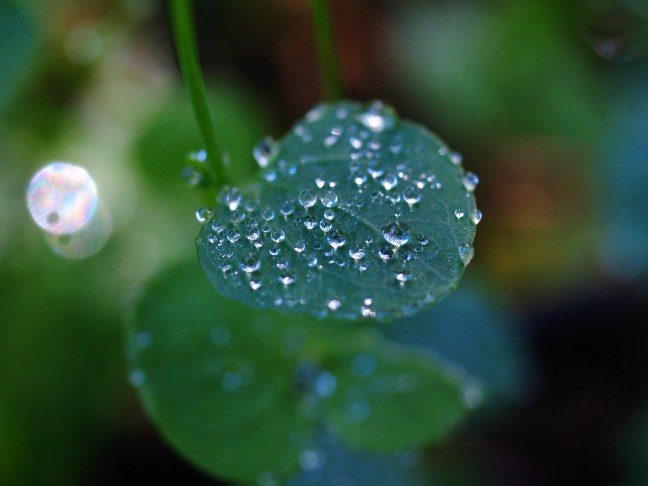
Photo by sheldon0531 on Foter.com / CC BY-NC-ND

.

Is it the morning dew,
Or the remains of a summer rain?
We guess a sun deep in the chlorophyll;
It shines as you see in children’s drawings 
With all its regular rays 
Arranged, brightly shining

The pearls are on display, fine or replete
Protected on the surface of the pond.
Emerald bubbles or golden balls flowing by 
Like small, distant herds carried by the waters;
The wandering foam,
The giant reflections that shimmer

Deployed like antennas
Water lilies have other games
Other functions and other hidden links
With the peaceful waters, the sunshine, the impalpable ether
The deep nights, the shoals of stars
The whims of the moon

A world of connections
Subtle balances settled from the bottom of ages;
There are millions,
Of these intelligent immensities
Of these stories everywhere at work
These invisible rounds, these intimate marriages

And you are part of it
Only you do not know that well
Until one day, gazing at the water lilies 
They might invite you into the dance
And you may find yourself to be
Not the pond, nor the moon, or the sun

Not the water bubbles, nor the stars in the night
But the very fabric of it all, what holds them together;
The rhythm of the dance itself
And above all, the thin subtlety 
That is at the origin of such alliances
That makes them thrive and rejoice

.

~~~

Text by Alain Joly

~~~

.

Suggestion:
Voices from Silence (other poems from the blog)

.