
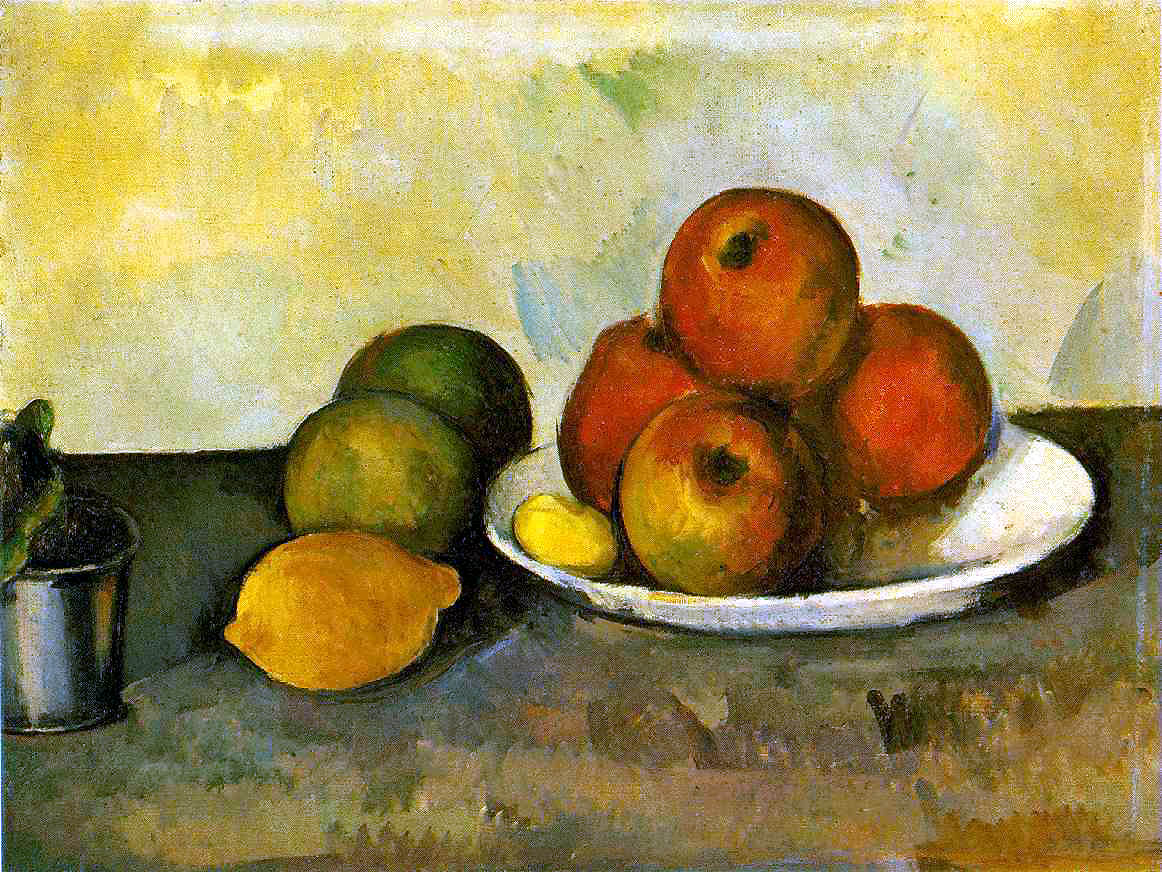
 ‘Still life with Apples’ – Paul Cezanne, 1890 – WikiArt
We really have made a muddle of it all, by believing that all things nameable are so in reason of their being there. It has made what is truly here — formless, absolute, undeniable being — seemingly absent in reason of its not being perceivable and nameable. Our true and essential being is unnameable because it has no objective quality. To name it is to spiritualise it, to give it a form, and finally destroy it. It is to set ourself as a being outside of it, which we are able to name, or describe. So if you have named yourself, know that you are therefore not there. You are still a shadow, a belief, a repetition, a form incompatible with the formless. And if you have qualified yourself as this or that, know that these limits, expressions, or colours you have imposed on yourself are illusions, the clothing of your reality, but not reality itself, not your nature, not the truth of your essential being, not the nameless, not that which is here and now, beyond any shadow of doubt. The named is for absence, and the nameless for presence. For how could you name presence, how could you give a qualification to something which is so here that it could never be there, so now that it could never be then, therefore never made into an object there and then, at a distance from yourself, in capacity to be named.
What is truly here, when it is recognised, ceases to be named. It is the nameless, the unnameable. The names we give to consciousness, to god, to that which is aware and constitutes us for the most part, are only provisional names, given when we are still part of the things that are named, still a person, an entity, a self. But this entity is not truly here. If we can name ourself, it is in reason of our being made into something objective through endless names and qualifications. So make yourself nameless, approach yourself so fully, investigate it so thoroughly, that you cannot name it anymore. Un-name yourself, strip it from objectivity or qualification until you are recognised as being only being. Then notice that you cease to be nameable. You are too close to yourself for that. Then the only way to name that reality of yourself is to not give it a name but to say simply ’I Am’. ‘I Am’ is the only name we can give to God’s being, and its supreme subjectivity indicates that its reality can only be felt as your own reality or being. It is the intensity of its subjective nature that prevents it from being given a name.
So names, or naming, is for qualifying the unnamable. It is to split it apart, and draw out of it a life, a world, a billion beings, and the multitude of trees, and the wings of birds, and a universe of suns and globes. But that one thing which we cannot name would have to be the one being, at the exclusion of any other being or form that seemingly stand out of it, which are all things that can be given a name. That which cannot be named, that cannot be split apart, has to be who you are. Only separate from it, or turn your back to it, and you will fall into the dark hole of suffering and loss. You will have to wear names and qualifications, you will have to become an object degradable and mortal. But this frailty is not who you are — you know it from the bottom of your heart. You know that you are, in secrecy, something that is indestructible, and cannot be diminished, broken, or even perfected, in reason of its absoluteness. This presence is that which bears within it all passing experiences and appearances, all the things that have a name but which cannot truly be.
How could you name that which is formless, which doesn’t become, doesn’t change? How could you name something that has no quality, that is transparent, silent, non-objective, and that is absolutely present? If you can name something, it is bound to not be, to not have an existence by itself. It is bound to be something that is not. It may take the appearance of a thing, a shape, a quality, a consistency, something that has to appear and is destined to dis-appear, that you can name because of its having a form and a destiny. But in fact, everything that seems unquestionably there as objects, as things that we can name and point to, all these… are not there. Not truly so. And because they are not there, they have to be given a name, so they can have an existence separate from every other seeming things. Their not being there is in reason of their secondary nature, of their being only an appearance, and not a thing in itself. The thing in itself is the One. It is the one thing from which all things and beings borrow their existence. It is the nameless that gives form to the ten thousand things which are given a name.
Now we may state that being is transparent and nameless, and we may attempt to describe its qualities, even its shapelessness, its emptiness, or its absolute presence. We may try to reach it, to fathom it, to understand it, to live it. But we don’t. We don’t because we name it. And by naming it, objectifying it, we have pushed it away. If we want to keep the nameless ‘nameless’, then we have to be ourself without name, without quality. We have to surrender our existence, and to be only and exclusively being — not a part of that being, but the totality, the emptiness that it is. We have to be of that place which we cannot name anymore, because it is not at a distance from ourself. We have melted within its transparency, and are made incapable of naming that which we are. We may play the game of names and forms, but we ourself are without name and without form. We are in a position of indescribability. We can only name and point to all these which are not fundamentally there. But to be the witness of their absence, we as a seemingly other — with name and form — have to take the journey to the recognition of our nature as seamless, nameless, formless being.
.
~~~
Text by Alain Joly
Painting by Paul Cezanne (1839-1906)
~~~
.
Website:
– Paul Cezanne (Wikipedia)
Suggestion:
– Other ‘Reveries’ from the blog…
.
Back to Pages
.
 The Dawn Within
Alain, A excellent bit of writing and much in line with my thoughts of late. I’ve come to appreciate Zen more because of this. The Zen adherent looks out at non-duality (the formless and seamless) and as the Zen adherent looks at it, they consciously choose not to name it or decompose in any way. It is what it is. Thanks for what you’ve written here. Dennis
LikeLike
Thank you Dennis! I’m happy you liked it. 🙏
LikeLike