The Carder of Innermost Souls

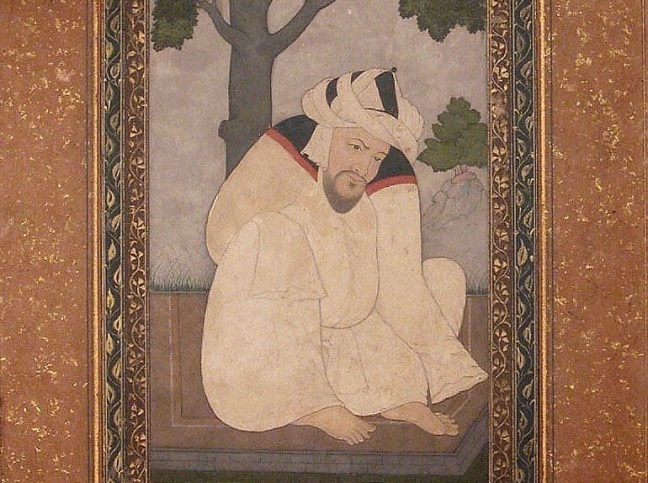
‘Portrait of a Sufi’ (part), 17th AD –Metropolitan Museum of Art – Public Domain

.

أنا الحق
Anā l-Ḥaqq
“I am the Truth.”
~ Mansur al-Hallaj

.

We all enjoy a good story. Here is one coming from far ago, in ancient Persia, where lived a man who became one of the most celebrated mystic, poet, and teacher of Sufism. Mansur al-Hallaj was born in 858 AD near Shiraz, in the Pars province of today’s Iran. He was considered an ‘al-Insān al-Kāmil’, which in the Islamic tradition is a honorific title meaning literally ‘the complete person’, a human being whose identity is merged with pure consciousness. Al-Hallaj is also known as the ‘Jesus of Islam’. He was tortured and publicly crucified for having pronounced the highly blasphemous statement: “I am the Truth”, which equals in Islam to saying ‘I am God’. The French scholar of Islam Louis Massignon wrote that al-Hallaj was “the most beautiful case of human passion that I had yet encountered, a life striving entirely towards a higher certainty.” The mystic’s last words were said to be:

.

Help me, O You only One,
to whom there is no second!
~ Al-Hallaj (‘I Am the Truth’)

.

From an early age, Mansur al-Hallaj was a devoted practitioner of truth. He grew up in a Sunni Muslim family and read the Quran at an early age, but he was irresistibly drawn towards the mystics. As a young man, he received the Sufi habit and moved to Basra in today’s Irak. After marrying, he began travelling extensively and made his first pilgrimage to Mecca, staying there for a year, facing the mosque in fasting and total silence. Although also the father of three children, he kept pursuing a life of devotion and started preaching to a growing number of followers. He became known as ‘ḥallāj al-asrār’, ‘the carder of innermost souls’, for his name ‘hallaj’ means ‘cotton-carder’. From that time on, he began writing exclusively in Arabic. His reverence for truth and the simplicity of his writing are here perceptible:

.

I have abandoned to the people
their religion and their customs
to dedicate myself to Thy love,
Thou my religion and my use.”
~ Al-Hallaj

.

”For your sake, I hurry over land and water;
For your sake, I cross the desert and split the mountain in two,
And turn my face from all things,
Until the time I reach the place
Where I am alone with You.”
~ Al-Hallaj (‘Perfume of the Desert’)

.

Know that Judaism, Christianity and Islam, like other religions,
are only denomination and appellation,
the goal sought through them never varies or changes.”
~ Al-Hallaj

.

[…]

.

The life and teaching of the ancient Sufi master Mansur al-Hallaj… (READ MORE…)

.
Rumi

“We are all returning.”
~ The Koran


“On the seeker’s path, wise men and fools are one.
In His love, brothers and strangers are one.
Go on! Drink the wine of the Beloved!
In that faith, Muslims and pagans are one
.”
~ Rumi, Quatrain 305

6BFFE2AC-01F8-45DD-8892-0D968690B787

در راه طلب عاقل و دیوانه یکی است
در شیوه‌ی عشق خویش و بیگانه یکی است
آن را که شراب وصل جانان دادند
در مذهب او کعبه و بتخانه یکی است


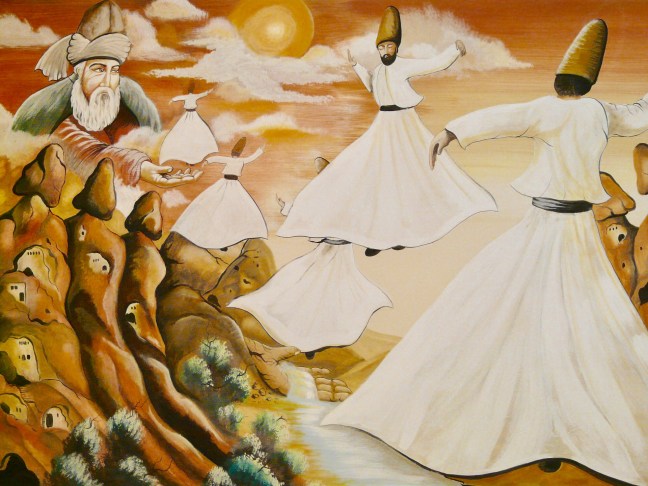
Rumi is a giant. Somebody whose words resonate with the perfume of truth, but about whom we paradoxically know very little. At least I didn’t. Quoted far beyond the small circle of spiritual seekers, he is taken for granted, like a distant angular stone of spirituality. His verses are shared, loved as so many gems of human history, but without showing off. And yet, what depth of understanding they convey! In what subtle and intricate ways they describe the torturous alleys of spiritual endeavour! And with what simplicity!


Why do you stay in prison
When the door is so wide open?
Move outside the tangle of fear-thinking.
Live in silence.
Flow down and down in always 
widening rings of being
.”
~ ’The Essential Rumi’ (Translated by Coleman Barks)


Rumi was a Sufi. He was born Jalāl ad-Dīn Muhammad Balkhī, in 1207, in Balkh in present day Afghanistan, in a family of Sufi tradition. Sufism, which could be defined as ‘the inward dimension of Islam’, has its origins shrouded in mystery. How did it suddenly grow, nobody knows. The word comes from ‘sūf’ which refers to the woollen garment worn by the first mystics who broke away from the mainstream Islamic religion. Sufism didn’t grow in opposition to Islam, the religion that gave it birth around the 9th century, but as a deepening, a going back to the very source and meaning behind traditional Muslim orthodoxy. The Sufi devotee wanted to feel, to know God as the true presence in the heart, not putting an illusory figure at a distance to be worshipped. That’s how Sufism placed love, the love of god, at the centre and expressed it in the most exquisite poetry. That’s how music and dance were allowed and praised. Sufism is understanding and living this primary statement of faith in Islamic religion: ‘There is no god but god.”

Immerse yourself in Rumi’s path of divine love and poetry… (READ MORE…)


Tripping over Joy

BD266EB8-3B13-4016-A613-8F7742E48D91What is the difference
between your experience of existence
and that of a saint?

The saint knows
that the spiritual path
is a sublime chess game with God
and that the Beloved
has just made such a fantastic move
that the saint is now continually
tripping over joy
and bursting out in laughter
and saying, “I surrender!”

Whereas, my dear,
I am afraid you still think
you have a thousand serious moves.

~ Hafiz


~~~

Text from Hafiz, a 14th Century Persian poet

Picture from Alain Joly

~~~


Bibliography:
– ‘I Heard God Laughing: Poems of Hope and Joy’, by Hafiz (translation by Daniel Ladinsky) – Penguin Books

Website:
Hafiz (Wikipedia)

Suggestion:
Voices from Silence (other poems from the blog)


The Whirling World

.

A secret turning in us
makes the universe turn.
Head unaware of feet,
and feet head. Neither cares.
They keep turning.”

~ Rumi

.

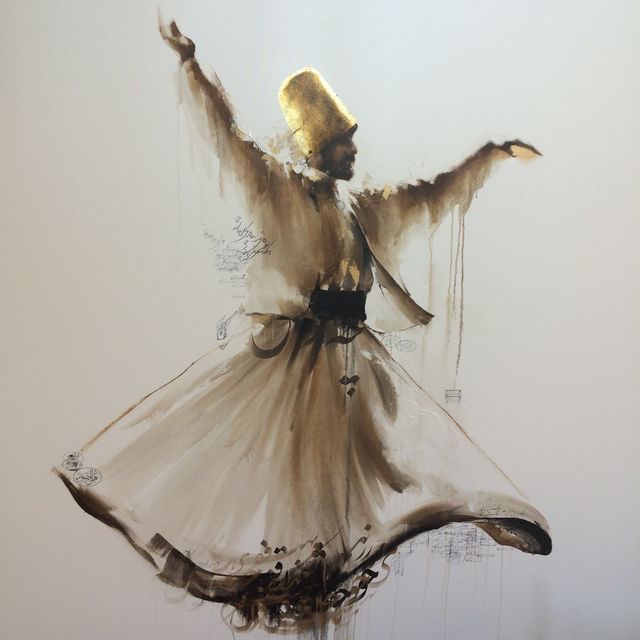
“What is the significance of this dance? See that if you experiment yourself, turning and turning around in circles, you may realize that it is the world that rotates while you stand still. Here, in our center, and for ever, is the Immobility. When Rumi turned and turned, he must have seen around him the trees, the ground, his disciples, the sun, the moon and the stars. He must have seen his body, his arms stretched out, his feet, all moving. But closer than that, there was Immobility, Silence, Peace. While he was turning and turning, while he let go of the turning world, his sense of oneness with the Source probably got deeper. The depth, the jewel and the mystery of Immobility must have swallowed him and washed him wave after wave. In this Ocean of Love where he drowned, he dissolved until only the Ocean remained. While Immobility lies in the center of the whirling world, without anything that neither comes nor goes, like a rock that is always present and sure, joy sprung forth everywhere around, and so did the ecstasy of the dance. In the midst of the fuzzy world, spinning again and again, he had capitulated, drunk with the beauty, the wisdom and the love of the Beloved.”

.

~~~

Text by Ergin Ergül – ‘La sagesse de Rumi’
(Translated from French by Alain Joly)

Painting from Iranien artist Hossein Irandoust

~~~

.

Bibliography:
– ‘365 Days With Rûmî’ – Ergin Ergül

Website:
– Rumi (Wikipedia)

Suggestions:
Other articles from the same category ‘Shreds of Infinity
Rumi (Homage to Rumi)

.