
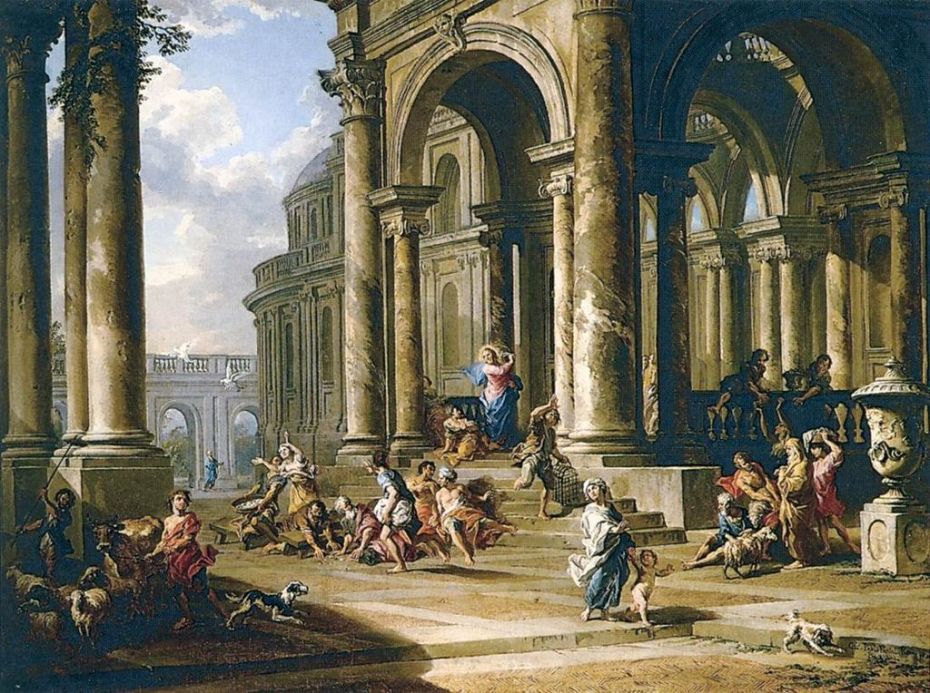
 ‘Expulsion of the Moneychangers from the Temple’ – Giovanni Paolo Pannini, 1724 – Wikimedia
Maybe this is where peace in fact resides. In the fact that peace or happiness can never be found, never be reached. It will be nowhere where you expect it, not in any objective appearance or event, not in any wish granted, not in any kind of alignment between what you want and what you have. You will never obtain what you want. Truth is not there, in what you wish. It doesn’t care for your egoistic projections, for your own private self-interest. Truth is not a mere good to be bargained for, or hoped for, or waited for, which, if not granted will disappoint you, and make you like a rejected lover, or a bruised self. Truth is not any kind of crude object. Remember Jesus who cast out the merchants in the temple. Were you really thinking that there was a physical Jesus actually chasing the merchants from the temple, on the ground of some kind of moral rule?
The merchants in the temple, it is you. It is all of us when we have decided to argue with reality, to buy our happiness with some kind of object obtained, to bargain or negotiate with some invented superior entity the responsibility of what is happening to us, to come to god with pockets full of expectations and desires, making peace a simple object to be bought in the market place of our likes and dislikes. “Wouldst thou be free from any taint of trade?” did Meister Eckhart ask. Imagine the relief that it is: to know or realise that you will not have what you want, that ‘what is’ is all there is, all that you will ever have. What a relief! What a load finally put down, and got rid of! All that you want, desire, expect, all that, will never ever be granted to you. You can forget it all. ‘What is’ is the deal. The grandiose enlightenment you were waiting for lies there, in what simply is! It will never get better than that! You have it all here, in front of you. That is the gift that was specially designed for you. Happiness resides in what you have, in what you are, here and now. This is the secret that Krishnamurti meant when he said: “I don’t mind what happens.”
And don’t think that you have to accept ‘what is’. Any acceptance is the result of your refusal of ‘what is’, and is nothing but a bargain in your own interest. True acceptance is in fact the noticing that there is no person here in capacity to accept or reject. Acceptance or rejection are therefore only the superimposition of an idea on ‘what is’. For ‘what is’ is not to be accepted or argued against. It is the inescapable silhouette of being. It is being revealing itself when you have ceased believing in ‘what is not’. And ‘what is’ has a special secret to tell. ‘What is’ is like a double agent, whose appearance is conditioned by your attitude towards it. Treat it as an unwanted object, and you will make it an enemy in your life, and you will make yourself an untruth, an illusory entity who conditions its happiness to that which in life matches its desires or expectations. But treat ‘what is’ just as it is, without the distortion of a self looking at it, and it will reveal itself as being made of love. And it will make yourself not a greedy, separate entity, but the very being that is the being of all selves and things. That being is in essence the very nature of ‘what is’, and of what you are.
Never forget: You too are an expression of ‘what is’. You are nothing but that which you are now. There is no need to run after a future, idealised self, no necessity to change anything, to strive, travail, suffer. What you are is ‘what is’. Make any move to modify it, arrange it, perfect it, and ‘what is’ ceases to be itself. It becomes tainted by your looking at it, judging it, evaluating it. ‘What is’ has been made into ‘what should be’. So you’ve lost it — all the purity of it. You have soiled it, spoiled it. Any of your imposition or judgement on ‘what is’ is a form of violence, a truth that you have denied, a blasphemy that you have perpetrated, raising yourself as an equal of god, as one who can judge, measure, accept, reject, prefer, and is therefore never placed in the humble, indifferent and magnanimous position that is in fact the position of the divine as unconditional love. All your voices coming to bargain with ‘what is’ are like the merchants that need to be chased from the temple of your pristine self. Don’t come in to arrange anything, you are not qualified. Only god is.
So this is the other deeper reason why Jesus wanted the merchants out of his temple. The merchants, the bargainers, the ones who are arguing, complaining, ‘buying and selling’ as it is said in the Bible, all these are but the voices of your belief in separation. “God wants this temple cleared of everything but himself.” stated Meister Eckhart. This ‘temple of God’ is yourself, when you have let go of all your many identifications with thoughts, feelings, and perceptions. You will have to chase them out, all your many ties with objects. If you don’t, they will make you like “a den of thieves”, as the Bible suggests. So “[overturn] the tables of the moneychangers, and the seats of them that sold doves”. Throw off everything in yourself that is not truly you. “My house shall be called the house of prayer”, Jesus said. Prayer being nothing but this continual and natural abiding in being, that primary presence which you are. So cleanse your temple of every objective impurity, every belief about yourself, every old identification. Find this temple of ‘what is’ which you are. As Meister Eckhart said: “There is none like this temple but the uncreated God himself.”
~
“And Jesus went into the temple of God, and cast out all them that sold and bought in the temple, and overthrew the tables of the moneychangers, and the seats of them that sold doves, And said unto them, It is written, My house shall be called the house of prayer; but ye have made it a den of thieves.”
~ Matthew 21:12-13 (King James Version)
.
~~~
Text by Alain Joly
Quotes by Meister Eckhart (1260-1328)
Painting by Giovanni Paolo Panini (1691-1765)
~~~
.
Websites:
– Cleansing of the Temple (Wikipedia)
– Giovanni Paolo Panini (Wikipedia)
– Meister Eckhart (Wikipedia)
Suggestion:
– Other ‘Reveries’ from the blog…
.
Back to Pages
.
 The Dawn Within
Alain, thank you very much for another beautiful text. Maybe you can answer a question that always comes to mind when I read about this subject. Isn’t my lack of acceptance, my belief in separation also an expression of what is? Isn’t trying to abandon my identifications also trying to arrange things?
LikeLike
Thank you for your appreciation! 🙏 To me, it seems that ‘what is’ is apparent when all comment or idea or superimposition have been recognised to be redundant. They are part of ‘what is’, but borrow their reality to something more fundamental, that never dies. This is truly ‘what is’. The seeing of ‘what is’ is itself seeing the absence of self, and therefore of any possibility of identification. Being stands alone.
LikeLike
As usual a wonderful post…..arriving in the midst of a decluttering of my home. Hehe Thank you. Warm wishes and happy Christmas to you. Love Emma
LikeLike
Thank you Emma! 🙏 I wish you a wonderful Christmas!
LikeLike