
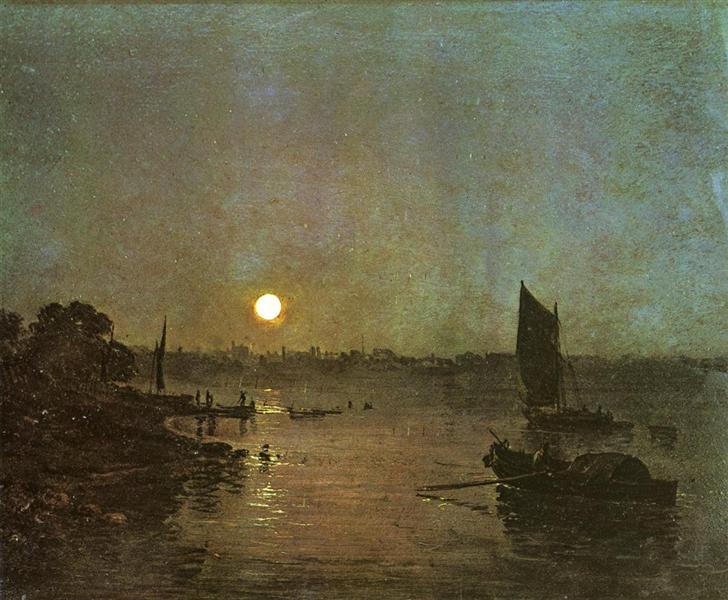
 ‘Moonlight, A Study at Millbank’ – J.M.W. Turner, 1797 – WikiArt
This text is directly inspired by an analogy used by the teacher of non-duality Rupert Spira. I found it to have such evocative power that words started to pour out and I couldn’t stop them. This text is therefore dedicated to Rupert and his timeless vision and teaching.
~~~
Sometime a painting just comes timely to move your heart. It is a gorgeous landscape painting, depicting a coastline and the Thames, with boats and fishermen in the moonlight. At Millbank, Turner was painting in dark, subtle hues of black, blue, and purple browns, to define a night, leaving here and there traces of light, golden reflections on the water. In the wide expanse of the sky, he had left one portion of the painting untouched. Pure as white. Undarkened. For the painter had a view in mind. He was to paint a moon, bright and resplendent. And no moon was ever so bright.
This part of the scenery that wasn’t painted, it was you. You, before you were made a person, before the identification with thoughts, feelings, body, story, hurts, memories, projections, beliefs. The nature of the moon was that part of you that was left unseen, unexplored, but that had quietly illuminated you all along, giving you a self and an identity without your knowing, lending you a hidden strength for your bruised self, and bathing you in its unheard silence. It was the trusted one, the one reliable thing in a life of relentless changes and challenges. It was the peace of your true self, the precious being that had been covered up by the night of objective experience. This is the moon Turner had meant to convey.
But you took the moon to be just a localised self, another thing in the picture, when it was in fact the gift of god hidden as your innermost sense of being. It was what had quietly held you and the world all along — the humble core of it all. It was your newly found transparency; your life basking in the full moon of your being; and what you drew your knowing and living faculties from. That moon that you took to be a self, was in fact that part of your life left untouched, unpainted, unbruised, shining with its pristine, loving, un-judging way. Amongst the night of suffering that your life is for the most part, is placed a transcendent moon. A portal that opens to another dimension, another understanding, and the revelation of your hidden nature. This portal is yourself. It is that which we take to be just another thing in the picture, but is in fact not. It opens to the sublime grounds of being, which had been covered by your fascination for the objective nature of experience.
But Turner knew. He knew that this part of the painting was to be the key for it, its underlying meaning and purpose. Sometimes, we don’t see that what is left behind, unseen, unknown, in the background, is in fact the foremost reality, the foreground that we have ignored. His painting — he knew it — receded a living intuition. He knew it as a sacred knowledge. So he stood by it. Kept his patience alive. Exercised his legendary stubbornness. The foreground is lit up by the background. He was checking that all along in himself, looking deeper and deeper as he was sculpting his moon, cherishing it, adorning it with all the love incumbent on a truth. Slowly, meticulously, he rounded the pristine area with a halo of grey and dark brown, and rings of yellowish glows. He pampered it. Circled its moon with loving affection. For he knew that this part unpainted was meant to be as if painted, and was to confer to the whole painting its profound significance and ‘raison d’être’. It was what gave to the night its light and the promise of day.
The moon as the feeling of being is everything you need to know, all you need to focus on. It will illuminate your life from inside out. It will make it a piece of art, will impregnate it with beauty, and reveal it to be just like a Turner’s painting — a masterpiece. Keep your moon clear of clouds. Leave it burning bright in your life — it will rinse every part of it with its gold. Keep entering the moon of your self. See and feel that it is not yet another object in your life. It is neither a place to reach, nor a state to be achieved. It is what you are and have been all along without your noticing, because of your being lost in the content of the painting of your life. You didn’t get it. You were in fact that part not painted. That pristine being left behind as the matrix of all possibilities. That white canvas. That infinite.
The moon is the only existing light that can illuminate your life. Without it, there is no painting. Nothing at all. Pitch black. Your life is the same. Because you see yourself as being a mere self, you miss the shining of being that is its reality. Your life as a result has darkened, has been painted with a halo of suffering. But this shining of being is what gives your self its true nature and reality. It is what makes everything perceptible. It is what stands as the maker and the knower of your own being. It is a witnessing presence that is selfless, but is the only self present, giving colours and forms to all appearances; filling the world with the colours of being; infusing it with tender shades of peace, joy, beauty, all qualities found in causeless being.
So Turner was painting feverishly. Experience can be a dubious thing. So you got lost in it, mesmerised, tantalised, diminished. And you never took the time to look at your moon, to be interested. You have overlooked it, made it just a thing that you took for granted, that you had to feed like you feed an ogre. But the moon was never itself an experience. It was a window for the infinite to peep into your life. It was an intervention of eternity into the timed structure of your self. It was freedom making itself known in the prison of your existence. It was the truth of reality inviting itself into your shaky self, laying bare its fake nature, and revealing the unborn nature of your being. It was an invitation to dive into your self, unveil its hidden essence, to let yourself be nourished by it, and finally die joyfully in its grip. That’s how you lit up a night. That’s how Turner lit up his painting. From the canvas itself. From emptiness. And you are due to honour that same insight in your life. To be yourself like Turner’s moon.
.
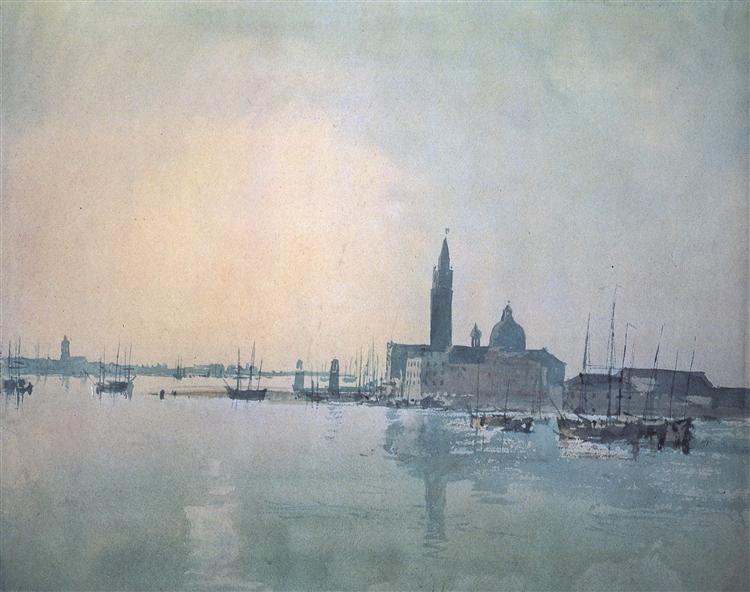 ‘San Giorgio Maggiore in the Morning’ – J.M.W. Turner, 1819 – WikiArt
.
~~~
Text by Alain Joly
Paintings by J. M. W. Turner (1775-1851)
~~~
.
Bibliography:
– ‘The Heart of Prayer’ – by Rupert Spira – (New Harbinger)
Websites:
– Rupert Spira
– J. M. W. Turner (Wikipedia)
.
Back to Pages
.
 The Dawn Within
A couple of possible identifications of a watercolour here:
https://transparencyofthings.substack.com?utm_source=navbar&utm_medium=web
https://transparencyofthings.substack.com?utm_source=navbar&utm_medium=web
It doesn’t matter if (as Google AI says)Turner didn’t actually use the ‘canvas showing through’ technique: RS’ use of the idea is, as ever, profound, lucid, and helpful.
LikeLike
Thank you for commenting! 🙏
LikeLike
I was looking for Turner’s moon online and was directed to your beautiful words again, Alain and they are yet again always so profoundly timely for me. Like you, I also find Rupert’s analogy to contain so much beauty and boundless freedom. I found your words here absolutely exquisite and they’ve given me an even deeper appreciation of the metaphor. Much love and gratitude to you Alain.
carrie x
PS can I also comment on your beautiful use of the English language too. I am in awe really when it’s not even your first language. Your words and pacing and tone are so sublime. I am sorry if I in an way make you uncomfortable with my effervescent appreciation! 👌🙃😍
LikeLike
Thank you so much Carrie, for your kind appreciation. 🙏 I’m so happy that these words resonate so beautifully in you, and I’m grateful for your expressing it! Much love to you. Alain x 💕✨
LikeLike
I wonder about the story that you and Rupert Spira tell about Turner’s painting Moonlight. Are you aware that the medium for the painting at the Tate Britain is described as ‘Oil paint on mahogany wood’? In that case, how can the moon be left unpainted? According to the Tate, the work is not painted on white paper or canvas. I love what you have written though; maybe you could use it in a different context (if you have made a mistake about the Turner painting). Best and warm regards,
Meera
LikeLike
Thank you for your appreciation, Meera. You’re right, I was well aware of that imprecision. But the painting made an impression on me on one hand, and there was Rupert Spira’s analogy on the other which fitted it so perfectly, so I did as if… I couldn’t resist. I decided to put it on account of poetical license. The text is the most important here. And what I say of Turner’s painting is imaginary. It’s just very handy to make clear something at the level of the nature of mind. Thank you for your attention though. Warmest regards, Alain
LikeLike
Perhaps Rupert was referring to a different Turner painting? I recall he mentioned it as a watercolor. So maybe this one, or another in the same series?
LikeLiked by 1 person