
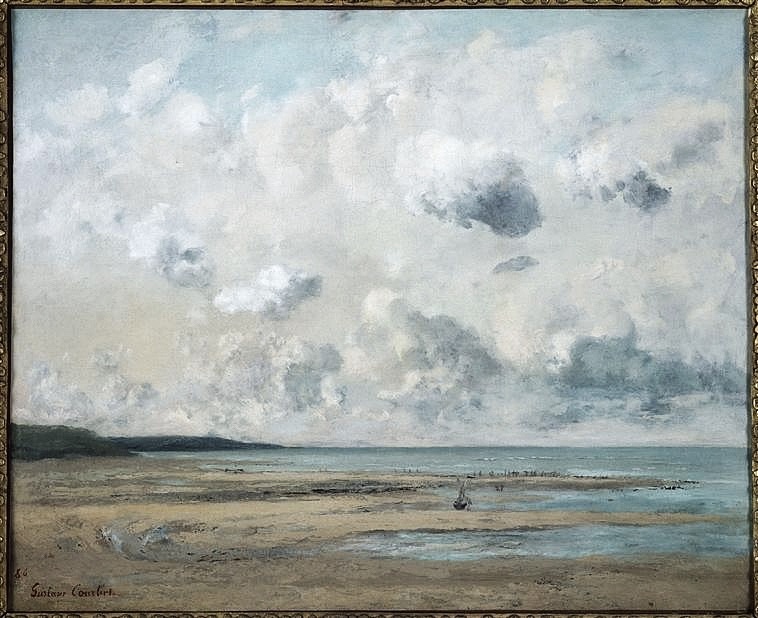
 ‘Shores of Normandy’ – Gustave Courbet, 1866 – WikiArt
.
“To know that your Self has not changed,
this illustration itself is enough.”
~ Ramana Maharshi
.
There is no ameliorating emptiness, developing the unborn, aggrandising what is, and expecting the timeless to be anything more or different than what it is. Being leaves no room for improvement because it is not a thing, it is not a result, a something that has a cause. How do you improve the non-objective? How does the infinite progress? How do you make better a self that is absent as self — as something different or separate from experience? So self-improvement is a misunderstanding and a form of violence. It is an imposition, a belief that we squeeze to fit our idea of reality, an objection to the innate perfection of what is. It is mind-made, a product, a progeny of conditioning. It is designed for the continuation of our belief in being a self or entity that can be objectively defined. And remember this: every object, every ‘thing presented to the mind’ — as Latin word ‘objectum’ stands for — is in fact nothing but something thrown in the way of your knowing who you are. This is the meaning of Latin ‘obicere’ — ‘ob-‘: ‘in the way of’ and ‘jacere’: ‘to throw’. The self that you believe yourself to be, and that you strive to improve, is your hindrance. It is what makes you blind to your true nature.
To improve on a self is to make it continue, it is to give it credit, to give it the existence it never had. After all, we all want to feel real, to see that we can act, and have a power on our self. So we have the desire to consolidate and sculpt our being through rendering it an object that we can manipulate. We want to make a profit of our self, and see a return on our investment. In fact, to improve myself is nothing but a form of merchandising. It is a trade and a transaction. It is retail management, the ‘cutting off’ of our self with the aim of maximising profits. But don’t ever forget that if you are able to improve yourself, you can therefore also make it deteriorate, worsen, decline, decay. So what then?… is self-improvement decay, error, illusion? Is it ourself going astray, being mislaid? Are we really so sure that our being could ever decay? That awareness is a so fragile thing?
There is of course a possibility of improvement in your outer life and circumstances, but the difficulty comes when external changes are used as a means towards self-improvement. The improvement of your external environment is never as effective as when initiated by the qualities that comes from the recognition of your own, unchanging being. Change then becomes natural. But to forcibly change your experience has a very limited value, because happiness is never found as any kind of improvement. Life’s worth is always only derived from its inner, most fundamental essence as being. To look for better, richer experiences is but an extension of self-improvement. Both are ultimately one and the same, for experience always appears and culminates as being. With the desire of improving yourself, you keep yourself at the level of dissatisfaction and suffering. Self-improvement is suffering. It is still a form of entertainment. A search. An escape. It is a movement caught in separation, comparison, belief, hope, and achievement. To desire any kind of achievement is to misunderstand who you are already, truly, here and now. All things considered, the safest kind of improvement is in the shining of being that lightens objects and makes them appear in their new clothes of truth. This is an improvement that is non objective, which reflects the qualities contained in simply being. So improvement is ultimately never in qualities, shapes, morals, or thoughts, although they might benefit from echoing being. The only and worthiest improvement there is, is in the effects of your being aware of simply being. True improvement is in the absence of self-improvement.
.
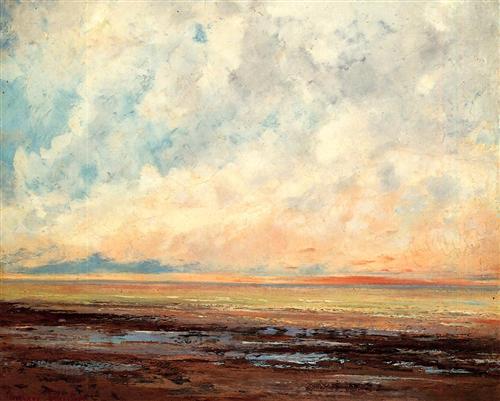 ‘Seascape’ – Gustave Courbet, 1865-66 – WikiArt
.
So, to be aware is the end of self-improvement. Awareness is killing all velleity, necessity, or even possibility of progress or betterment for your self. In that, it is a form of death, and the ending of your idea of being somebody — a self with its own existence separate from the existence of everything else. Now, how is it going to feel for yourself, to stop seeking for betterment, to give up all forms of self-improving, to not have that burden, to live as ‘I am’? What will remain? What space will you have left available, to watch, listen, and be aware? Awareness was never the tool of a separate self, but is the entirety of your self, with no separation found within it. Awareness is wholeness, and has therefore no need for transformation. Completeness is its ever-living nature. And your life will improve of itself naturally, when you will have given up, or released, any desire for improving yourself. Being is that which can never improve or change. Improvement may be observed or initiated in the peripheral, objective body-mind-world, but never in the deepest, subjective, undivided core of your self. That remains untouched, unvarying, so to say set in stone: “As a mountain of lead stands unmoved by a breath of wind” did say Meister Eckhart once.
So notice that you are not fit for improving yourself, or for being the creator and arranger of your inner life or quality of being. It is not for you to do that. You are not there. You are not equipped, have not the necessary requirements or skills, are lacking the required substance. Your doing is in your undoing. Your knowing is in your unknowing. Release your self and its desperate cascade of ambitions and desires — this endless seeking for happiness — and that action will appear as a flowering of both yourself and your life. You will be magically lit from within, which is without too. But this isn’t improvement, although it may look like it is. It is simply the recognition of yourself as you are — already improved, already aggrandised, already achieved, and devoid of a self in need of being perfected. You will be without a self, and this — what remains — is what you are, your newly discovered, eternal self that you had overlooked through your desire for improvement. So now live as you should — which is as you are — and you will never ever have the thought of improving yourself again. Here is my motto on self-improvement:
‘Let me live as I am,
and not as I will,
could, or should.
Let me live as I am,
and I live as I should.’
.
~~~
Text by Alain Joly
Quote by Ramana Maharshi (1879-1950)
Paintings by Gustave Courbet (1819-1877)
~~~
.
Websites:
– Ramana Maharshi (Wikipedia)
– Gustave Courbet (Wikipedia)
Suggestion:
– Other ‘Essays’ from the blog…
.
Back to Pages
.
 The Dawn Within