
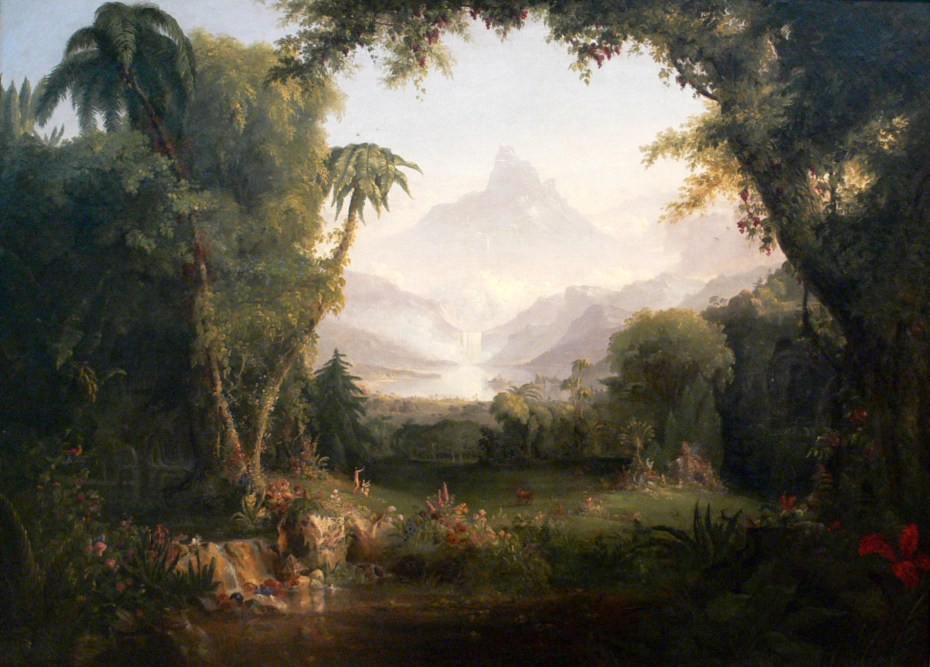
 ‘The Garden of Eden’ – Thomas Cole, 1828 – WikiArt
It is always revealing to reflect upon a certain word in the context of spirituality, and see how it came to appear and be chosen. Why this one and not another word. There are many synonyms to the word ‘peace’, amongst which tranquillity, calmness, or quietness, which all seem better suitable to an entity or an object than peace. Peace is profound. It stands on its own. Just its pronouncing deepens you, fills you with its referent. ‘Peace’. The word takes you somewhere else, makes you leave your habitual field of suffering, desiring, projecting, coping, aiming, all that renders life a battlefield. ‘Peace’. Peace is a mantra in itself. A prayer. An occasion to go within. It has the automaticity of something fundamental, inescapable, and the simplicity of something that everybody knows or has experienced.
The word ‘peace’ comes from the mid-12th century root ‘pes’, meaning ‘freedom from civil disorder’ or ‘absence of war’. Likewise, in the dictionary, the first meaning for peace is stated as ‘freedom from disturbance’. Peace is always negative. It is here when something else has receded or died down. It is revealed through an absence. After all, in common parlance, the word ‘peace’ has always been used to refer to the state of things that exists in the absence of conflict or disorder. The word was almost invented to refer to this moment when a war ends and one can return to the state of affairs that existed before the conflict started. It is never a new state or occurrence. It is what is usually here in the background and is disrupted by the incursion of movement, conflict, war, thought. The tiniest thing, as long as you believe it to be you, will disrupt your peace. Peace is a return. A recognition of something known but forgotten for a time, or rather eclipsed by the incursion of time. Peace is something that is always here in the background, waiting patiently for your return. Our mind as ego is the disruptive factor, the war in which we have decided to engage, and found ourselves caught and lost. Make it end and peace will come automatically. It is not a new state invented, but the pre-existing state of your deepest self as being, which only a quietening of your wrestling with the objective world will make apparent. Peace is the very foundation of your self. It is the cornerstone of the edifice of life, as is easily seen in nature, which seems to have peace as its very fabric.
I think it would be a mistake and an impediment to consider peace as a feeling, or some kind of state of mind. What is this urge to make peace into a thing, a state to be obtained, to battle for? To objectify peace is the perfect way to push it away. There can be no moment, no occurrence in your life when you can say there is peace, in the same way you can say there is a thought, a feeling, a pain, fear, sadness, anything that happens, that exists for a while and dies down. Peace is never happening, is never an occurrence. Peace is only recognised to be, its presence only noticed, stumbled upon. It sometimes feels that it descends upon you, but in fact you only can descend upon it. Peace is more like a presence sitting at the core of your being. It is always here, fundamental, something you can only avoid, or forget, but which you can never leave. We descend upon peace in the same way that we descend from the battle that is our objective life to the still ground of being; in the same way that we descend from the clouds of illusory identity to the pristine air of our essential self as being. And how ironic that we should use this term ‘Rest in peace’ (R.I.P.) when someone has died, or has ceased to exist. As if peace had this deep connection with death. And it has indeed. For this common wish for the deceased is the expression of an intuition that when everything that we had taken to be us, when our body, thoughts, feelings, sensations, and sense perceptions, have died, when all that is of the realm of objective experience is taken away from us, we are in fact finding right here, present eternally, the peace that is nothing but our eternal self.
Don’t think of peace as some kind of object. Peace as a thing will never give justice to the ineffable and divine presence that it is when fully deployed. This has been clearly stated in Philippians, 4:7, where it is said: “the peace of God, which passeth all understanding.” Real peace surpasses, or transcends all understanding, in the sense that it is not to be easily caught in the net of your senses, let alone your thoughts and feelings. Another deeper root for the word is found with the Old French ‘pais’, which means ‘reconciliation, silence, permission’. Peace reconciles you with your deepest nature as being. It allows you to remain tranquil, essentially unaffected, serene. It has been described as the ‘state or character of a place in which there is no agitation or noise’. That state is one of deep silence, a silence that is prior to noise, and that clothes your being with its most precious garment. Peace has also been stated as the ‘state of someone whose rest remains untroubled’. It is the place where you are allowed to be yourself, to let go, to be recognised at last for who you truly are. It is a permission to just be, and to find in that primal sense of being a rest so deep as to be untroubled, untouchable, and unrivalled. But all these positive descriptions fall short to describe what peace really is. One thing can be said though: when peace is recognised or seen as being — what we are at the deepest level — its incarnation in our life is experienced as happiness. Or simply, as stated in the Gospel of James 3:18: “When there is peace, there is a good life.”
.
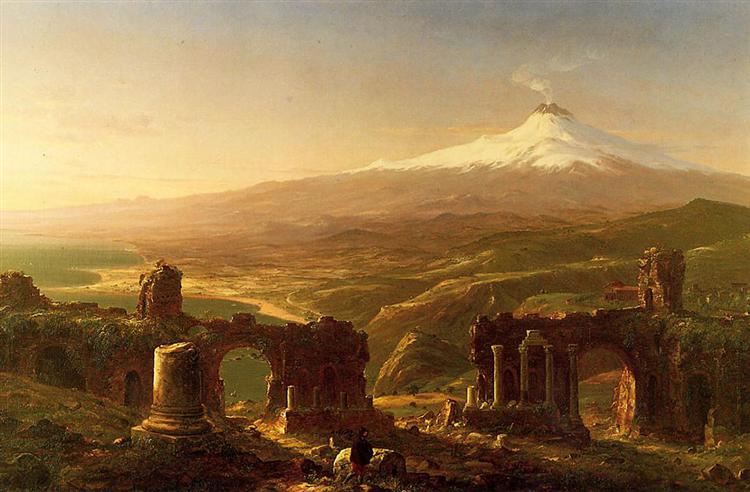
‘Mount Aetna from Taormina’ – Thomas Cole, 1843 – WikiArt
.
An older etymology for ‘peace’ is to be found in the Latin word ‘pacem’, which as its correlated verb ‘pāco’ brings in such ideas as to ‘pacify, subdue, subjugate, refine, plow a land’. Peace will allow you to pacify your world, to subdue your experience, make it apparent as awareness, and reveal its essence as being equal to the essence of your self. And peace will refine your world, make it transparent, fill it to the brim with the most subtle hues of a felt presence, which many have called the presence of god pervading everything and everyone. “God gives peace” is stated over and over again in the Bible. And peace will give you the occasion to plough the land of your experience and make it bear fruit in accordance with the sumptuous qualities contained in the knowing of your own being. It will transform your life and reveal it to be knitted in ‘harmony, concord, and equanimity’, which are all meanings of the Latin noun ‘pax’.
Other languages and cultures give us some other interesting meaning and usage. In Hebrew, the word ‘shalom’ is used as a form of greeting or on parting. ‘Peace be upon you’. More than a wish, it can be interpreted as the noticing, recalling, or proclaiming of something that binds us, a truth, a sameness in our lives — our common shield against the war of objective experience. The originality of ‘shalom’ is that it conveys the idea of ‘completeness, soundness’, and by extension ‘security, prosperity, well-being’. Peace will make you whole, undivided. It will put an end to your illusion of being a separate entity. It is the expression of a life lived as being, in which no parts are ever experienced, and therefore no conflict and suffering. This is true and ultimate security, not a security that implies protection and fear, but a security born of the annihilation of the sense of separation. Wholeness becomes your shield. This is the same idea that we find in the Arabic word and form of greeting ‘salaam’. The word ‘Jerusalem’ is therefore understood to be nothing but the ‘foundation of peace’, and the Arabic term ‘islam’, meaning ‘submission’, literally implies that ‘I surrendered because I found safety in the peace of my own being’.
India’s voice gives us yet another precious understanding of the word for peace. ‘Shānti’ is the Sanskrit word for ‘peace of mind’, a term that is often repeated three times at the end of many prayers, invocations, mantras. A peace that is the finality of any spiritual endeavour, the underlying truth and purpose contained in the understanding of our true nature. ‘Om shānti shānti shānti’. Peace of being is the only true celebration worth having; the ultimate beacon to go for; the final light at the end of a tedious process of inquiry; the eternal rest contained in just being. The Sanskrit etymology speaks for itself. ‘Shānti’ is formed of ‘sham’ meaning ‘to exert or fatigue oneself, to become tired, to come to an end, to finish, be extinguished’, even ‘to kill, destroy, remove’ but also ‘to conquer’ and finally ‘be appeased, pacified, soothed’. So, peace is here understood to be nothing but what remains when you have become tired with the false, when you have seen the idea of yourself as an illusion, when you have therefore killed it, or are finished with it. When you have been extinguished, blown up, as the thing you should never have been in the first place. Then, your ‘state of being’ — the ‘-ti’ suffix of ‘shānti’ — is recognised to be peace. That’s what you are left with. That’s the destination. ‘Om shānti shānti shānti’.
How revealing it is to find that peace is in fact nothing but the nature of our self, this very essential fact of being that can never leave us, but is covered up by our many escapes into objective experience. It is our very desire to attain or seek that peaceful state of mind, that is ironically making us flee from it. In fact, most of our activities are unconscious means to run away from our innermost presence as being. The problem lies in identity. Peace is just the discovery of our true identity which we were before expecting to find through the mind, in the realm of outer activity and movement. But peace doesn’t live there. It is present already, thriving in the background, hiding itself from our gaze in reason of our frantic search for it. It is this eternal being or self which we can never not be. To believe in our thoughts, in our being a self separate from the world, with its actions, movements, feelings, is what renders peace unknowable. We are killing peace at every moment with the illusion we have built about ourself. We have become a slave to an idea about ourself and not a servant of peace. By binding ourself to an untruth, to movement, excitement, desire, we are missing that innermost peace that lies just here and now as our very being, as our very self. But feel it once, feel this peace of your self once, as the very essence of your being, and all your life peregrinations will appear as having no meaning of their own, drawing their significance only from their living in the peace where they find their essence and home. Peace then becomes the canvas on which are drawn the many activities and possibilities of your life.
This is where comes handy this last, oldest etymological origin of ‘peace’, namely the Proto-Indo-European root ‘pag-‘ meaning ‘to fasten, agree, bind together’. So peace is also the final, firm agreement contained in our life. It is the discovery that all that our experience contains — the whole world, every thing believed to be external or ‘other’ — is in fact ‘attached, bound’ to our self. They have no existence of their own, no consistence other than the consistence of our self, no essence separate from the essence of our being. It is ‘joined’ to us in an irrevocable manner. We are that — that ‘pact’ of peace — unified both as our apparent self and as our apparent world. This has been made ‘firm, fast, solid’ through the recognition of our self as peace. We are made of this peace. It is not something we have, but something we are. It can never leave us, should we recognise its presence within us. It will pervade everything that we do, that we see, that we hear. Every possible objective experience finds its intelligibility and essence in peace, which is absence of movement, supreme subjectivity, the true home of life. We as every apparently separate beings and things in existence are bound together by and in an ‘agreement’, a ‘treaty’ of peace. A ‘binding’ that is expressed in our lives as love.
.
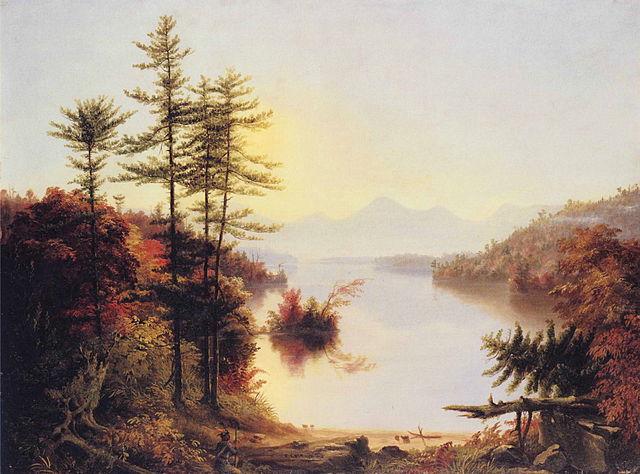
‘View on Lake Winnipiseogee’ – Thomas Cole, 1828 – Wikimedia
.
~~~
Text by Alain Joly
Paintings by Thomas Cole (1801-1848)
~~~
.
Website:
– Thomas Cole (Wikipedia)
Suggestion:
– Other ‘Essays’ from the blog…
.
Back to Pages
.
 The Dawn Within