
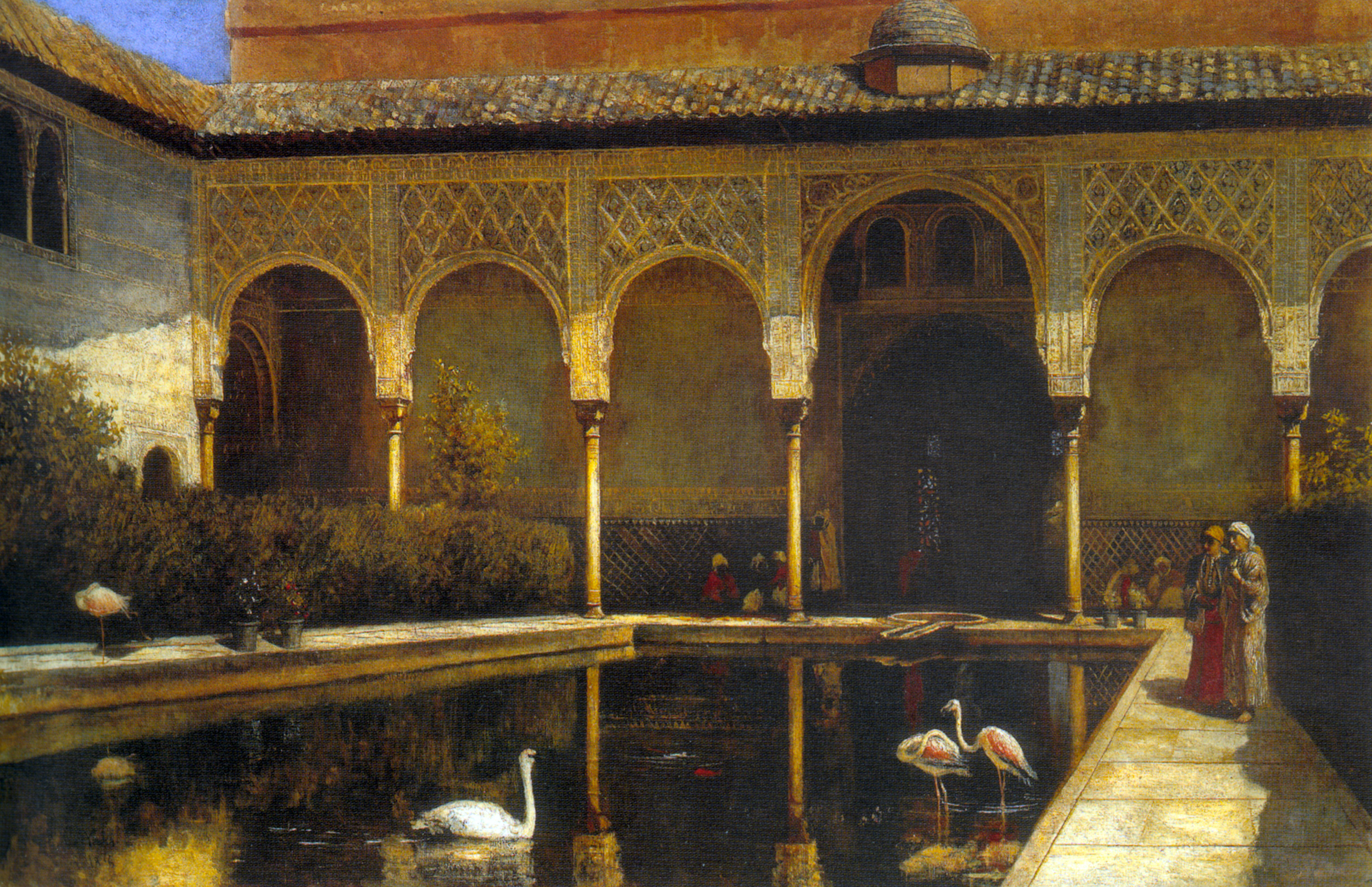
 ‘Court in the Alhambra’ – Edwin Lord Weeks, 1876 – WikiArt
.
The spiritual endeavour is really such good fun. You may happen to experience some suffering in your life and feel entangled — with thoughts rushing into your mind and problems seizing the entirety of yourself. The web of experience is overwhelming you and you can find no space to breathe within. You may then have to have a little conversation with yourself. You may have to disentangle yourself from your stubborn identification with thoughts and with the overcrowding objects born of the senses. That’s when you may present yourself with a simple question like: “What is this part in myself that is aware of my experience?” And so are you now taken amongst the scents of 8th century India, treading its immemorial dust with Shankara, debating with the great Vedantic master. He will show you how to move inwards right at the core of that aware presence in yourself. You will be taken with him to the core of this investigation, which is but the separation of the multiple objects of experience from the one aware, pervading presence of consciousness that is your true identity. That’s when Shankara leaves you with this one infaillible recipe:
.
“I bow down to that all-knowing One
which is pure Consciousness, all-pervading, all,
residing in the hearts of all beings
and beyond all objects of knowledge.”
~ Shankara (Upadesasahasri, 1:1)
.
You may then find yourself sitting in your kitchen, cutting vegetables, with your thoughts suddenly wandering in the 17th century Paris, surrounded by the walls of a Carmelite monastery’s kitchen, chatting along with Brother Lawrence. He might tell you with his big generous smile: you know brother, “nothing is easier than to repeat often in the day these little internal adorations.” That’s when you understand that this investigation can be made into a joyful, often repeated practice, where you go and meet yourself within, have a little chat with this hidden presence, spontaneously, as you gaze into the eyes of a friend. Amongst the frantic sound of knives hitting the wooden board and the fumes of the next meal simmering on the stove, you meet Brother Lawrence’s glance offering you this last precious advice:
.
“I renounced, for the love of Him,
everything that was not He;
and I began to live as if there was none
but He and I in the world.”
~ Brother Lawrence
.
You may now encounter a dark night, where your suffering is found intolerable. That’s when you are transported in 1578 in the city of Toledo, inside a Spanish prison, sitting with John of the Cross writing courageously his ‘Spiritual Canticle’. You are watching his unabated willingness to observe and feel his own, unblemished, unaffected, uncorrupted being, and are taken in turn into your own, resting there, finding solace and freedom just behind the bars of your identifications with experience. In spite of his being regularly beaten and famished, John is there for you, letting his most precious guidance sip into you. Speaking of god, he gently whispers in your ears:
.
“You are yourself that very tabernacle where He dwells,
the secret chamber of His retreat where He is hidden.
Rejoice, therefore, and exult, because all your good
and all your hope is so near you as to be within you;
or, to speak more accurately, that you can not be without it.”
~ John of the Cross (‘The Spiritual Canticle’, 1.8)
.
But you may find this pathway a little tedious — to have to dig again and again your utmost presence below the forms of experience. You may yearn for a more direct approach. This is when you find yourself sitting on a couch in the peaceful home of a police officer in southern India. Atmananda Krishna Menon has now invited you in the 20th century, amongst his beloved wife and three children, for a serious talk. He is showing you how experience is never a hindrance, and that everything, all appearances, are but an expression of your deepest ‘I’, which is nothing but your shared consciousness — the womb that hosts all experiences, and lends them its incorruptible essence. So you are now given this new, most precious Mantra — maybe the best of all — to be pronounced and chewed on all occasions:
.
“The ‘I-Principle’ is the only Experience that one can have.”
~ Atmananda Krishna Menon
 ‘Street Scene in Bombay’ – Edwin Lord Weeks – WikiArt
So you are now well equipped, but you keep forgetting the presence of your essential being at times. That’s when you decide for another trip to Southern India, to the sacred mountain of Arunachala, and treat yourself with the enigmatic gaze of the sage of whom Carl Jung said that he was “the whitest spot in a white space”. The towers of the great temple of Tiruvannamalai are now emerging from the early morning’s mist, and Ramana Maharshi’s great pointer rises into your mind: “Who am I?”. You follow its many offsprings that act on you like efficient, homeopathic reminders of your true nature: ‘What am I?’, ‘What is I?’. They have the power to send you back to the peaceful presence of your infinite self, before it gets invaded by, and lost in the persuasive power of objective experience.
.
“There are two ways to realize the Truth:
ask ‘Who am I?’ and trace the ‘I’, the ego,
to its source, the Self, and allow it to dissolve.
The second way is to surrender the ‘me’ that is the ego
to the Supreme, which is the state of ‘I Am’ within you.”
~ Ramana Maharshi (‘The Human Gospel’)
.
You are now well acquainted with your true nature. A lot of your time is spent within its landscape and you feel the peace contained in that new identity, as well as the quiet reverence that you grow for it. The time is ripe to pay a visit to Lallā walking and dancing amongst the thriving nature of the Himalayan range, in her natal Kashmir. There, in the wake of the 14th century, she enjoins you to abolish all the barriers that separate you from the beloved, and to see the face of god in every experience. “I saw and (found) I am in everything; I saw (God) effulgent in everything. […] The house is His alone : who am I, Lallā?” She infects you with her untamed enthusiasm and love for the One, and leads you to dance in its throbbing aliveness. You leave her with a new vigour and willingness to go to the bottom of it.
.
“Thou alone art the heavens, and Thou alone art the earth.
Thou alone art the day, the air, the night.
Thou alone art the meal-offering, the sandal inunction, the flowers, the water of aspersion.
Thou alone art all that is. What, therefore, can I offer thee?”
~ Lallā (trans. George Grierson)
.
There is one more little pointer that you came to cherish above all. It is the fastest, most effective and direct of all pathways towards your deepest reality. You keep it for the times when you are just about to slip out of your most intimate presence. You know, this moment just before you grab your coat and move out of the house of being, just before you pass the door and leave the home of your inner being for the thrill of multiple outside experiences and objects. That’s when you choose to pronounce: ‘I Am’. ‘I Am’ is sending you back home, safe and sound. And you are now sent in the home of a beedi cigarettes seller in the teeming Bombay of the seventies, in the little room he converted for the sharing of truth, on the first floor, 10th lane, in Khetwadi. There Nisargadatta Maharaj will keep you in the fire of ‘I am’, which he describes as the very door toward your essential being. “Look at yourself steadily — it is enough. The door that locks you in, is also the door that lets you out. The ‘I am’ is the door. Stay at it until it opens.”
.
“All has its being in me, in the ‘I am’,
which shines in every living being.”
~ Nisargadatta Maharaj (‘I Am That’)
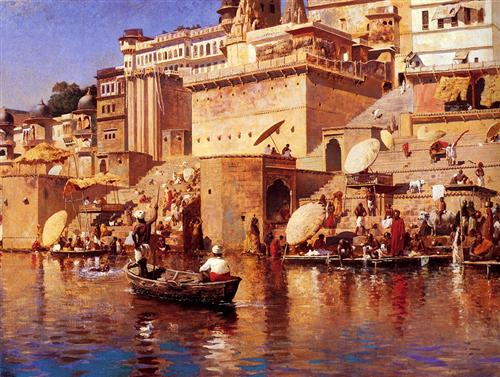 ‘On the River Benares’ – Edwin Lord Weeks, 1883 – WikiArt
The time has now come to explore the nature of your being as love. This love is found to be a powerful tool to deepen the intimacy of presence within yourself. So you abide in this love that you know will lead you to your beloved. In love you lose yourself and acquire a new identity. In love you come to meet Mirabai, a Krishna devotee and Rajasthani princess of the 16th century, in Western India. In her company you are taught to devote yourself to god’s being, which is nothing but the infinite presence that you are of all eternity. “My Lord, I long for Thee in my heart, Come, knowing me to be Thine.” Mirabai shows you that to surrender to the intimacy of just being is to flood your heart with love and to be offered the gift of being at rest, quenched, or just simply happy.
.
“Seeing Him, my heart blossoms in joy.
Peace permeates this body of mine;
His arrival has filled my home with bliss.”
~ ‘Mira The Divine Lover’ (V. K. Sethi)
.
Being has now been made the place where you reside. Your self as the reality of everything is your new identity. But you long to empty yourself so totally that you are made like a vessel for reality to move in. You need to let yourself go, and are reminded of Rumi, that great Sufi poet and lover of being. In the 13th century of present day Turkey, in Konya, Rumi has lost his beloved friend and mentor Shams. His broken heart and excruciating longing precipitated him towards a deepening of his innermost presence to meet his beloved in his soul and heart. “O Soul of my own Soul, my I as I am Thou: Thou art the All, and I in thee have all I sought.” Rumi looked at me and encouraged me to open so completely to my true nature as to “flow down and down in always widening rings of being.” I left him determined to engage in this new perspective.
.
“In the existence of your love, I become non-existent.
This non-existence linked to you is better
than anything I ever found in existence.”
~ Rumi
.
I am now surrendered to the one infinite being which is in truth God’s being. I decide for a trip to central Germany in the 13th century, to receive one last, definitive teaching from the great Meister Eckhart. Between two of his glorious sermons, and while tirelessly travelling from one monastery to a distant city where he is invited, the master advises me to now live my understanding outside the compound of spiritual achievement and the constraints of spirit as form: “Thy soul must be de-spiritualised: stripped of spirituality. For while thy soul is specifically spirit, she has form; the while she has form she has neither unity nor union.” (Sermon 49) I could feel Meister Eckhart’s mind scrutinising my being, assessing if there still was a place in me where god could have its being. He then said with his most loving tone: You have to be “too poor to have or be a place for God to work in. To preserve place is to preserve distinction. Why I pray God to rid me of God is because conditionless being is above God and above distinction.” (Sermon 87) ‘Then how shall I love God?’ did I ask feverishly.
.
“Love him as he is; a not-God, a not-spirit,
a not-person, a not-image; as sheer,
pure, limpid unity, alien from all duality.
And in this one let us sink down eternally
from nothingness to nothingness.”
~ Meister Eckhart
.
Meister Eckhart’s presence had by now become so pregnant that it melted with my being and the being of all things. I surrendered to it and vanished in unison with its empty nature.
.
 ‘The Alhambra’ – Edwin Lord Weeks, 1880 – WikiArt
.
~~~
Quotes by Collective
Accompanying text by Alain Joly
~~~
.
Guests on this page (with the page on the blog dedicated to their teaching or poetry):
– Adi Shankara – ‘Shankara the Great’
– Brother Lawrence – ‘The Practice of the Presence of God’
– John of the Cross – ‘The Mystical Doctor’
– Atmananda Krishna Menon – ‘The Householder Sage’
– Ramana Maharishi – ‘Rendezvous with Ramana, Part II’
– Lallā – ‘I, Lallā’
– Nisargadatta Maharaj – ‘Khetwadi Lane’
– Mirabai – ‘O Mystic Nuns!’
– Rumi – ‘Rumi’
– Meister Eckhart – ‘This is Meister Eckhart’
Website:
– Edwin Lord Weeks (Wikipedia)
.
Back to Pages
.
 The Dawn Within
Very beautifully written! I love the teachers you picked and the quotes! Thank you for sharing this work of art, filled with love, inspiration, and the highest knowledge that can be spoken.
LikeLike
Thank you for your comment! I’m glad you enjoyed it. 🙏
LikeLike
wow. how awesome and intriguing. Thank you. I’d like to see a short video based on what you have written. I started anticipating an entry into present day USA with someone……like maybe one of the Kriya Yoga (Himalayan) personalities. (Swami Rama, Yogananda, or Sri M). ha.
LikeLike
Thank you! Yes so many entries possible! It was fun to do… 🙏
LikeLike