
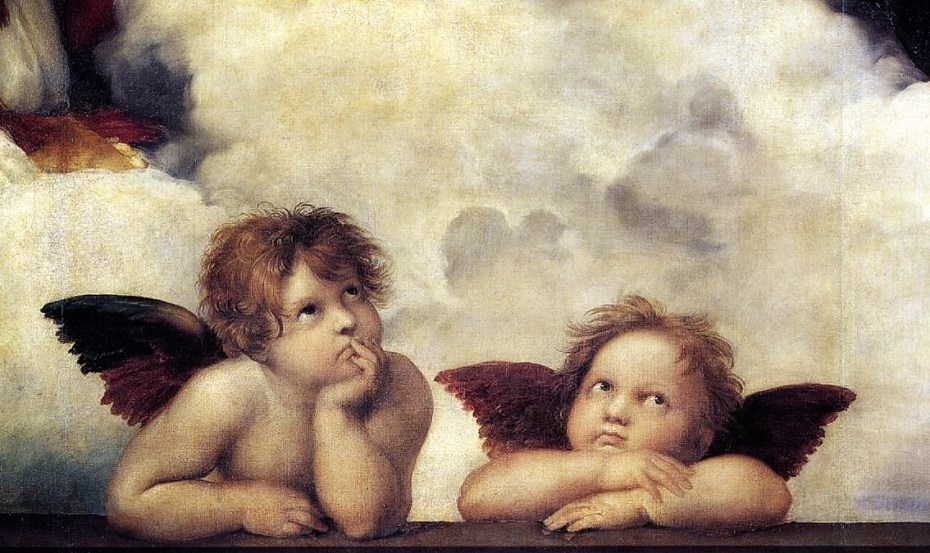
 ‘Putti, detail from The Sistine Madonna’ – Raphael, 1513 – WikiArt
.
γνῶθι σεαυτόν
.
Know thyself. Know who you are. That’s how simple it is. You may start from the far end, from a belief, a philosophy, an exotic term. You may call it religion, or spirituality, or non-duality — whichever name you want. You may go through the rugged path of belief, faith, practice, meditation, prayer, philosophy — all the names and concepts, the endless thinking about it, and the seeking that seems to never end. But now, when you stop and consider it all at last, you will come to the realisation that, deep down, it all comes down to that simple sentence. ‘Know thyself’. Not the knowing of your thoughts, ideas, opinions, feelings. Not your idiosyncrasies, or character, or outer shape, or preferences. None of that. To know oneself points directly to the knowing of your essence, of your innermost being, what you are made of at the core, when every other thing that can be pointed to has been discarded as superfluous. This is who you truly are. This maxim was once carved in golden letters on the front of the Temple of Apollo in Ancient Greece. That’s what this wisest of civilisations gave to the world as its supreme and most fundamental advice. ‘Know Thyself’.
So self-knowledge is the key. Of course, you may analyse it, take it apart, trace the endless chain of philosophers that gave their stand on this famous maxim, but I would not encourage you to do so. Sometimes, what’s really of crucial, definite importance resides at the simplest, closest address. The one you never truly considered for fault of being almost as nothing, a child’s play unworthy of your attention. Could it be that simple? That the meaning of the whole of life, the solution to our happiness, and the key to the whole riddle of existence could be found there, in the simple knowing of ourself? Let’s assume that it can and consider it seriously. Let’s embark on this shortest of journeys, the one going within, in the direction of our own self, where no distance is needed, no time necessary, and no special expertise required. This simple journey is the one of which the Ancient Greek poet and philosopher Ion of Chios wrote in the 5th century AD: “This ‘know yourself’ is a saying not so big, but such a task Zeus alone of the gods understands.”
Know thyself. This is a command, a simple command. You are being enjoined to know who you are. And should you be taking the challenge, it will set you in the right direction, which is within, in yourself. Then you will have to feel, to sense the nature of your being. Not to go out in search of a thing, not to project yourself as you have been doing so far, but to stay there, where you are, attentive to your most intimate essence. You will have to go beyond everything that you have taken to be yourself until now. These old identities have failed you, unable to give you what you were longing for. You have rummaged through your thoughts endlessly, have been drowned in feelings again and again, have been fascinated by the world, wearing your senses out in the process, stretching them to no avail. So now for once, you have reverted the process, have shuttered all windows on your self, and are willing to get accustomed to a new light.
Know thyself. There is a half-light here that needs some habituation. Your presence is required in a new way. So you are willing to stay, and get accustomed to your self. At last you accepted the invitation to your own home. You won’t discard it as you have done before, every time. You’re willing to be humble for once. So you stay there: within. Within. Is it really within, this ‘within’? What is this self that I am? Let’s find some evidence of my self. What is it that I am? You feel that you have to let it come. It’s the subtlest thing you’ve ever had to go to. Nothing like the usual thoughts and feelings, their coarseness and availability. Your being is not a thing to go to. You need to only be, if you want to be being. This is the way to know myself, by simply being, before every other kind of appearance, every minute surging of a thing, of a movement, every sizzling of an object that wants to be known. Don’t go there. Don’t be fooled this time. Don’t run after every belly dancing. Don’t get attracted. Don’t lose yourself. Not this time.
Know thyself. Get acquainted with your old pal, the one for whom you never really stopped, that you have passed by a thousand times, for whom you had no time, no energy to give, no generosity to convey. Now you embrace him. You hold her tight. Your self. Your being. You are being one with it. You have not taken leave from it. Now you commit at last. You feel a new comfort in this intimacy. Your self is becoming attractive, spacious, and you feel the warmth contained in it. You are being yourself for the first time. You observe that you have been yourself all the time, without your noticing. But you had been too proud to look. Maybe scared… didn’t want to die. For there is a subtle death involved here, in being yourself, in knowing yourself. There is a stillness. An objectlessness. You are being engulfed in your self. Burnt by its flame. Consumed with it. And the windows that you had closed on yourself have now opened of their own accord. Your self has acquired new proportions. Or maybe this was yourself, all that you are seeing now, this world that your self is, whose light and majesty you had been blind to until now. Until now.
Know thyself. So this was this, this ‘know thyself’. This task that god only understands. This commandment. This immensity never held before. This was the presence of god revealed. This was what it meant — this religious paraphernalia, these countless spiritual paths. What it came down to be, now embraced, here, in myself, as myself, as who I am. That’s the extent of knowing myself, to be here, in this understanding, in this light, in God’s being revealed as myself. This was that simple, this life I had taken to be hideous, this Hydra whose head could never be severed, and now was, definitely, uncompromisingly, at last. Its simplicity now revealed as the simple knowing of my own being. This is why one of the greatest Hindu sayings is ‘that thou art’ (‘tat tvam asi’), why Socrates wrote that this “region [of my self] resembles the divine”, and why Islamic literature makes constant references to it in sayings such as “He who knows himself knows his Lord” (Yahya ibn Mu’adh al-Razi, 830–871 CE). This is why Stoicism — this ancient school of philosophy — made ‘know thyself’ the core of its wisdom, and why the early Christian theologians understood that the doctrine ‘God made man in his own image’ implied ‘to know oneself is to know God’. After all, Meister Eckhart, in his own time, said in such irrevocable terms:
“I say, no man knows God who knows not himself first. Mark how to know yourselves. To know himself a man must be for ever on the watch over himself, holding his outer faculties, breaking them in by vigorous training to obey the higher powers of his soul. This discipline must be continued till he reach a state of consciousness so pure that nothing short of God can form in it. Then thou dost come acquainted with thyself and God.”
.
~~~
Text by Alain Joly
Quote by Meister Eckhart (1260-1328)
Painting by Raphael (1483-1520)
~~~
.
Websites:
– Know thyself (Wikipedia)
– Meister Eckhart (Wikipedia)
– Raphael (Wikipedia)
Suggestion:
– Other ‘Reveries’ from the blog…
.
Back to Pages
.
 The Dawn Within