
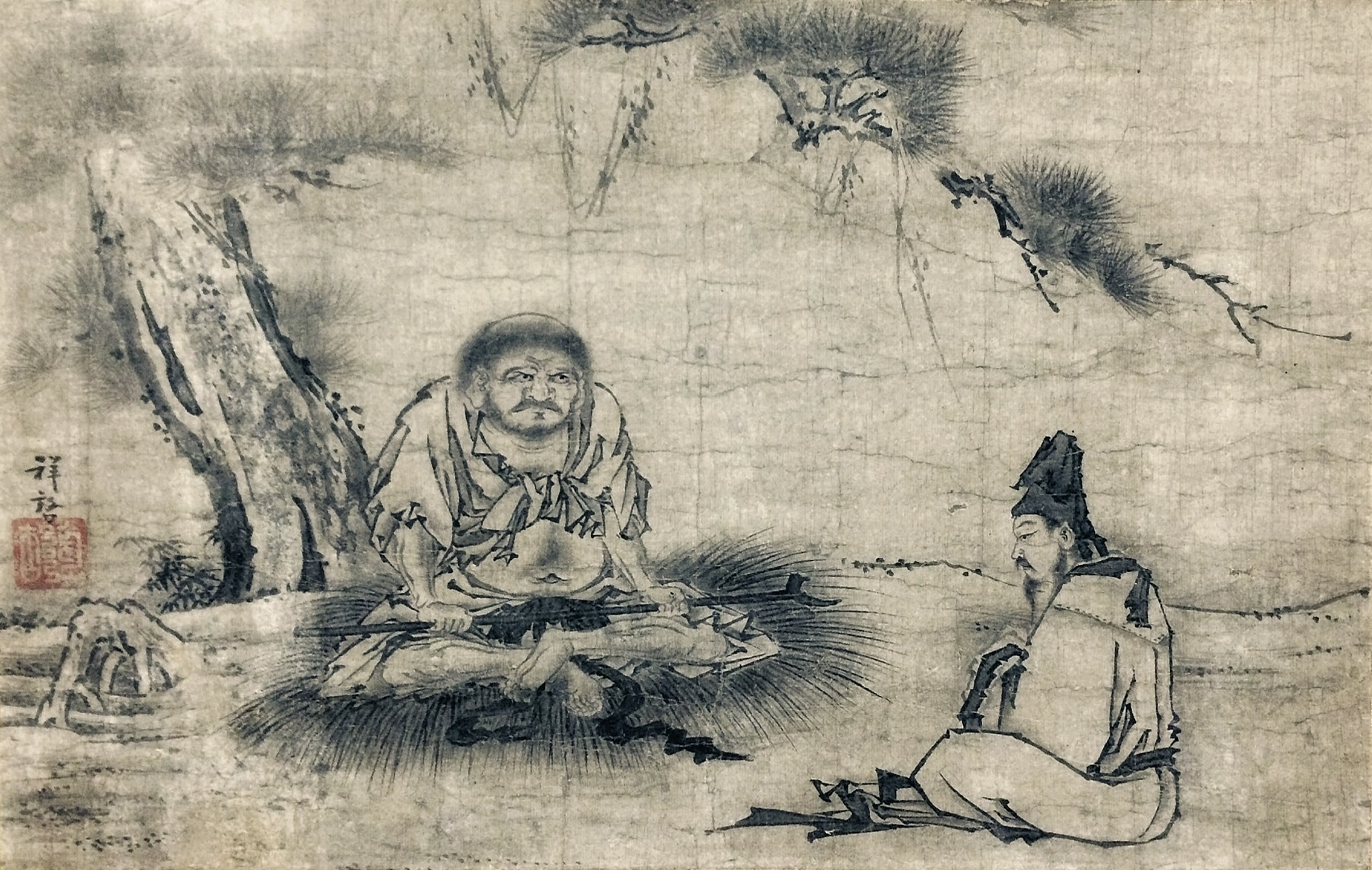
 ’Zen Encounter (Niaoke Daolin and Bai Juyi)’ – Kenko Shokei, 16th AD – Wikimedia
.
“This Dharma is Mind, beyond which there is no Dharma;
and this Mind is the Dharma, beyond which there is no mind.”
~ Huang Po (Ch.7)
.
Every religion has its mystical counterpart, where beliefs, rituals, and book studies are replaced by self-investigation, direct experience, and understanding. Buddhism is no exception. Out of the nimbus of Buddha’s awakening came a single practice called by the simple word ‘chán’, which means ‘meditation’ (‘dhyāna’ in Sanskrit). Bound by the rigorous practice of watching their mind and recognising its true nature — which is called Buddha-Nature in Buddhism — a whole dynasty of influential Patriarchs and Masters have transmitted this tradition known as Zen in the West. Huang Po was one such eminent Chinese Master. His concise work called ‘On the Transmission of Mind’ is one of the world’s major expositions of truth. Recorded by the scholar of the time P’ei Hsiu, this collection of Huang Po’s sayings and sermons opens with this simple, illuminating phrase:
‘
“All the Buddhas and all sentient beings
are nothing but the One Mind,
beside which nothing exists.”
~ Huang Po (Ch.1)
.
In this book, Huang Po wants to make very clear and very simple, that all understanding, all mystery, all the content of Zen practice, is to be found here, in ourself, as ourself, as our Mind, and that this Mind of ours, of all of us, is the Buddha. In other words, what we take to be our everyday little, separate, private self is, when investigated, nothing but the one supreme being that we share with all other beings. This understanding is what Huang Po calls the Way. This is the only recognition that we need:
.
“To awaken suddenly to the fact
that your own Mind is the Buddha,
that there is nothing to be attained
or a single action to be performed –
this is the Supreme Way.”
~ Huang Po (Ch.13)
.
“If you are not absolutely convinced that the Mind is the Buddha,
and if you are attached to forms, practices and meritorious performances,
your way of thinking is false and quite incompatible with the Way.”
~ Huang Po (Ch.2)
.
“This Mind is the pure Buddha-Source inherent in all men.
All wriggling beings possessed of sentient life
and all the Buddhas and Bodhisattvas
are of this one substance and do not differ.
Differences arise from wrong-thinking only.”
~ Huang Po (Ch.7)
.
Very little is known of Huang Po’s life, except that he was born in the city of Fuzhou, in ancient China, and that he died around 850 AD, on the mountain where he lived and taught. This is a man who was so deeply steeped in his “original Buddha-Nature” that he was named after the mountain where he began his monastic life, Mount Huangbo, name which was later given to another mountain, and to the monastery built for him there, and of which he had the charge. He describes the One Buddha-Mind — therefore his own Mind — as “devoid of any atom of objectivity. It is void, omnipresent, silent, pure; it is glorious and mysterious peaceful joy — and that is all” (Ch.8).
.
“The Mind is the Buddha, nor are there
any other Buddhas or any other mind.
It is bright and spotless as the void, having
no form or appearance whatever.”
~ Huang Po (Ch.2)
.
“This spiritually enlightening nature is without beginning, as ancient as the Void, subject neither to birth nor to destruction, neither existing nor not existing, neither impure nor pure, neither clamorous nor silent, neither old nor young, occupying no space, having neither inside nor outside, size nor form, colour nor sound. It cannot be looked for or sought, comprehended by wisdom or knowledge, explained in words, contacted materially or reached by meritorious achievement. All the Buddhas and Bodhisattvas, together with all wriggling things possessed of life, share in this great Nirvāņic nature. This nature is Mind; Mind is the Buddha, and the Buddha is the Dharma.”
~ Huang Po (Ch.14)
.
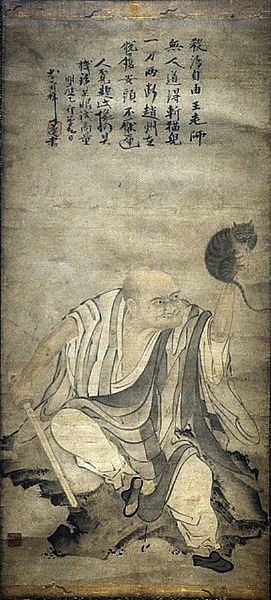 ‘Nansen zanbyo’ – Kenko Shokei, 16th AD – Wikimedia
.
Huang Po was given the title ‘The Zen Master who Destroys all Limitations’. For in truth, our mind is the totality, which cancels the possibility of any limits or edges in ourself. In chapter 8, he asserts: “That which is before you is it, in all its fullness, utterly complete. There is naught beside.” This fullness implies that “there is nowhere which is outside the Buddha-Mind” (chapter 9). When you realise your mind to be only Buddha-nature, the outside world in which you live reveals its profound nature. Huang Po stresses this point in chapter 21, saying: “Just let your minds become void and environmental phenomena will void themselves.”
.
“Nothing is born, nothing is destroyed.
Away with your dualism, your likes and dislikes.
Every single thing is just the One Mind.”
~ Huang Po (Ch.16)
.
“[There is no] difference between sentient beings and Buddhas,
or between saṁsāra and Nirvāņa, or between delusion and Bodhi.
When all such forms are abandoned, there is the Buddha.”
~ Huang Po (Ch.14)
.
Above all, Huang Po was a teacher of great talent due to the purity of his understanding. His methods were known to be extraordinarily direct, to the point of severity, and his tall appearance was striking. He insisted that “Mind and the object of [the people’s] search are one.” (Ch.10) The next two pieces of teaching are a beautiful and striking exposition of the illusory nature of the path and the progression towards Buddahood:
.
“If you would only rid yourselves of the concepts of ordinary and Enlightened, you would find that there is no other Buddha than the Buddha in your own Mind. The arising and the elimination of illusion are both illusory. Illusion is not something rooted in Reality; it exists because of your dualistic thinking. If you will only cease to indulge in opposed concepts such as ‘ordinary’ and ‘Enlightened’, illusion will cease of itself.”
~ Huang Po (Ch.32)
.
“Even if you go through all the stages of a Bodhisattva’s progress towards Buddhahood, one by one; when at last, in a single flash, you attain to full realization, you will only be realizing the Buddha-Nature which has been with you all the time; and by all the foregoing stages you will have added to it nothing at all. You will come to look upon those aeons of work and achievement as no better than unreal actions performed in a dream.”
~ Huang Po (Ch.8)
.
“There is only the one reality,
neither to be realized nor attained.
To say ‘I am able to realize something’
or ‘I am able to attain something’
is to place yourself among the arrogant. […]
There is just a mysterious tacit understanding
and no more.”
~ Huang Po (Ch.17)
.
~~~
Excerpts by Huang Po (died 850 AD)
Paintings by Kenkō Shōkei (1478–1506)
Additional text by Alain Joly
~~~
.
All the above quotes or excerpts from Huang Po are excerpted from ‘The Zen Teaching of Huang Po: On the Transmission of Mind’ – by Huang Po (Trans. by John Blofeld) – (Rider & Company, London)
Bibliography:
– ‘The Zen Teaching of Huang Po: On the Transmission of Mind’ – by Huang Po (Trans. by John Blofeld) – (Grove Press)
Websites:
– Huang Po (Wikipedia)
– John Blofeld (Wikipedia)
– Kenkō Shōkei (French Wikipedia)
Suggestion:
– Explore other exponents of truth in ‘Homage to …’ from the blog…
.
Back to Pages
.
 The Dawn Within
This is an excellent post, Alain…in my opinion, one of your best. It is well-organized and considered as well as beautifully illustrated with those wonderful paintings of Kenkō Shōkei. I like the way the text oscillates between pithy Huang Po quotations and your commentary…a non-dual, advaitic philosophy presented in a nutshell…a delight to read and reflect on. Thank you!
LikeLike
Thank you for sharing your appreciation! 🙏 I’m happy that you could connect in this way…
LikeLike
Once again, through your words something is asking me to pay attention! Thank you!
Michael 🇨🇦
LikeLike
Thank you Michael! 🙏
LikeLike
this truth is well expressed. Thank you for bringing it to our attention. Your blog is in service to the light.
LikeLike
Thank you! I’m happy that you enjoy it. 🙏
LikeLike