
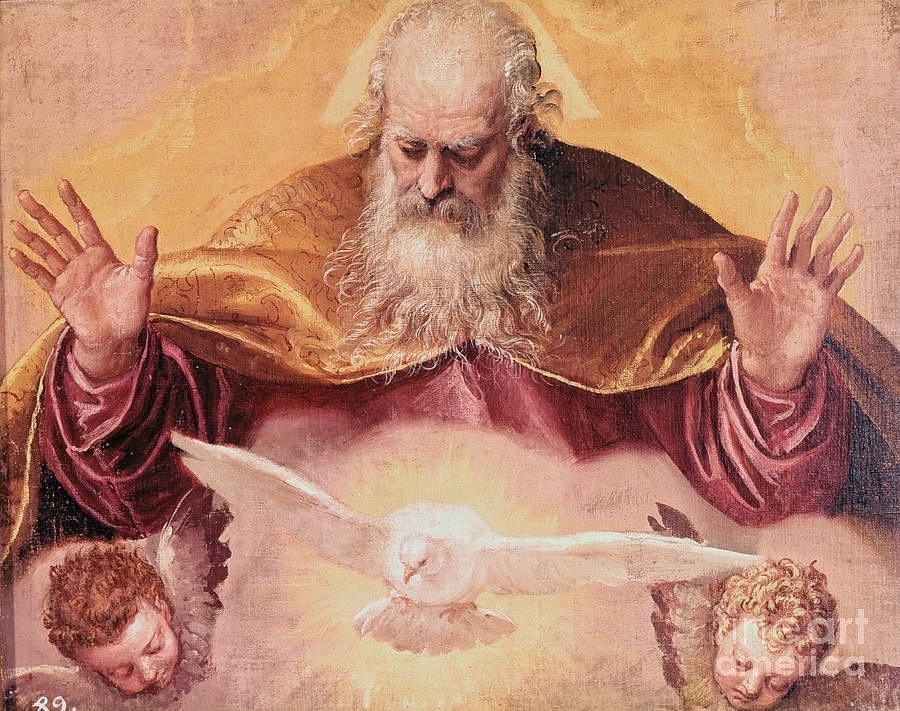
 ‘Illustrated Depiction of God with Holy Bettmann’ – Tintoretto, 16th AD – WikiArt
.
For many of us, god is nothing more than the idea or belief we have inherited of such a being, an idea that is conditioned by religion as the lazy representation of an omniscient, omnipotent entity that is both our creator and protector — in the popular Christian imagery an old bearded figure who lives far and away from us, in a lofty, elevated place for a good view on its creation and creatures. The existence of such a god is almost only a matter of belief or faith, and the relationship we have with it one of reward and punishment, devotion, fear, prayer, praise, but rarely of understanding and exactitude. It seems that we better have god in a hazy place, feel more at ease with not knowing too much about the wisdom that may hide behind that term. So our ignorance is a calculated one, a refusal to rock the boat, and a patting of our carefully assembled opinions from which we derive our sacrosanct identity and security. But let’s tackle god here. Let’s undress the myth and have a thorough eye-contact with the divine. Let’s dare some experiential understanding. Let’s have god out of its hiding place.
Maybe god was never defined because it is the one thing in life that is indefinable. Everything objective that we can know, see, hear, touch, smell, taste — qualities and all — can be described with words and given a name. We have our life surrounded by objects. The objective has filled our experience to the brim, and we are being choked in it — with no breathing possible, and no space allotted to the unknown. God is one such unknown. But how could we describe something that we cannot know as an object? So to god we can only give a generic, provisional name. Because god cannot be pointed at and recognised as an object or entity. God is not an easy catch. The divine defies our understanding, and this defiance is at the core of our misinterpretation of god. So if you want to know god, you have to look for it in your life, and turn every stone and pebble that crowd your experience. So start by removing everything in existence that you can know, see, hear, touch, smell, taste — qualities and all — that have an objective quality and can be given a proper name. You know: everything that you can show to another fellow, and that he too can see, hear, know, understand, and comprehend, just like you. Take it all away, and then see what remains behind.
Now chances are that what is left behind, and that you have now isolated, is that essential unnoticed piece of yourself which allows for objects to be known. For what would an object be without your being aware of it? So could it be possible that god is this aware power that is here buried in myself, living hidden under all that is objective, planted here as my very being? Could it be possible that here, deep down, attached to my most profound being, lies quiet something that lights up everything, and makes everything visible, manageable, possible? Could it be envisaged that what remains behind, after the removal of all objects — that cannot be named, showed, seen, heard, and in no way objectified — that this is plainly the god that we had thought far and unreachable?
So don’t ever look for god outside yourself, in an outer faraway direction. The divine is all an inside game. The great religious books of humanity have led you to think of the religious endeavour and of god, as something otherworldly, extraordinary, exotic. But their pages are simply describing the simple reality of our daily living — they are the teachings of our self, of our essence or nature as it is now, right now, in our simple, everyday existence. We don’t need to go to god through belief, faith, anything odd or supernatural. No. God is not supernatural. God is rather super natural. The most natural, accessible thing there is. God is the one presence that can be guessed before it can be known. It is that which supports and illumines all the existing, passing, objective appearances of our lives. God is that fundamental part of ourself which we could never get rid of, or even dispense with. “I equip you, though you do not know me”, is it said in Isaiah (45:5).
Now, we cannot even have the excuse of ignorance. We already and clearly know the name of god, from the very mouth of its supreme being. In Exodus 3:14, to Moses who asked God what its name was, the answer came with no ambiguity: “I Am That I Am”. So if you suffer one day, and find yourself wanting to call god for some relief, make sure that your plea is sent at the right address: which is within yourself, and with the right name: which is ‘I am that I am’. So to call god, to feel god, to know god experientially, say ‘I Am’, go within, in yourself, in God’s home, find your release there, in and as your very own being — which is god, and where are its benefits. This placeless place that your self is, that you can experience when you say simply ‘I Am’, is objectless and therefore unnamable — not because you cannot give god a name, but because naming god will make it into an object and spoil its most profound signification, sending its inescapable reality into the hiding.
So there comes a time when we notice that we in fact live as this inner, objectless presence that is aware, and therefore giving birth to everything in existence. The nameless is our very essence, the landscape in which, and out of which, our limited bodily existence can thrive for a while and recede. This is why god is said to be the Creator, because out of its objectless essence, out of empty being, is formed, sculpted, assembled, through our senses, all seeming objects, selves, and activities. Out of the one, everything is given birth. Out of the father the creation emerges, and we as selves are like the sons and daughters of our divine father or mother goddess. This is why god is described as Omnipotent and Omniscient. So God’s qualities as all-powerful and all-knowing are now descending from their inaccessible pedestal to incarnate their common, simple signification in our everyday living reality.
So you don’t have to walk to god, or reach it, or strive for it in any way. For god is in fact your very essence, the being of your being, what emerges as your purest and truest identity when you feel ‘I Am’. There is therefore nothing but your self — and that self is pervading all beings. You are borrowing God’s consciousness to be yourself conscious. You are borrowing God’s awareness to be yourself aware. You are borrowing God’s being to be yourself being. Nothing of importance in yourself is yours. Your body, thoughts, feelings, memories, are negligible, as death will surely one day convey. But you cannot put an end to god so easily, and therefore neither can you of your essential self. This is how Christ could be brought back to life, through the true body of his ultimate being — which is traditionally called the Father. We are literally God’s presence. Because there never was a human being here other than the universal being or presence which manifests and flowers as a human form, shaping the world and experience through the senses.
So god was never a matter of beliefs, but rather of noticing. Enlightenment, awakening, or resuscitation, don’t pertain to bodies and minds but are the names given to the simple realisation of our true, effective nature. Realised beings are so called not out of a perfection of their individual, separate selves, but rather of the perfection of their already complete, shared being. That being, which is God’s being, is the living essence of every beings, and of the being of all things derived from the awareness that ‘creates’ them. So everything is god. There is nothing but god. That’s how god is said to be Infinite. So the ten thousands things of our lives bear, in the secrecy of their being, an objectless nature. We and our world are eternally filled and pervaded by the empty being of the divine. The finite is in fact the infinite disguised, and the passing of time is God’s being reflected through our thoughts — the billions of selves being nothing but the one self or being having its essence shared and seemingly multiplied.
God as being is the one aware canvas where the living is painted, and where are formed and erased seas, mountains, bodies, activities, and qualities. God’s lending its essence to all that exists, and its intimate reality as the reality of everything, and its being as the ‘I Am’ of all beings, is truly an act of love. That’s why god is called Loving and Merciful — why god is love and why the realisation of our being as god’s being is traditionally called repentance. Repentance is the simple noticing that our being is wrongly identified with our sole body-mind. And god’s forgiveness is God’s sigh of relief when receiving the gift of our understanding that our being is its being. The sorrow and suffering contained in separation, conflicts, and wars are not the signs of god’s cruel intention, but are the signatures of our misunderstanding. But god has open arms and the grace we feel in life is god pulling our being to its being — making us the likes of Him or Her. That’s why god is called Just and Righteous. And god is also the peace-giver. For happiness is not given from outside or from circumstances. It lives in and as the ‘I Am’. It is the intrinsic, unavoidable consequence of our being aware of the nature of our being as god’s infinite being. It is the natural ease felt with the noticing of our inborn, frictionless, conflictless oneness. It is simply God’s own sense of satisfaction. With that knowledge, all our prayers to god will be made into praises to, remembrance of, and abidance in our most intimate, universal being. Then, when you know god in that way, and can praise Him or Her as the owner of your sublime heart, forget all about it. God is better lived in unknowing — in mystery and through its trail of love and beauty.
.
“You have turned for me my mourning into dancing;
you have loosed my sackcloth
and clothed me with gladness,
that my glory may sing your praise and not be silent.
O Lord my God, I will give thanks to you forever!”
~ Psalm 30:11-12
.
~~~
Text by Alain Joly
Painting by Tintoretto (1518-1594)
~~~
.
Websites:
– God (Wikipedia)
– Tintoretto (Wikipedia)
Suggestions from the blog:
– ’The Names of God’
– ‘I have Called You by My Name’
.
– Back to Pages
.
 The Dawn Within
Alain, you have spoken directly to my heart! I feel humbled and exalted at the same time. Repentance can only be a verb. Thank you for all of your writings, and this one has especially sparked some awakeness! ❤️🙏🏼
LikeLike
Thank you! I’m happy you enjoyed! 🙏♥️
LikeLike
yes
LikeLike
Thank you! 🙏
LikeLike