
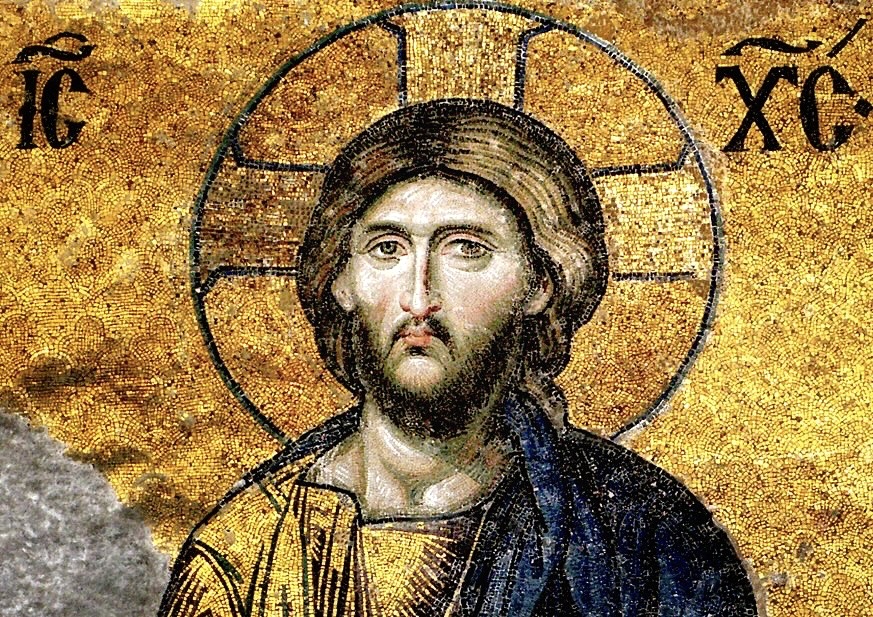
 ‘Christ Pantocrator mosaic from Hagia Sophia, Istanbul’ (part) – Unknown, late 13th AD – Wikimedia
.
Sometimes, the simplest questions are the ones never asked. Like, for example: ‘What is ‘Christ’?’ Were we ever curious about it? To know why this word was chosen to represent what it represents. Don’t we want to know? A word that has lent itself to a whole religion, that has been used to name a person —Jesus — who was worshipped for millennias, who is nothing less but the son of God, and who claims to be the solution to the relief of our suffering, to our being cleansed of our faults, and to our being reborn, resurrected, and blessed eternally. Don’t we want to know, to approach it with an inquisitive mind? Just once?
But it’s like we are being afraid. A sort of strange ‘fear of god’ that we have deep down, both as lovers of god or as atheists. Especially in religious matters, where it feels that we are often satisfied with a hazy understanding, a shaky belief, or a quick judgement, and are never prone to go deeper than that. ‘This is too big for us! Too remote! Where too much is at stake! So we’re not going to shake that boat! Not now!’ And so… This is how we keep a simple misunderstanding safe, how we keep an old stale belief alive, and how we keep at bay the truth of who we are… but we’re not going to do that now. Now is for truth. Now we have come to know at last! And one way to start an inquiry, in our highly conceptualised world, is to humbly dig for the etymology of the word that defines the thing we want to know about. That usually reveals some deeply buried secrets. So…
‘Christ’ comes from the Greek word ‘chrīstós’ meaning the ‘anointed one’. A meaning that is shared with the Hebrew word ‘mašíaḥ’, translated as Messiah. To be anointed is to be smeared or rubbed with oil, typically in a ceremonial way. It is a form of consecration, of elevation. It was used throughout history in multiple ways, for example as a form of medicine, or for the blessing of a king, or to attract the influence of the divine. But behind all the pompousness of it, is simply an act of redemption: We want to be happy, to be brought back to a state of health and harmony. It is the desire to elevate ourself from our conditioned ways of thinking and believing, and find the peace that we all think to deserve. It is the longing to be relieved from our suffering, and to rest at last in our own glorious being.
So the anointed one, or the messiah, and by extension the saviour, is nothing exotic or even remotely religious, and nothing that needs to be believed or adhered to. It is simply the recognition of our identity as being. It is the realisation that here stands a presence or reality in ourself, that is our very own identity — that which we truly are — and that is concealed from us by our fascination with experience. All our beliefs about ourself, that entity — what we were taught to be — this self that stands separate from the world and from every other self, that is defined by our thoughts and feelings, and finally limited by them, that finds its home in our body, and that dies at the end of the long and tedious dream that our life is, all that… was loony.
We want to be ‘the Anointed King’, the ‘al-Masīḥ’ (messiah) of the Arabic world, who is also referred in this tradition as the ‘traveller’, or the ‘one who cures by caressing’. We long to travel, to leave our usual, tedious habits of living to visit a land of space and newness, where we can breathe at last. And we want to caress and be caressed. We want to notice within our own presence, that pure independent sense of simply being, and divest ourself of our thousands attachments, of the prison that our life is for the most part. So ‘Christ’ is that part of ourself that comes like a caress, when we have disengaged ourself from our identifications with what we are not. The ‘messiah’ or ‘anointed one’ is then nothing but our very own self, when the soft landing or realisation of our new identity as being comes to the fore.
.
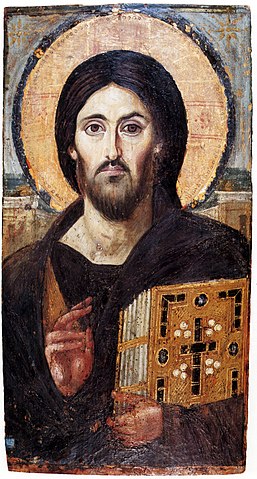 ‘The Christ Pantocrator of St. Catherine’s Monastery at Sinai’– Unknown artist, 6th AD – Wikimedia
.
The ‘anointed one’ may also refer to the one who is about to die to everything in experience that has an objective quality, all the things of our life, that pass by for a moment to be noticed and finally disappear, and that we have mistakingly taken to be ourself. You know — all that incessant round of thoughts, feelings, sensations, perceptions, that we believe constitute our reality as selves, bodies, and world. At the moment of this small death, of this crucifixion, when our old, fabricated self is about to give way to its true reality as simply and irrevocably being, when it is about to be anointed with and in its new reality, and receive the anointment, or extreme unction of death, then do we come to notice the nature of our true self. Then do we appear as we truly are, anointed with, in, and as God’s being, so that our being may be lustrous with that consecrated oil, bright and shining with and as a presence that is larger than us.
This is when we come to this older meaning of ‘Christ’, which comes from its Proto-Indo-European root ‘ghrēi-‘, meaning ‘to rub’. This original meaning stresses the importance on that which is veiling the simple truth of being. This ancient root has given rise to English words such as ‘cream’, ‘grime’ or ‘grisly’, to the Lithuanian verb ‘grieju’, meaning ‘to skim the cream off’, or the Old English word ‘grima’, which stands for ‘mask’, ‘helmet’, or ‘ghost’. So here we are, in just a few words, a teaching exposed, a manual for truth in our hands. Should we want to recognise the truth of our being in ourself, to have a first-hand experience of it, we then have to ‘skim the cream off’ our false identifications, to remove that illusory self, the ‘mask’ that we have ‘grimed’ our self with. This is a non-existent ‘ghost’, that self. A ‘grisly’ entity, ridden with every measure of suffering and doubt. Disengage from it. Recognise its not being there. See its true and only reality as being, and you will be brought to the altar to be anointed in peace, and humbled with a love that is unconditional.
There is one last thing that needs to be understood about Christ, and this is not going to be conveyed through etymology, but through the most sumptuous imagery. We rely here on some famous icons called the ‘Christ Pantocrator’. These images were amongst the first ones to appear of Christ in the Eastern Orthodox Church. They depict a Christ watching you with that strange, unfocused, almost squint-eyed gaze that is the signature of so many icons. This is to convey that Christ is in fact directing its vision wholly inside, within its own being, never losing sight of it. Christ is “He Who Is”, entirely merged in being. And Christ is one being, with the capacity of lending its being both as divine nature, and as our human nature, without ever leaving itself. Or, in Thomas Aquinas’ words, being “both the Godhead anointing and the manhood anointed“. This is rendered in the icon through the division of Christ’s face into two slightly different appearances, while retaining the appearance of one Christ, or One Being. A highly evolved and subtle realisation that these artists were able to convey in such a distant past.
The ‘Christ Pantocrator’ also points to the all-powerful nature of Christ’s being, ‘pantocrator’ meaning literally ‘ruler of all’. Christ as being, is ‘Almighty’, indestructible. He holds the teachings of the New Testament with his left hand, signifying ultimate understanding, and makes a gesture of blessing with his right hand, which refers to his nature as peace. In another translation, Christ is the ‘Sustainer of the World’, giving birth to all appearances within itself, through its reality as ultimate, aware being. This is the anointment that we receive when we have realised that our nature is not bound to our body and mind, and not thwarted with separation and suffering, but lies unlimited, eternal, and peaceful, when we have recognised that our nature is in fact contained in, and made of, God’s being. In other words, when we recognise our being as ‘Christ’, the Anointed One.
.
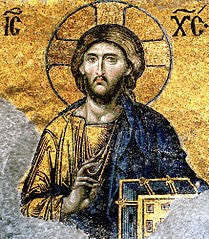
‘Christ Pantocrator mosaic ‘(Hagia Sophia, Istanbul)
.
~~~
Text by Alain Joly
Mosaic and Painting by Unknown (13th and 6th AD)
~~~
.
Websites:
– Christ (title) (Wikipedia)
– Messiah (Wikipedia)
– Anointing (Wikipedia)
– Christ Pantocrator (Wikipedia)
– Christ Pantocrator (Sinai) (Wikipedia)
– Thomas Aquinas (Wikipedia)
Suggestion:
– Other ‘Essays’ from the blog…
.
Back to Pages
.
 The Dawn Within