
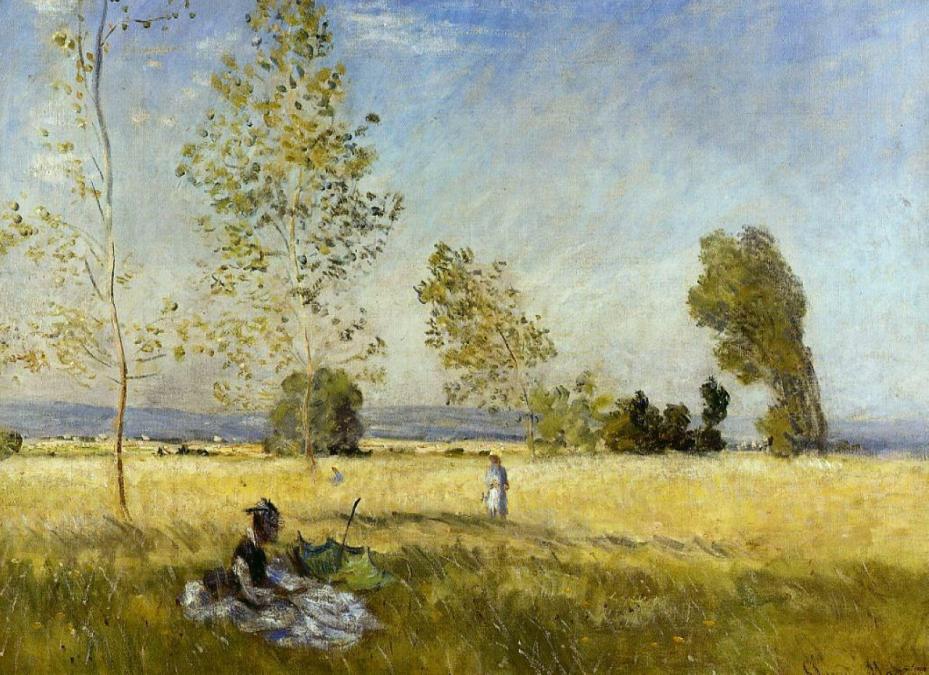
 ‘Meadow at Bezons’ – Claude Monet, 1874 – WikiArt
.
“You only have to receive everything and let it happen.
Everything is directing you, straightening you out, carrying you.
Everything is a banner, a litter, a comfortable vehicle.
Everything is God’s hand; everything is God’s earth, air and water.”
~ ‘Abandonment to Divine Providence’ (Muggeridge)
.
Truth is its own advocate. No matter where or when or in what obscure circumstances an expression of truth has been composed, it will find its way out into the light. This is what happened to a small book allegedly written by the French Jesuit priest Jean-Pierre de Caussade (1675-1751). Written in the first half of the eighteenth century, it remained unpublished until 1861, before being praised for its quality and lyricism, and appeared in multiple editions over time. It is known by the title ‘Abandonment to Divine Providence’. Jean-Pierre de Caussade was the author of many letters of spiritual instruction, and some of them appear in his book along with a treatise in self-abandonment. This latter text particularly ignited attention and was in style and quality so far removed from the other ‘letters’ that it became apparent that the author could not have written it.
Some say that the treatise was adapted from a work by Madame Guyon (1648-1717), another French Christian mystic of the time, whose writings were often judged heretical by the Catholic establishment for advocating Quietism. She was imprisoned for eight years after the publication of a book called ‘A Short and Very Easy Method of Prayer’, that became of considerable influence to many French Catholics including the famous priest and hermit Charles de Foucauld. Mme Guyon wrote: “Prayer is the key of perfection and of sovereign happiness; […] For the way to become perfect is to live in the presence of God. He tells us this Himself: ‘Walk before Me and be blameless’ (Genesis, 17:1). Prayer alone can bring you into His presence, and keep you there continually.” She added: “There was a period when I chose a time and place for prayer. […] But now I seek that constant prayer, in inward stillness known.” She was critical of these ‘righteous people’ who felt that their spiritual achievements were due to their own merits only. She often pointed that “God’s bounties are effects of His will”.
Quietism was essentially a passing trend in Christianity, which stated that the personal self that we believe ourself to be was to relinquish itself and be absorbed into the divine essence, in the present life. This could be accomplished by the favour of Grace on the part of god’s being, and abandonment on the part of the apparent, personal self. This provoked unabated critics and was judged heretical by the Church. In an entry from the original Catholic Encyclopedia, published between 1907 and 1912, the American Catholic priest E. A. Pace wrote that Quietism was “a sort of false or exaggerated Mysticism. […] These aberrations of Mysticism continued even after the preaching of Christianity had revealed to mankind the truth concerning God, the moral order, and human destiny.” He further scornfully stated that “In its essential features Quietism is a characteristic of the religions of India. Both Pantheistic Brahminism and Buddhism aim at a sort of self-annihilation, a state of indifference in which the soul enjoys an imperturbable tranquility.”
Yet what Quietism was advocating had been running in Christianity from the dawn of ages, from the personal spiritual knowledge emphasised in Gnosticism over the 2nd century, to the practice of Hesychasm in the Eastern Orthodox Church, from Meister Eckhart to Teresa of Avila, John of the Cross, and others. Many have placed the practice of ‘abandonment’ or surrender to god’s will and presence as an essential pathway towards the understanding of our true nature. In his paper on the famous treatise, the Jesuit and professor of theology Dominique Salin wrote beautifully of ‘abandonment’: “This tradition speaks of a secret union with God, of the soul’s peace, of a blessed life, of ‘rest’ and ‘quiet’. ‘Abandonment’ involves letting things be, in all circumstances, amid the night of faith: letting God act, letting God be God in the soul.”
I have chosen to present here some excerpts borrowed to the translation proposed by ‘Christian Classics Ethereal Library’. No matter who wrote with certainty this gorgeous text on ‘abandonment’, he or she has given us some sort of practical and humble course in abandonment. It is a profound account of truth woven in exquisite lyricism and poetry, and I hope you will enjoy it as I did. I will leave to Dominique Salin the last words of presentation:
“More than ever it has become clear that to live a spiritual or mystical life is not a matter of seeking after exalted feelings, sensational messages or rarefied and exclusive states of mind. To live a spiritual life is to live in faith, faith in the One whom one cannot see (Hebrews 11:1). This pure faith is another name for what the treatise calls ‘abandonment’.”
.
~~~
Abandonment to Divine Providence
.
In these few opening quotes, the author shows how the presence of god as pure consciousness is not to be found out there, in the objects of experience, but rather within, “under the most lowly forms”, in what appears to be secondary, of no importance…
.
“God reveals Himself to the humble under the most lowly forms,
but the proud, attaching themselves entirely to that which is extrinsic,
do not discover Him hidden beneath, and are sent empty away.”
~ Book I, Ch. I, Section 2
.
“This God of all goodness has made those things easy which are common and necessary in the order of nature, such as breathing, eating, and sleeping. No less necessary in the supernatural order are love and fidelity, therefore it must needs be that the difficulty of acquiring them is by no means so great as is generally represented. Review your life. Is it not composed of innumerable actions of very little importance? Well, God is quite satisfied with these.”
~ Book I, Ch. I, Section 3
.
“The more holy the life the more mysterious it becomes by its apparent simplicity and littleness. O great feast! O perpetual festival! God! given and received under all that is most feeble, foolish and worthless upon earth!”
~ Book I, Ch. II, Section 7
.
With poetical emphasis, the author is here stressing that the holy, or God’s presence as our very being, is not something difficult, out of reach, but is our very reality here and now, present in and as our everyday experience. It is “the treasure that none discover because they suppose it to be too far away” which amounts to nothing but “a conformity of will with the will of God”…
.
“There could be nothing more reasonable, more perfect, more divine than the will of God. Could any change of time, place, or circumstance alter or increase its infinite value? If you possess the secret of discovering it at every moment and in everything, then you possess all that is most precious, and most worthy to be desired.”
~ Book I, Ch. II, Section 3
.
“It is the drachma of the Gospel, the treasure that none discover because they suppose it to be too far away to be sought. Do not ask me how this treasure can be found. It is no secret. The treasure is everywhere, it is offered to us at all times and wherever we may be. All creatures, both friends and enemies pour it out with prodigality, and it flows like a fountain through every faculty of body and soul even to the very centre of our hearts. If we open our mouths they will be filled. The divine activity permeates the whole universe, it pervades every creature; wherever they are it is there; it goes before them, with them, and it follows them; all they have to do is to let the waves bear them on.”
~ Book I, Ch. I, Section 3
.
“O my God! how much I long to be the missionary of Your holy will, and to teach all men that there is nothing more easy, more attainable, more within reach, and in the power of everyone, than sanctity. […] Oh! all you that read this, it will cost you no more than to do what you are doing, to suffer what you are suffering, only act and suffer in a holy manner. It is the heart that must be changed. When I say heart, I mean will. Sanctity, then, consists in willing all that God wills for us. Yes! sanctity of heart is a simple “fiat,” a conformity of will with the will of God.”
~ Book I, Ch. I, Section 9
.
“We must understand that the only way of receiving the impression of this eternal idea is to remain quietly amenable to it; and that neither efforts, nor mental speculations can do anything to that end.“
~ Book I, Ch. II, Section 12
.
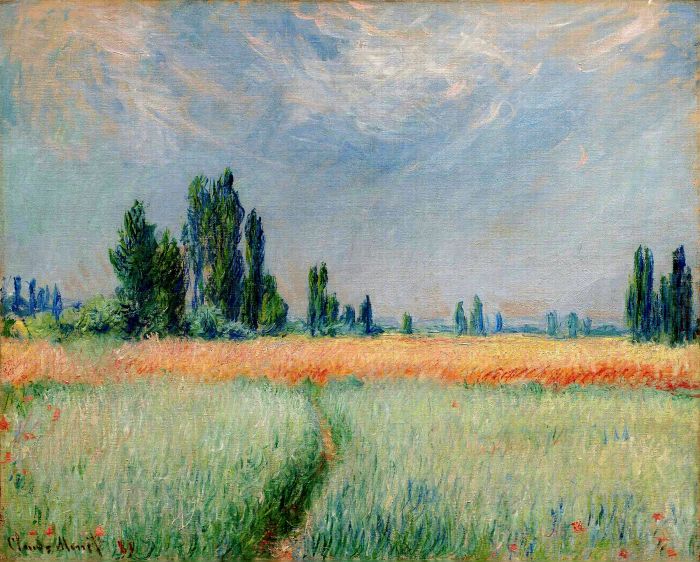 ‘The Wheat Field’ – Claude Monet, 1881 – WikiArt
.
The author is emphasising here the importance of the present moment, this place where presence can be found, at the very heart of our being, at the core of our self, a presence that can never be accessed through the past, or by means of future attainment. It is what we already have here and now, and this is all that we need. “Why seek it elsewhere? Do you know better than God?”…
.
“The divine will is a deep abyss of which the present moment is the entrance.”
~ Book I, Ch. II, Section 3
.
“O, all you who thirst, learn that you have not far to go to find the fountain of living waters; it flows quite close to you in the present moment; therefore hasten to find it. Why, with the fountain so near, do you tire yourselves with running about after every little rill? These only increase your thirst by giving only a few drops, whereas the source is inexhaustible.”
~ Book I, Ch. II, Section 9
.
“The present moment is the ambassador of God to declare His mandates. The heart listens and pronounces its ‘fiat’. Thus the soul advances by all these things and flows out from its centre to its goal. It never stops but sails with every wind. Any and every direction leads equally to the shore of infinity. Everything is a help to it, and is, without exception, an instrument of sanctity. The one thing necessary can always be found for it in the present moment. It is no longer a choice between prayer and silence, seclusion and society, reading and writing, meditation and cessation of thought, flight from and seeking after spiritual consolations, abundance and dearth, feebleness and health, life and death, but it is all that each moment presents by the will of God. In this is despoilment, abnegation, renunciation of all things created, either in reality or affectively, in order to retain nothing of self, or for self, to be in all things submissive to the will of God and to please Him; making it our sole satisfaction to sustain the present moment as though there were nothing else to hope for in the world.”
~ Book I, Ch. II, Section 10
.
“No soul can be really nourished, fortified, purified, enriched, and sanctified except in fulfilling the duties of the present moment. What more would you have? As in this you can find all good, why seek it elsewhere? Do you know better than God?”
~ Book I, Ch. I, Section 7
.
“The present moment, then, is like a desert in which the soul sees only God whom it enjoys; and is only occupied about those things which He requires of it, leaving and forgetting all else, and abandoning it to Providence. This soul, like an instrument, neither receives interiorly more than the operation of God effects passively, nor gives exteriorly more than this same operation applies actively.”
~ Book II, Ch. II, Section 4
.
“We can no longer consider our moments as trifles
since in them is a whole kingdom of sanctity.”
~ Book I, Ch. II, Section 10
.
It is important to notice that we, as the belief in being a separate self, are the veiling factor that hides god’s infinite presence to our gaze. All reasons or actions undertaken under the guidance and authority of this self is necessarily barren, and its relinquishing is what makes the action, or will, or Grace of god apparent and effective in our lives. “He is no longer object, or idea, but principle and source.”…
.
“The action of the creature is a veil which covers the profound mysteries of the divine operation. […] All that takes place within us, around us, or through us, contains and conceals His divine action. […] If we could lift the veil, and if we were attentive and watchful God would continually reveal Himself to us, and we should see His divine action in everything that happened to us, and rejoice in it. At each successive occurrence we should exclaim: ‘It is the Lord’, and we should accept every fresh circumstance as a gift of God.”
~ Book I, Ch. II, Section 1
.
“The light of reason can do nothing but deepen the darkness of faith: the radiance necessary to disperse it must proceed from the same source as itself. In this state God communicates Himself to the soul as its life, but He is no longer visible as its way, and its truth: The bride seeks the Bridegroom during this night; she seeks Him before her, and hurries forward; but He is behind her, and holding her with His hands. He is no longer object, or idea, but principle and source.”
~ Book II, Ch. IV, Section 1
.
“It is quite useless for man to trouble himself; all that takes place in him is like a dream. One cloud chases another like imaginations in the brain of the sleeper, some sorrowful, others consoling. The soul is the playground of these phantoms which follow each other with great rapidity.”
~ Book II, Ch. IV, Section 2
.
“The divine action, concealed though it is, reveals its designs, not through ideas, but intuitively. It shows them to the soul either necessarily, by not permitting any other thing to be chosen but what is actually present, or else by a sudden impulse, a sort of supernatural feeling that impels the soul to act without premeditation; or, in fine, by some kind of inclination or aversion which, while leaving it complete liberty, yet none the less leads it to take or refuse what is presented to it.”
~ Book II, Ch. IV, Section 4
.
The self as a separate entity cannot understand reality and find happiness through its own means as effort, practice, or any other wilful achievement, which are often but a form of resistance. One must accept to surrender one’s own will to the will of god, which means that it is only through and by means of its presence, which is our innermost foundation as pure being, that one can recognise our true nature and live by it. This is the surrendering or abandonment that we must abide by…
.
“The soul that does not attach itself solely to the will of God will find neither satisfaction nor sanctification in any other means however excellent by which it may attempt to gain them. If that which God Himself chooses for you does not content you, from whom do you expect to obtain what you desire?”
~ Book I, Ch. I, Section 7
.
“Do you imagine you will find peace in resisting the Almighty? Is it not, on the contrary, this resistance which we too often continue without owning it even to ourselves which is the cause of all our troubles? It is only just, therefore, that the soul that is dissatisfied with the divine action for each present moment should be punished by being unable to find happiness in anything else. […] It is a sign that one has strayed from the path of pure abandonment to the divine action, and that one is only seeking to please oneself. To be employed in this way is to prevent God from finding an entrance. All this must be got rid of because of being an obstacle to grace.”
~ Book I, Ch. I, Section 7
.
“It is by union with the will of God that we enjoy and possess Him; and it is an illusion to endeavour to obtain this divine enjoyment by any other means. Union with the will of God is the universal means. It does not act by one method only, but all methods and all ways are, by its virtue, sanctified. The divine will unites God to our souls in many different ways, and that which suits us is always best for us. All ways should be esteemed and loved, because in each we should behold that which is ordained by God accommodating itself to each individual soul, and selecting the most suitable method of effecting by it the divine union. The duty of the soul is to submit to this choice, and to make none for itself; and this without dispensing itself from esteeming and loving this adorable will in its work in others.”
~ Book II, Ch. II, Section 5
.
“[The] divine will is to the soul in all things its method, its rule, and its direct and safe way. It is an unalterable law which is of all times, of all places, and of all states. It is a straight line which the soul must follow with courage and fidelity, neither diverging to the right, nor to the left, nor overstepping the bounds. Whatever is over and above must be received passively, as it carries on its work in abandonment. In a word, the soul is active in all that the present duty requires, but passive and submissive in all the rest, about which there should be no self-will, but patient waiting for the divine motion.”
~ Book II, Ch. II, Section 4
.
“In the state of abandonment the only rule is the duty of the present moment. In this the soul is light as a feather, liquid as water, simple as a child, active as a ball in receiving and following all the inspirations of grace. Such souls have no more consistence and rigidity than molten metal. As this takes any form according to the mould into which it is poured, so these souls are pliant and easily receptive of any form that God chooses to give them. In a word, their disposition resembles the atmosphere, which is affected by every breeze; or water, which flows into any shaped vessel exactly filling every crevice. They are before God like a perfectly woven fabric with a clear surface; and neither think, nor seek to know what God will be pleased to trace thereon, because they have confidence in Him, they abandon themselves to Him, and, entirely absorbed by their duty, they think not of themselves, nor of what may be necessary for them, nor of how to obtain it. The more assiduously do they apply themselves to their little work, so simple, so hidden, so secret, and outwardly contemptible, the more does God embroider and embellish it with brilliant colours.”
~ Book II, Ch. II, Section 6
.
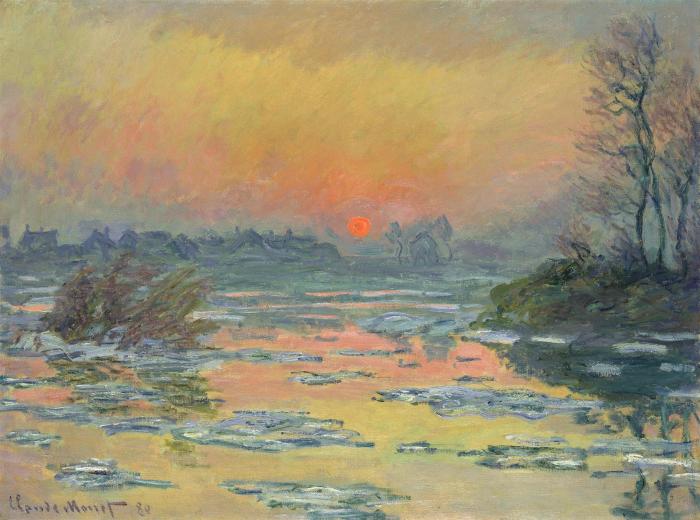 ‘Sunset on the Seine in Winter’ – Claude Monet, 1880 – WikiArt
.
This abandonment of our will to the will of god, or the relinquishing of our limited self to the eternal self contained in simply being, is the flowing of Grace in your life. This Grace “pervades all, makes all divine, and changes all into itself.”…
.
“Let us go to God, then, my soul, in abandonment,
and let us acknowledge that we are incapable of
acquiring virtue by our own industry or effort.”
~ Book II, Ch. IV, Section 1
.
“Your will is enough, and I am content to live and to die as it decrees. In itself it is more pleasing to me than all the attributes of the instruments of which it makes use, or than their effects, because it pervades all, makes all divine, and changes all into itself. It is all heavenly to me, and every one of my moments is a genuine divine action, and living or dying I shall always be satisfied with it. Yes, divine Love, I shall no longer single out times or ways, but shall welcome You always and in any fashion. It seems to me, O divine Will, as if You had revealed Your immensity to me; I will therefore take no steps save in the bosom of Your infinity, You who are the same yesterday, to-day, and for ever. The unceasing torrent of graces has its rise in You. It is from You that it flows, is carried on, and made active.”
~ Book I, Ch. II, Section 11
.
“The effects of grace, visible to watchful eyes, and intelligent minds, are nothing short of marvellous. Without method, yet most exact; without rule, yet most orderly; without reflexion, yet most profound; without skill, yet thoroughly well constructed; without effort, yet everything accomplished; and without foresight, yet nothing better suited to unexpected events. […] Every expedient of the divine action has an efficacy which always surpasses its apparent and natural virtue.”
~ Book II, Ch. IV, Section 4
.
“This order of the divine will is the solid and firm rock on which the submissive soul reposes, sheltered from change and tempest. It is continually present under the veil of crosses, and of the most ordinary actions. Behind this veil the hand of God is hidden to sustain and to support those who abandon themselves entirely to Him.”
~ Book II, Ch. IV, Section 7
.
For the author, the word ‘faith’ is used here as an inward attitude by which we are led to recognise our true nature. It is the revelation of our self as god’s being behind the so alluring objective experiences in our life. In other words, it is, as the author puts it, “a continual quest for God in and through what disguises Him.”…
.
“The life of faith is a continual struggle against the senses.”
~ Book I, Ch. II, Section 6
.
“Faith changes the face of the earth; by it the heart is raised, entranced and becomes conversant with heavenly things. Faith is our light in this life. By it we possess the truth without seeing it; we touch what we cannot feel, and see what is not evident to the senses. By it we view the world as though it did not exist. It is the key of the treasure house, the key of the abyss of the science of God. It is faith that teaches us the hollowness of created things; By it God reveals and manifests Himself in all things. By faith the veil is torn aside to reveal the eternal truth.”
~ Book I, Ch. II, Section 1
.
“The instinct of faith is an elevation and enlargement of the heart
above and beyond all that is presented to the senses.“
~ Book II, Ch. I, Section 4
.
“The soul, enlightened by faith, judges of things in a very different way to those who, having only the standard of the senses by which to measure them, ignore the inestimable treasure they contain. He who knows that a certain person in disguise is the king, behaves towards him very differently to another who, only perceiving an ordinary man, treats him accordingly.”
~ Book I, Ch. II, Section 2
.
“The life of faith is nothing other than a continual quest for God
in and through what disguises Him, disfigures Him,
as it were destroys Him, and annihilates Him.”
~ Muggeridge translation (IX, 122)
.
“The present is ever filled with infinite treasure, it contains more than you have capacity to hold. Faith is the measure. Believe, and it will be done to you accordingly. Love also is the measure. The more the heart loves, the more it desires; and the more it desires, so much the more will it receive. The will of God is at each moment before us like an immense, inexhaustible ocean that no human heart can fathom; but none can receive from it more than he has capacity to contain, it is necessary to enlarge this capacity by faith, confidence, and love.”
~ Book I, Ch. II, Section 3
.
“There is no way more safe and sure than this dark way of faith. […]
Go wherever you please; you cannot lose the way where there is no path.”
~ Book II, Ch. IV, Section 1
.
The author shows now that the whole world, and all things contained in it, are in fact nothing but the expression of a unity made of consciousness, or god’s being. In the author’s words, “that which God does at each moment is a divine thought expressed by a created thing.”…
.
“All things have, in God, their likeness.”
~ Book I, Ch. II, Section 12
.
“How is it that although continually warned that everything that happens in the world is but a shadow, a figure, a mystery of faith, we look at the outside only and do not perceive the enigma they contain? We fall into this trap like men without sense instead of raising our eyes to the principle, source and origin of all things, in which they all have their right name and just proportions, in which everything is supernatural, divine, and sanctifying.”
~ Book I, Ch. II, Section 1
.
“To hallow the name of God, is according to the meaning of the holy Scripture, to recognise His sanctity in all things and to love and adore Him in them. Things, in fact, proceed from the mouth of God like words. That which God does at each moment is a divine thought expressed by a created thing, therefore all those things by which He intimates His will to us are so many names and words by which He makes known His wishes. His will is unity and has but one name, unknown, and ineffable; but it is infinitely diverse in its effects, which are, as it were, so many different characters which it assumes. To hallow the Name of God is to know, to adore, and to love the ineffable Being whom this name designates. It is also to know, to adore and to love His adorable will at every moment and in all its decrees, regarding them all as so many veils, shadows and names of this holy and everlasting will.”
~ Book I, Ch. II, Section 10
.
“You seek God and He is everywhere; everything proclaims Him, everything gives Him to you. He walks by your side, is around you and within you: there He lives, and yet you seek Him. You seek your own idea of God while all the time you possess Him substantially. You seek perfection, and it is in everything that presents itself to you. Your sufferings, your actions, your attractions are the species under which God gives Himself to you, while you are vainly striving after sublime ideas which He by no means assumes in order to dwell in you.”
~ Book II, Ch. III, Section 5
.
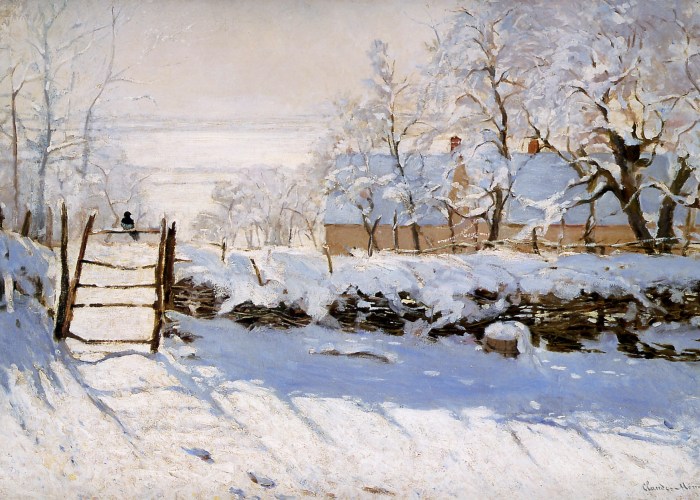 ‘The Magpie’ – Claude Monet, 1869 – WikiArt
.
The author is here stressing that nothing is more effective in this endeavour than to possess a strong love for god or truth. Your desire is the more attractive asset that you have. “If your heart is entirely devoted to God, it is itself, for that very reason, the treasure and the kingdom that you seek and desire.”…
.
“God does not give Himself to us by reason of our own efforts. […]
Let us content ourselves with loving Him unceasingly.”
~ Book II, Ch. III, Section 3
.
“Divine love then, is to those who give themselves up to it without reserve, the principle of all good. To acquire this inestimable treasure the only thing necessary is greatly to desire it. Yes, God only asks for love, and if you seek this treasure, this kingdom in which God reigns alone, you will find it. If your heart is entirely devoted to God, it is itself, for that very reason, the treasure and the kingdom that you seek and desire. From the time that one desires God and His holy will, one enjoys God and His will, and this enjoyment corresponds to the ardour of the desire. To desire to love God is truly to love Him, and because we love Him we wish to become instruments of His action in order that His love may be exercised in, and by us.”
~ Book II, Ch. IV, Section 9
.
“God disguises Himself, therefore, to raise the soul to the state of pure faith, to teach it to find Him under every kind of appearance; for, when it has discovered this secret of God, it is in vain for Him to disguise Himself; it says, ‘He is there, behind the wall, He is looking through the lattice, looking from the windows’ (Cant. 2:9). Oh! divine Love, hide yourself, proceed from one trial to another, bind by attractions; blend, confuse, or break like threads all the ideas and methods of the soul. May it stray hither and thither for want of light, and be unable to see or understand in what path it should walk. […] May the uselessness of its efforts teach it to seek You henceforth in Yourself, which means to seek You everywhere, in all things without distinction and without reflexion.”
~ Book II, Ch. III, Section 5
.
This deep presence at the core of our being, when revealed as being who we truly are, is discovered to be an overwhelming and pervading one. We discover that the self separate from the world and from experience that we had taken ourself to be is nowhere to be found, for its essence as pure being drowns all the shadows, beliefs and travails of this illusory sense of self…
.
“God finds this soul quite empty of its own inclinations, of its own movements, of its own choice. It is a dead subject, and shrouded in universal indifference. The whole of the divine Being, coming thus to fill the heart, casts over all created things a shadow, as of nothingness, absorbing all their distinctions and all their varieties. Thus there remains neither efficacy, nor virtue in anything created, and the heart is neither drawn towards, nor has any inclination for created things, because the majesty of God fills it to its utmost extent. Living in God in this way, the heart becomes dead to all else, and all is dead to it.”
~ Book II, Ch. II, Section 2
.
“It is necessary to be detached from all that one feels, and from all that one does, to follow this method, by which one subsists in God alone, and in the present duty. All regard to what is beyond this should be cut off as superfluous. One must restrict oneself to the present duty without thinking of the preceding one, or of the one which is to follow. I imagine the law of God to be always before you, and that the practice of abandonment has rendered your soul docile to the divine action.”
~ Book II, Ch. II, Section 6
.
The author is now showing that behind all that is objective in our life reigns a peace that is unbreakable. This flooding of peace can be accessed when we recognise our being as to be made of god’s being, this “ineffable [that] holds the soul at an infinite distance from all that is specific in shadows and created atoms.”…
.
“Let us live in the higher regions of the soul in which God and His will form an eternity ever equal, ever the same, ever unchanging. In this dwelling entirely spiritual, wherein the uncreated, immeasurable and ineffable holds the soul at an infinite distance from all that is specific in shadows and created atoms, it remains calm, even when the senses are tossed about by tempests. It has become independent of the senses; their troubles and agitations and innumerable vicissitudes no more affect it, than the clouds that obscure the sky for a moment and then fade away, affect the sun. We know that all passes away like clouds blown along by the wind, and nothing is consecutive nor ordered, but everything is in a state of perpetual change.”
~ Book II, Ch. II, Section 1
.
~~~
Excerpts by unknown author
(published under Jean-Pierre de Caussade, 1675-1751)
Paintings by Claude Monet (1840-1926)
Additional text by Alain Joly
~~~
.
Here is the full text of ‘Abandonment to Divine Providence’ on Christian Classics Ethereal Library…
You can read here Dominique Salin’s text: ‘The Treatise on Abandonment to Divine Providence’…
Bibliography:
– ‘Abandonment to Divine Providence’ – by Jean-Pierre de Caussade (trans. by E. J. Strickland) – (Tan Books)
– ‘A Short And Very Easy Method Of Prayer’ – by Madame Guyon – (Independently published)
Websites:
– Jean-Pierre de Caussade (Wikipedia)
– Quietism (Wikipedia)
– Madame Guyon (Wikipedia)
– Christian Classics Ethereal Library
– The Catholic Encyclopaedia’s entry on ‘Quietism’
– Claude Monet (Wikipedia)
.
– Back to Pages
.
 The Dawn Within
wow. More than once in the past few years I have become aware of Christian mystics that are as inward and deep as any of the mystical Hindus and Buddhists I have read. It is unfortunate that Christian mysticism is so obscure, I imagine having been thrown under the bus by the Christian powers that be (as a threat I suppose). I perhaps would have never had good reason to abandon Christianity (throw out the baby with the bathwater) had I been aware of these souls and their universal message. “Truth” is the same regardless of its source or in what clothing it wears. It is unfortunate that these mystical messages have been downplayed and deemed heretical by the Christian church. Gratitude to you for bringing out these writings.
LikeLike
Thank you! I cannot agree more. Christianity contains treasures of understanding that only need to be dug out. 🙏
LikeLike