
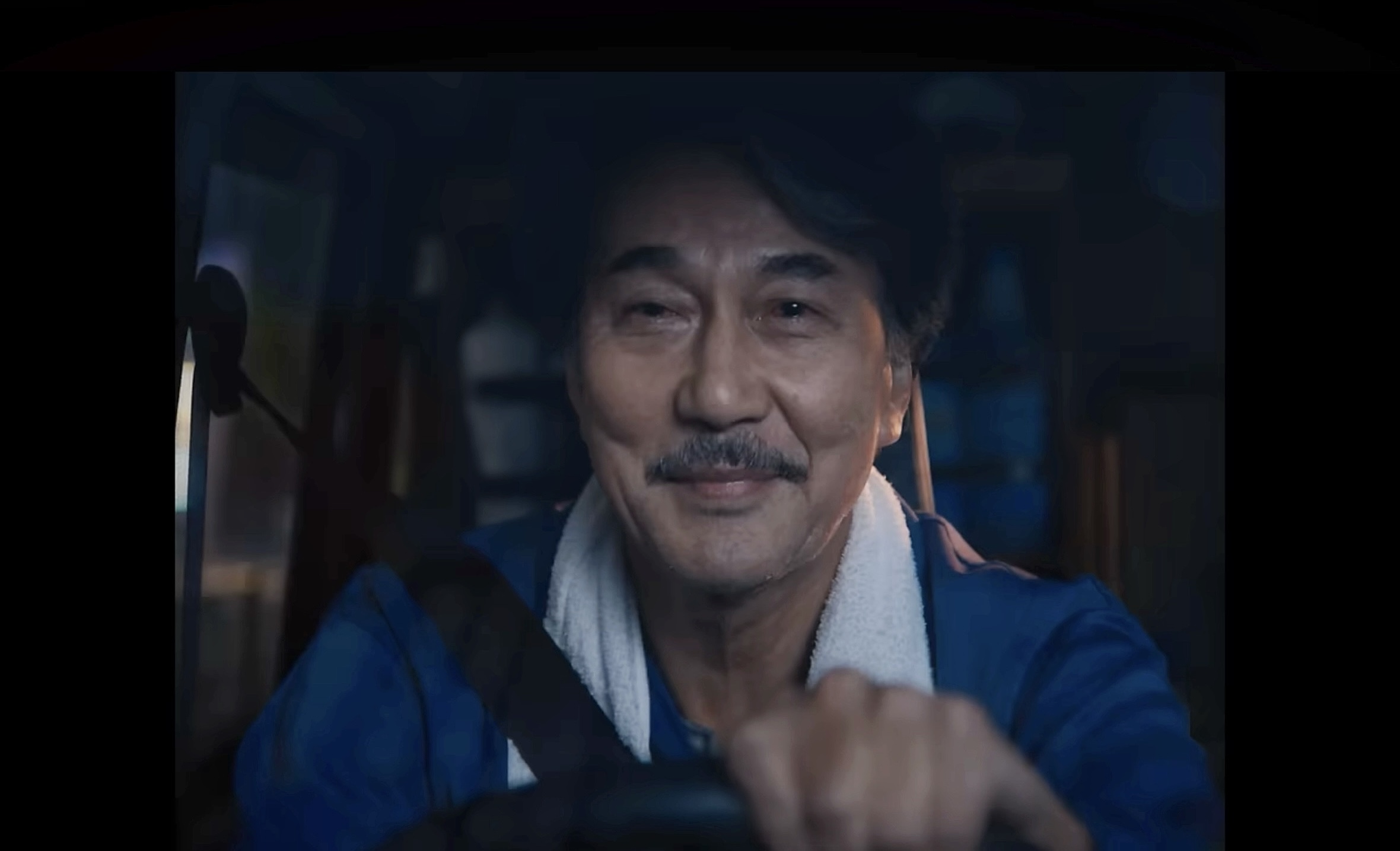
‘Perfect Days’ – by Wim Wenders (with Koji Yakusho)
.

“All my films deal with how to live.”
~ Wim Wenders
.
Why do we watch a movie or enjoy any piece of art but for the joy, happiness, or relief we derive from such activity? Well, sometimes we use a movie not so much to feel, but rather to stop feeling. We want to be alleviated from our sense of boredom, or be distracted from our constant worry, or have the lowest ambition to be rewarded with pleasure, plain simple pleasure which, if not delivered, will make us move on to something else. Film as an art form is ambiguous, for it has in itself an entertaining power which makes it the prey to our most suspect desires. Well, Wim Wenders, in this movie, wasn’t going to give way to that ubiquitous trap and fall. With ‘Perfect Days’, he made a movie in which there is no desire to be had, which offers no suspense, no excitement, no resolution of any kind, but from which you would never want to move away. A movie that describes the quiet, plain, orderly living of a man whose job is to clean public toilets in Tokyo.
Hirayama lives each and everyday as if it was a perfect day. For him, there is no possibility of failure in life. And he makes sure that boredom is an impossibility. So he cares. Hirayama cares about everything he does, and seems to be profoundly related to his modest home, to his morning toilet, and to the watering of his plants. He does what he has to do, with no judgment or resistance. He doesn’t mind. He feels his inner freedom. He has everything he needs, so he smiles at life and life smiles back at him. He breathes when he steps outside and looks at the sky as for the first time, the wonder of it all. Then he buys himself a can of coffee from a local vending machine, opens his van, sits, drinks a sip, chooses a song from a bunch of cassette tapes, lights the engine, drives, and listens to ‘The House of the Rising Sun’ by The Animals. For that’s where he is now, in the house of the rising sun, going to his work through the sprawling suburbs of Tokyo’s morning, undisturbed, confident, present.
And that’s how you would want to live, if you were a poor, quiet toilet cleaner in Tokyo. You would want to clean a public toilet with the same care that you would give to a work of art in a rich people’s home. For this is how you act when you live in the now, when you are not absent to yourself, not caught in your thoughts, entangled in your constant worries. This is how you feel when you don’t need to be anything or anybody, when you don’t beg your happiness to a status, when you don’t look for any kind of aggrandisement or betterment to be fully yourself and be contented with it. So don’t expect for something to happen in this movie. For Hirayama is doing just that: living his quiet life and enjoying every part of his experience, seated at the place of his peaceful being. After all, you cannot be bored when nothing needs to be achieved, cannot complain when all is already completed. So life then becomes factual and easy. Lou Reed described it in a song:
.
“Just a perfect day
drink sangria in a park
and then later
when it gets dark we go home”
~ Lou Reed
.
Of course, Wim Wenders didn’t make a film about non-duality, where Hirayama had recognised his true nature, and was living in the now, in peaceful being. This is not the point. He wanted you to enjoy not only his movie, but yourself. So he didn’t want you to be forgetful, by presenting you with a whole array of objective feelings, difficult plots, thrill, adventure, sensation, all the usual kick and buzz. No. He chose to simply show you how a happy man lives, and infect you with it. He wanted you to remember yourself — who you are deep down. He didn’t want to condition your experience as a viewer by filling it with content, but rather to show you what comes to the surface when you become indifferent to the plot and neglect your seeking mind for an adventure into the peace contained in simply being. He wanted you to feel that there is a happiness here waiting for you when you stop always characterising yourself, by feeding your being with a food it doesn’t need.
.
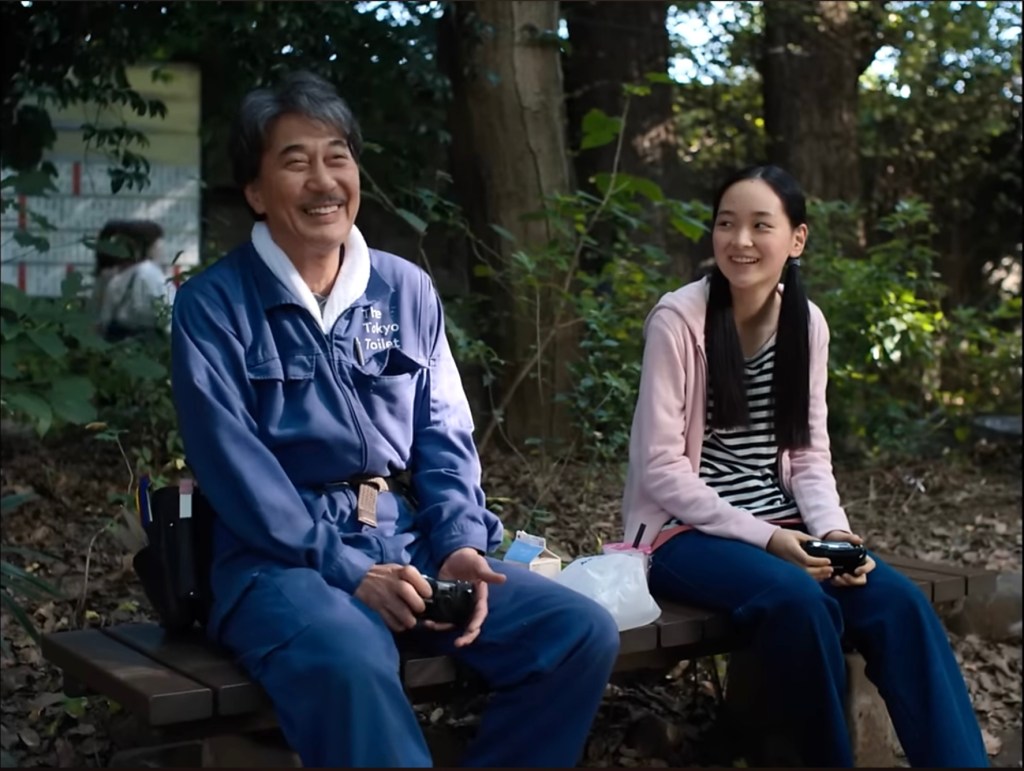 ‘Perfect Days’ (with Koji Yakusho and Arisa Nakano)
.
And Hirayama doesn’t live his life in a cotton bubble either. He goes in a public bathroom for his toilet, rides his bike under pouring rains, enjoys a meal at his habitual greasy spoon in a shabby mall, has his car run out of gas, is confronted to the ups and downs of life, has family issues popping up, and gets dragged by a colleague who takes advantage of his generosity or by a runaway teenage niece who finds him friendly and wise enough to hang around with. But Hirayama’s life is a testimony that there is a hidden simplicity when you don’t attach your life to expected results, and an intrinsic elegance in the fabric of experience when you stop identifying yourself with everything that is not fundamentally you. And there is a quiet joy that lives at the bottom of your heart and comes bubbling at the surface every time you know yourself to only be this pure awareness of being. So you’re eager to follow Hirayama — in whatever he does.
.
“just a perfect day
you make me forget myself
I thought I was someone else
someone good”
~ Lou Reed
.
And Hirayama has put art and friendship in the interstices of his life. That’s because he is interested. He is open and has love in his heart. He has beauty as his everyday companion. So he watches everything, especially the foliage of the trees as they sway in the breeze. He has a fondness for it. And he smiles at people and observes them with tenderness, without judgment. So he has built a gorgeous bookshelf in his home, and reads William Faulkner and Patricia Highsmith. He takes pictures in the park where he has a sandwich, with his old film camera, from trees and foliage. And he listens to music, from a collection of old cassette tapes — he particularly loves the sixties, The Kinks, The Animals, and Patti Smith — ‘Perfect Day’ by Lou Reed, and ‘Feeling Good’ by Nina Simone. That’s how it is when you have love in your heart: You want to share lovely things, and you want to express in the world what your heart dictates.
And Hirayama never loses an occasion to be with people, to be either ridiculed or appreciated, when he has a drink in a bar, or visits a bookshop, or meets a stranger in the street. And he’s not afraid of being a mess, when life wants him to be. He is humble and open to the vicissitudes of life, ready to offer himself to growth without setting himself or his ego as an obstacle. He knows the worth of vulnerability. He has in fact a ritual of collecting little maple saplings that he brings home to be watered everyday. He feels connected with everyone and gently supports and accompany their being every time he is in the company of another. “Oh it’s such a perfect day, I’m glad I spend it with you” said Lou Reed in a song.
I think Hirayama beholds the world within him. So he’s never lost, and always bears within him the responsibility of who he is. He knows that his capacity to be happy resides in him, and looks therefore to nobody and to nothing to provide that to him. He has found himself to be his home. He knows there is a secret in recognising the true and sweet home of your self and abide in it. At the end of his song ‘Perfect day’, Lou Reed keeps repeating: “You’re going to reap just what you sow”. I think that this recognition is Hirayama’s sowing, and his happiness is what he keep harvesting day after day. In fact, Hirayama may be nothing short of a Zen master. For his attitude is one of polishing and refining his experience to bring it to the simplicity of being. And this is a sacred endeavour. Wim Wenders said: “The spirit of the film is in the fact that everything feels almost holy because that’s how he looks at everything.” And holiness always—always—finds its purest expression in life in just living by ‘what is’ and being grateful for it.
.
“Just a perfect day
feed animals in the zoo
then later, a movie too
and then home”
~ Lou Reed
.
 ‘Perfect Days’ – by Wim Wenders
.
~~~
Film by Wim Wenders (born 1945)
Text by Alain Joly
~~~
.
‘Perfect Days’, 2023 – Directed by Wim Wenders
Script written by Wenders and Takuma Takasaki
Produced by Takuma Takasaki and Koji Yanai
Photography by Franz Lustig
(With actors Koji Yakusho, Arisa Nakano, and Tokio Emoto…)
Buy DVD
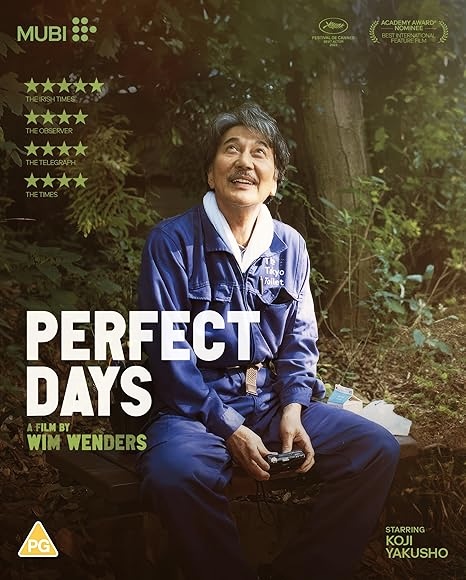
Wim Wenders (born 1945) is a German auteur film director, playwright, and photographer. He was a major figure in the New German Cinema, and received honours and prizes in Cannes, Venice, and Berlin film festivals. Amongst his many major feature films, we find widely acclaimed movies such as ‘Paris, Texas’ (1984) which won the Palme d’Or in Cannes, ‘Wings of Desire’ (1987), or ‘Perfect Days’ (2023). He also made documentary films on Pina Bausch and the Skladanowsky brothers, as well as video films for bands such as U2 and Talking Heads. German film journalist Dieter Osswald wrote of ‘Perfect Days’: “With furious ease, Wenders succeeds in making a rather perfect film.”
.
A trailer of the film ‘Perfect Days’ is available here on YouTube…
Websites:
– Perfect Days (Wikipedia)
– Wim Wenders (Wikipedia)
– Perfect Day (Lou Reed song) (Wikipedia)
.
Back to Pages
.
 The Dawn Within