
 Fresco of Ephrem the Syrian, 14th AD (detail) – The Protaton Church, Mount Athos – Wikimedia
.
If you go for its gems, you will find the Christian tradition to be unbelievably rich of the highest wisdom. The work of Ephrem the Syrian is one such gem. He was a prominent Christian theologian and hymnographer born in 303 AD, expressing himself in the Classical Syriac language of early Christianity, in the eastern part of modern-day Turkey. But he was also known for his outstanding poetry, which he used as a vehicle for theologian purposes. Over four hundred of his hymns have come down to us, and many more got lost along the way, that have earned him the title of ‘Harp of the Holy Spirit’. It is said that his poetic descriptions of the Last Judgment influenced Dante Alighieri in some sections of the Divine Comedy. There is no doubt that he had a passion to put his long years of studying and reading into the fire of experience, as can be felt in this eloquent verse:
.
“On a certain day a pearl did I take up, my brethren;
I saw in it mysteries pertaining to the Kingdom;
Semblances and types of the Majesty;
It became a fountain, and I drank out of it mysteries of the Son.”
~ The Pearl, Seven Hymns on the Faith (1:1)
.
Ephrem the Syrian is said to have been baptised as a young man, and to have been a deacon, with a more limited liturgical role than a priest, and a duty centred on service. He had a great knowledge of the Scriptures and was devoted to his mission as a teacher. He made theology accessible through his poetry, and is recognised as one of the first to introduce songs into the Church’s public worship. He was eager to transmit his passion and devotion in whatever way was possible to him.
.
“In its brightness I beheld the Bright One Who cannot be clouded,
And in its pureness a great mystery,
Even the Body of Our Lord which is well-refined:
In its undivideness I saw the Truth
Which is undivided.”
~ The Pearl, Seven Hymns on the Faith (1:1)
.
There is no doubt that he was an influential man, being honoured with titles like the ‘Sun of the Syrians’, or the ‘Column of the Church’. He lived a simple, ascetic life, embracing the ideals of poverty and celibacy. During the last decade of his life, he moved to Edessa, and stayed there in a small cave overlooking the city, devoting his time to his writings. In Hymns on Faith (VIII.9), he stressed that “the intellect was not intended to pry into hidden things”, emphasising the fact that our deepest identity as being cannot be understood conceptually, through the mind, but is a living, subjective reality. In his Hymns on Paradise, he described this with these exquisite words:
.
“Your nature is far too weak
to be able
to attain to its greatness,
and its beauties are much diminished
by being depicted in the pale colors
with which you are familiar.”
~ Hymn on Paradise, XI:7
.
In some hymns, he further describes the difficulty to realise the truth of our nature through our limited mind, how it is concealed, and how that leads us to take our ignorance to be the norm, and to indulge in it.
.
“They saw the ray: they made it darkness, that they might grope therein:
they saw the jewel, even the faith: while they pried into it, it fell and was lost.
Of the pearl they made a stone, that they might stumble upon it.”
~ The Pearl, Hymn 6:3
.
“Our very confinement in darkness
has become for us a source of pleasure;
we are proud
of the land of curses;
how we love
our confinement in a pit!”
~ Hymn on Paradise, XIII:9
.
Ephrem’s writings include hymns, homilies, and biblical commentaries. In his Hymns, he has favoured poetry over philosophical discourse, making the truth contained in the Scriptures accessible to all through vivid imagery. He speaks here of the eloquence of silence in spiritual matters, and of oneness, which is what God’s presence feels like when we “let faith wipe clean the senses outwardly”.
.
“Let your stillness speak to one that hears;
with silent mouth speak with us:
for whoever hears the stammerings of your silence,
to him your type utters its silent cry concerning our Redeemer.”
~ The Pearl, Hymn 2:1
.
“And since I have wandered in you, pearl,
I will gather up my mind,
and by having contemplated you,
would become like you,
in that you are all gathered up into yourself;
and as you in all times are one,
one let me become by you!”
~ The Pearl, Hymn 5:5
.
“Let prayer within wipe clean the murky thoughts,
let faith wipe clean the senses outwardly,
and let one such man who is divided
collect himself together and become one before You.”
~ On Faith, Hymn 20:17
.
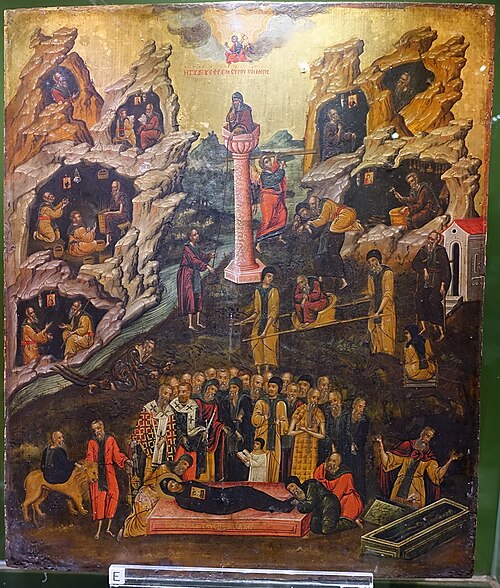 ‘Death of Ephrem the Syrian’ – Emanuele Zanfurnari, 17th AD – Wikimedia
.
In his Hymns on the Nativity, Ephrem emphasises that what is felt as our personal, individual sense of self or being, that we have mistakingly attached to the body, is in fact God’s being, the One that is hidden behind our belief in being a separate self. He equates our individual, located, body-related point of view to god having consented to become lowly without ceasing to be high, “stripping off glory and putting on a body” so that we “might become boundless” through Him.
.
“The High One became lowly, yet ceased not to be high;
the Mighty One put on weakness, yet lost not His might.
In Him all things are one, and creation is joined to its Creator.”
~ ‘Select Works of S. Ephrem the Syrian’ (J.B. Morris, 1:3)
.
“All these changes did the Merciful One make,
stripping off glory and putting on a body;
for He had devised a way to reclothe Adam
in that glory which Adam had stripped off.”
~ ‘Select Works of S. Ephrem the Syrian’ (Trans. J.B. Morris, 23:13)
.
“The Lord of all came down to us, not in His greatness,
but in our lowliness; He took our form, yet lost not His own.
In Him the boundless became bounded,
that the bounded might become boundless.”
~ ‘Ephrem the Syrian: Hymns’ (Kathleen E. McVey, 3:
.
Ephrem’s celebrated Hymns on Paradise have been beautifully translated by Sebastian Brock. In these hymns, Ephrem investigates chapters 2 and 3 of Genesis, offering profound insights into them through his poetry. The translator said eloquently that “St Ephrem’s poetry is profoundly theological in character, expressing his awareness of the sacramental character of the created world, and of the potential of everything in the created world to act as a witness and pointer to the Creator.” See with what delicate and concise way Ephrem conveys that suffering or conflict are the ways god conveys to us that we are mistaken. They are the symptoms of our belief in the illusion of being a self separate from everything and everyone, when we are in fact made of God’s peaceful being.
.
“He did not use threats,
but gave a rebuke in order to save;
even though He said ‘woe’,
yet His nature is peaceable.”
~ Hymn on Paradise, XII:14
...
Here, Ephrem is illustrating the fact that our belief in being separate causes us to ‘shrink’ through the idea of being limited to a body. Conversely, the realisation of our likeness with God’s being will make us cross the boundaries of our mind to venture into oneness.
.
“[The bodies of the righteous] resemble the mind
which is able,
if it so wills, to stretch out and expand,
or, should it wish, to contract and shrink;
if it shrinks, it is in some place,
if it expands, it is in every place.”
~ Hymn on Paradise, V:8
.
 ‘Icon of St Ephrem’ – Romanian nun, 2005 – Wikimedia
.
Here are a few quotes taken from Ephrem’s wonderful hymns on Paradise. They speak of a place within which is felt in and as our very own being, which is not of the mind and brings within itself the qualities of peace, joy, and beauty.
.
“Scripture brought me
to the gate of Paradise,
and the mind, which is spiritual,
stood in amazement and wonder as it entered,
the intellect grew dizzy and weak
as the senses were no longer able
to contain its treasures —
so magnificent they were.”
~ Hymn on Paradise, VI:2
.
“In it there resides a beauty
that has no spot;
in it exists a peacefulness
that knows no fear.”
~ Hymn on Paradise, V:12
.
This presence of our being, this ‘paradise’ as the Scriptures have chosen to call it, can be experienced by all through understanding, but above all, through the exercice of grace — not the grace of a distant god, but the one contained in the infinity of our very own being.
.
“They count themselves
blessed
unendingly,
for their warfare is over;
they have taken up their crowns
and found rest in their new abode.”
~ Hymn on Paradise, VII:23
.
“If not by right,
yet at least by grace;
if not because of good works,
yet at least through mercy.”
~ Hymn on Paradise, V:12
.
“None grow old there,
for none die there;
none are buried there,
for none are born there.”
~ Hymn on Paradise, VII:22
.
In these three magnetic quotes, Ephrem makes us feel the way by which our illusory sense of being a separate self gets dimmed through investigation, and how we get accustomed to the light or reality of our true nature or being. He then gives us to taste of our newly discovered self or reality, the ‘awe’ and ‘delight’ contained in it, that finally comes to justify the title of ‘paradise’.
.
“The Lord who is beyond measure
measures out nourishment to all,
adapting to our eyes the sight of Himself,
to our hearing His voice,
His blessing to our appetite,
His wisdom to our tongue.”
~ Hymn on Paradise, IX:27
.
“Being unburdened,
the senses stand in awe and delight
before the divine Majesty.”
~ Hymn on Paradise, IX:17
.
“Paradise raised me up as I perceived it,
it enriched me as I meditated upon it;
I forgot my poor estate,
for it had made me drunk with its fragrance.
I became as though no longer my old self.”
~ Hymn on Paradise, VI:4
.
Ephrem.the Syrian died in 373 from illness and exhaustion, following his efforts to relieve the population from a famine. He leaves a consequent legacy through his writings, and has remained an influence in both Eastern and Western Christianity. He was proclaimed a Doctor of the Church in the Catholic tradition by Pope Benedict XV, making him one of the 38 saints honored for their eminent doctrine, holiness, and contributions to theology.
.
“For it is a marvel in Man, that though he is one,
he is to himself a Temple, he is to himself a Priest,
he is to himself a Pontiff, he is to himself a Sacrifice;
he is the Offering, and he is the Offerer of the Offering:
for he is like that Lamb of God, who was to Himself everything.”
~ Hymns on Virginity (C.W. Mitchell, I:55)
.
 ‘Mosaic in Nea Moni, 11th AD – Wikimedia
.
~~~
Quotes by Ephrem the Syrian (303-373)
Accompanying text by Alain Joly
~~~
.
Bibliography:
– ‘Hymns On Paradise’ – by St. Ephrem the Syrian (Trans. Sebastian Brock) – (St Vladimirs Seminary Press)
– ‘Ephrem the Syrian: Hymns’ – by St. Ephrem the Syrian (Trans. Kathleen E. McVey) – (Paulist Press International)
– ‘Select Works of St. Ephrem the Syrian’ – by St. Ephrem the Syrian (Trans. J.B. Morris) – (John Henry Parker, Oxford)
– ‘The Luminous Eye’ – by St Ephrem the Syrian (Trans. Sebastian Brock) – (Cistercian Publications)
Websites:
– Ephrem the Syrian (Wikipedia)
– Emmanuel Tzanfournaris (Wikipedia)
– Nea Moni of Chios (Wikipedia)
Suggestion:
– Explore some other exponents of truth in ‘Homage to …’
.
Back to Pages
.
 The Dawn Within