
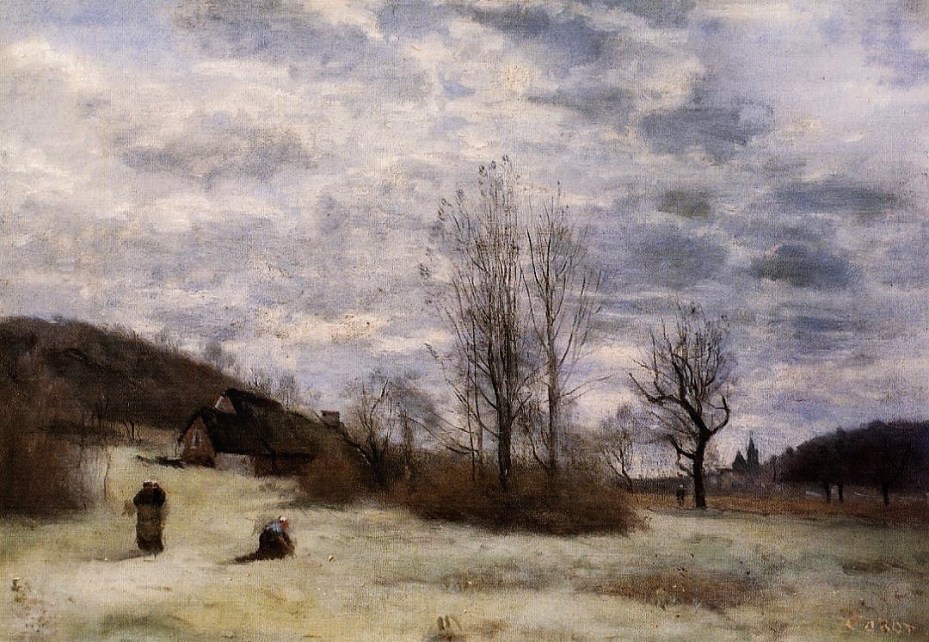
 ‘Plains near Beauvais’ – Camille Corot, 1860-70 – WikiArt
.
“The fear of the Lord is a fountain of life,
to depart from the snares of death.”
~ Proverbs, 14:27
.
There is an expression that we may find puzzling, maybe slightly paternalist, condescending and outdated, but is well worth looking at. We find this expression mostly in Christianity and Islam, where the mentions ‘fear of God’, ‘fear of the Lord’, or the injunction ‘fear God’ are found far more than a hundred times in the Bible, or in the Quran. This fear is said to be one of the seven gifts of the Holy Spirit, along with wisdom, understanding, guidance, mightiness, knowledge, and devoutness. But why would we be afraid of what we longed for the most in our lives? We should be embracing it with ardour and ease. So what is this “fear of the Lord” that, in Proverbs 9:10, is said to be “the beginning of wisdom”? Why is it given such primary importance?
Maybe we fear god for the same reason that we fear death. We think that we are something, someone, a self that we appreciate and have a fondness for, that we love and want to cling to as something precious. We want it to continue. So we have elaborated strategies to keep our self padded with multiple pleasurable sensations through our various habits as thoughts, daydreams, pleasure oriented activities, routines, manipulations, avoidances, all these addictions that have come to form the main part of what we call our self. But these are vain distractions, for awareness as god seems to have in itself a momentum, a power to draw every thing and being to itself. So this pull can be felt as a threatening force from the limited point of view of a self that feels vulnerable, and finds temporary security in being something, even if this something is in final analysis the cause of its suffering. In Hebrews 10:31, it is said: “It is a fearful thing to fall into the hands of the living God.”
But this fear is not yet the fear of god that is meant and has true relevance in our spiritual endeavour. It is still a fear that exists on behalf of ourself. This is not the fear that is meant when it is said, in Isaiah 11:2-3, that we “will delight in the fear of the Lord”, or that “the fear of the Lord is pure, enduring forever“, as is said in Psalm 19:9. We need to go deeper, and notice that in spite of all our stratagems to find contentment in our illusory self, there is a holy fear that sits deep inside us. It is the fear that we may never find our way back home. The fear that we might stay here, lost, in this land of uncertainty where our happiness has not yet been truly found, our thirst for love not been entirely quenched, our questions not been fully answered, and our suffering not been quite alleviated. We feign indifference, but in doing so, are failing to notice in ourself our true identity — that self of all eternity, invincible, glorious, which is but our sought after stamp for a happy living. So the fear of god is in fact nothing but the longing for truth. It is that part of ourself that is longing to see, to notice that we have taken a wrong turn, that we will have to abandon all our precious investment in ourself, that there is a truth not yet seen and encompassed, that will engulf us in itself and make us face the death of that precious, but erroneous idea of our self. As Augustine wrote in Confessions 1:1, “Thou hast made us for thyself and restless is our heart until it comes to rest in thee.”
After all, a closer look will show us that, depending on the translations of these ancient texts, the word ‘fear’ is sometimes replaced by ‘reverence’. “Let all the earth fear the Lord; let all the people of the world revere him”, is it said in Psalm 33:8. The word ‘reverence’ comes from ‘revereri’, which is composed of ‘vereri’ meaning ‘to fear’, ‘respect’, ‘stand in awe of’, and the prefix ‘re-’ meaning ‘with intensity’. So the fear of god, or the reverence for god, can be equated with the love of god, or that necessary love of truth so indispensable to every serious seeker. Notice that if you don’t have a deep reverence for god or truth, you will lack an essential in your spiritual path. To have a reverence for anything is a gift in itself, for reverence has at its core the qualities of humility, wonder, patience, diligence, and many others that will act as a precious tool in your quest. “Love the brotherhood of believers, fear God, honor the king“. (1 Pet. 2:17)
.
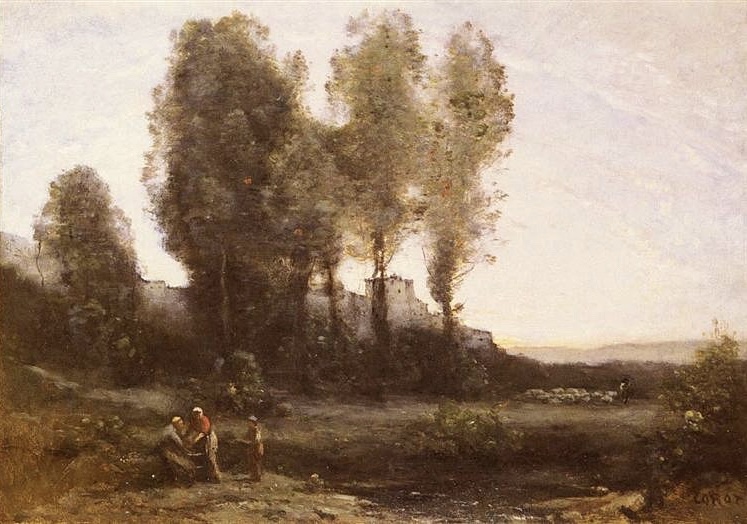 The ‘Monastery Behind the Trees’ – Camille Corot – WikiArt
.
After all, if I don’t fear god, I run away from him. I indulge in my own, particular, separate, suffering self. To love god, or truth — to be in awe with it, which is to somewhat fear it — is a necessary prerequisite to invite it in, to let yourself melt in its presence. The state of fearing god is what will allow you to open yourself to presence. You need that incentive. Otherwise you will never approach that truth which is so demanding. Otherwise you will escape, run back to your old habitual, easy self. God is difficult. Therefore it requires you to be reverent, fearful, which is paradoxically a state of love. At least for a while. As Meister Eckhart so majestically points out: “At the beginning of the virtuous life, fear is of use to man, providing him a thoroughfare for love. As the bodkin or the awl makes a passage for the thread and the shoe is stitched with thread, not with the iron; and as the bristle’s part towards the thread is to put it in as fastening while the bristle is withdrawn; so, to begin with, fear makes room for love and love binds to God, whereas fear passes out.”
So that awe, that reverence, that fear, will eventually disappear in pure delight, in a soft, trustful, abandoned joy. But to allow you to give in, you will need a measure of fear, an honouring, something you feel inside you that is worth of the deepest respect. After all, how do we feel in presence of a lover? When we want to succeed, seduce a friend, be worth of his beautiful being, see her like something you wouldn’t want to hurt in any way? Don’t we want to move with the utmost care, showing only the best of our ability? See what would happen if we were approaching truth with that same, respectful, awesome, careful, honouring, fearsome feeling. See how god would invite you in its infinite, bountiful arms, and how you would give yourself in with no resistance whatsoever. This adoration, worship, confidence, thankfulness, indeed, is the fear of god…
See the utter devastation of it. How it would break apart all that you have gathered to protect your old sense of self. See how your shell of protection would crack open; how that fear would send you in the soothing waters of fearlessness. So this reverence, which in that sense is nothing but love, is the tool for the open expanses of the deepest love. For only love can make you aware of your own nature as love itself. That’s how fear or reverence can be a glorious path to love. Not the fear born of hate, of anger, protection, judgement, abstraction, projection, thought, but the fear born of love itself. Love has produced that gorgeous fear, has made it possible for your own good. Remember — between lovers — this timeless moment when the fear, the tension, suddenly recedes into the warm embrace of love. Then, and only then, as it is said in 1 John 4:18: “Perfect love drives out fear.”
So at that time, at that level of understanding, all will fall into place, every religious utterance about the fear of god will appear to you in a different light. See how you would suddenly acquiesce on hearing that “[god’s] mercy is on them that fear him” (Luke 1:50); or on reading that “perfecting holiness in the fear of God” (2 Cor. 7:1); or when you are asked to “work out your salvation with fear and trembling” (Phil. 2:12); or when it is advised that you should “pass the time of your sojourning here in fear” (1 Pet. 1:17).
.
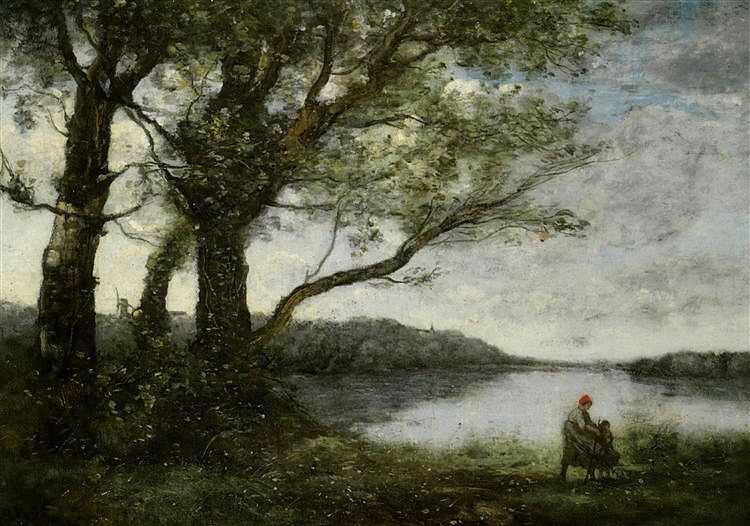 ‘Three Trees with a View of the Lake’ – Camille Corot – WikiArt
.
And should you be lacking of this love of god or reverence for truth, believe me, you may just bypass it. Remember that there is not a ‘you’ which has or should be having a reverence for truth. This love of truth belongs to truth itself. It is in God’s own indelible character to have a passion for itself. And should you believe to be a self separate from God’s being, only for a moment remember who you are, and the love of truth will come to you as naturally and unavoidably as your consciousness appears to yourself. This reverence for god — which you think you must have — is in fact God’s reverence for itself. Love is not owned by any particular entity. It is free, and being free it is available to all. The reason for its availability is that love is in fact the essence of all apparent beings and things in existence. You are God’s love itself, and your drive to realise your self as God’s being is not your own.
That is why realising truth can appear to be so difficult. Because it is often treated as a vulgar object to be obtained or gained through effort and practice. At the end of it, the path to truth is not a path at all. There is another older etymology for ‘reverence’ which is found in the Proto-Indo-European word ‘wer-‘, which means to ‘be perceived’, ‘to watch out for’. So in fear, in reverence, an openness is at stake, a letting go, an accepting of the invitation, a piety. Reverence is already made of the thing we have a reverence for. That’s why it is so effective. The reverence for god that we feel is already our visiting the interior of god as it were. That is why we have reverence. A recognition is at play. We recognise our being as God’s being, and in that recognition, a measure of awe, of reverence is produced, is available. There is no act of being reverent. It is a natural thing that we have smothered with our persistent beliefs about ourself. To be reverent is to let yourself be who you truly are. Any other identification with a method, or an incentive, or a practice, is a “lesser light”, as this poem of a Sufi master so beautifully expresses:
.
“O God, I fear Thee: not because
I dread the wrath to come; for how
Can such affright, when never was
A friend more excellent than Thou?
Thou knowest well the heart’s design,
The secret purpose of the mind;
And I adore thee, Light Divine,
Lest lesser lights should make me blind.”
~ Abu al-Husain al-Nuri
.
~~~
Text by Alain Joly
Quotes from The Bible, Augustine of Hippo, and Meister Eckhart
Poem by Abu al-Husain al-Nuri (840-908)
Paintings by Camille Corot (1796-1875)
~~~
.
Bibliography:
– ‘Meister Eckhart, Selected Writings’ – Translated by Oliver Davies – (Penguin Classics)
– ‘The Confessions’ by Saint Augustine (Trans. Henry Chadwick) – (OUP Oxford)
Websites:
– Bible Gateway
– Abu al-Husain al-Nuri (Wikipedia)
– Camille Corot (Wikipedia)
– Augustine of Hippo (Wikipedia)
– Meister Eckhart (Wikipedia)
.
– Back to Pages
.
 The Dawn Within